
Learning Outcome: By the end of this lesson, you will be able to explain what a digital competitor analysis involves, describe the difference between the visible and hidden layers of competitive intelligence gathering, and apply the framework to plan an audit of a competitor set.
Want to go further? Study a full online course and earn a certificate →
How Is a Digital Competitor Analysis Different?
A traditional competitor analysis is built largely from what a business can observe directly: a rival’s pricing, its shop locations, its advertising. A digital competitor analysis widens this considerably, because so much of a competitor’s real strategy now leaves a visible trace online – not just on their own website, but across search results, social platforms, and the traffic-benchmarking tools built specifically to estimate what a rival’s digital marketing is actually achieving. The goal is the same as it has always been – understanding a competitor well enough to make better strategic decisions – but the raw material available to build that picture from is far richer than it was even a decade ago.
The Visible Layer: What You Can See Directly
The most accessible starting point is simply searching for a competitor’s name, products, and industry terms using an ordinary search engine, then working through their own website in detail – product information, press releases, and even job postings, which often signal the direction a company intends to move in next. Chaffey (2019) frames a competitor’s marketing mix – product, price, place, and promotion – as a useful lens for structuring this initial pass, so that notes end up organised by which part of the mix they actually relate to rather than as one long unsorted list. A competitor’s social media presence is just as visible, and just as revealing: running a social media audit against a competitor’s own channels, using the same structured Five Ws approach used for auditing a brand’s own content, surfaces where they are actually getting engagement rather than where they simply have an account.
Setting the Wider Context: Five Forces
Before diving into tools, it helps to place a specific competitor within the wider competitive landscape. Porter (1979), in his classic Harvard Business Review article, set out five forces that shape how profitable an industry actually is: rivalry among existing competitors, the threat of new entrants, the threat of substitute products, and the bargaining power of both suppliers and buyers. The framework was originally built for analysing a whole industry, but marketers commonly narrow its scope to a specific market instead – a reasonable adaptation, provided the choice is made deliberately and checked against how the framework is taught on a given course, since not every tutor treats the narrower use the same way.
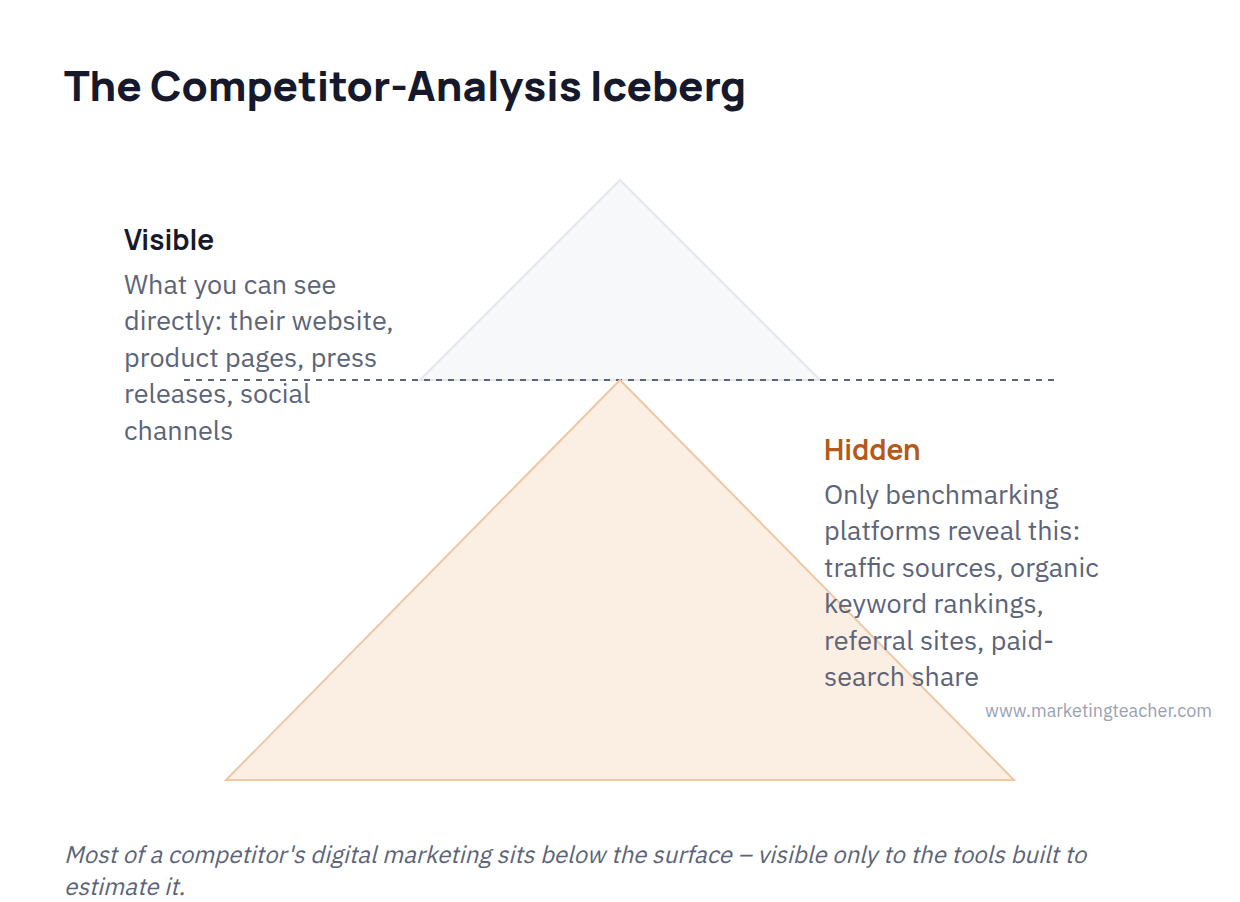
The Hidden Layer: Benchmarking Platforms
Beneath what a competitor publishes on purpose sits a second, much larger layer of data that only becomes visible with the right tools. Web-traffic and SEO benchmarking platforms can estimate a rival’s approximate visit volumes, where that traffic actually comes from, which keywords are driving organic search visits, and how much of their promotion budget likely goes toward paid search – all without the competitor’s own permission or knowledge, since the estimates are built from aggregated, publicly observable web data rather than anything the competitor discloses directly. Most of these platforms offer a limited free tier that is more than sufficient for an assignment or an initial audit, with paid subscriptions reserved for the deeper, ongoing monitoring a larger business might justify.
Example: Fenwick & Voss Benchmarks Two Rivals
The fictional homeware retailer Fenwick & Voss used a traffic-benchmarking platform’s free tier to compare its own website against its two closest online competitors over a single month. The results showed one rival received almost 40% of its traffic from paid search, far above Fenwick & Voss’s own 12% – a strong signal that competitor was actively buying visibility Fenwick & Voss wasn’t contesting. The same tool’s keyword-overlap report showed the second rival ranking organically for several product terms Fenwick & Voss had never targeted directly in its own content. Neither finding required anything beyond the free tier, and together they gave the marketing team two concrete, evidence-based priorities for the next quarter’s plan, rather than a vague sense that “competitors are doing more online.”
A Word on Ethics and Data Limits
A digital competitor analysis should stay within what is publicly observable and within each tool’s own terms of service – the aim is informed strategy, not attempting to access a competitor’s private analytics or account data by any other means. It’s also worth remembering that every benchmarking platform is estimating a competitor’s real numbers from indirect signals, not reading them directly, so figures from two different tools can genuinely disagree; treating any single number as a rough directional signal, rather than an exact fact, is the safer way to use this kind of data in a real decision.
Summary
A digital competitor analysis builds outward from what’s directly visible – a competitor’s own website and social channels, read through a structured lens such as the marketing mix or a Five Ws social audit – into a hidden layer only benchmarking platforms can reveal, such as traffic sources and organic keyword rankings. Placing findings within the wider context of a Five Forces view of the market helps prioritise which competitor signals actually matter strategically. Used ethically and within each tool’s free-tier limits, this combination gives a far more evidence-based picture of a competitor’s digital marketing than a traditional analysis alone could provide.
Key Idea: Most of a competitor’s digital marketing activity is visible if you know where to look – their own website and social channels sit in plain sight, while benchmarking platforms reveal a deeper, hidden layer of traffic and keyword data that no competitor publishes voluntarily.
More in this series: Digital marketing planning
Digital Marketing Situation Analysis · Digital Marketing Internal Audits · Digital Marketing Competitor Analysis · Digital Marketing Competitor Research · Digital Marketing and Promotion: Website Optimization · Digital marketing Mix
Teaching this topic?
The slides, worksheet, lesson plan and poster for this lesson are free to download and free to use in your course — no sign-up, no permission needed. See the teacher resources →
Assign this lesson to your class:
Using Canvas, Blackboard or Moodle? Copy the link and paste it into your course page or assignment. More ways to add lessons to your LMS.
Written by Marketing Teacher.
Online course · certificate on completion
Study a full online course — and earn a certificate
Three courses that turn the free lessons into ordered modules, written at university Levels 4 to 6, with a short quiz after each.

