
What’s the Difference Between Social Media Monitoring and Listening?
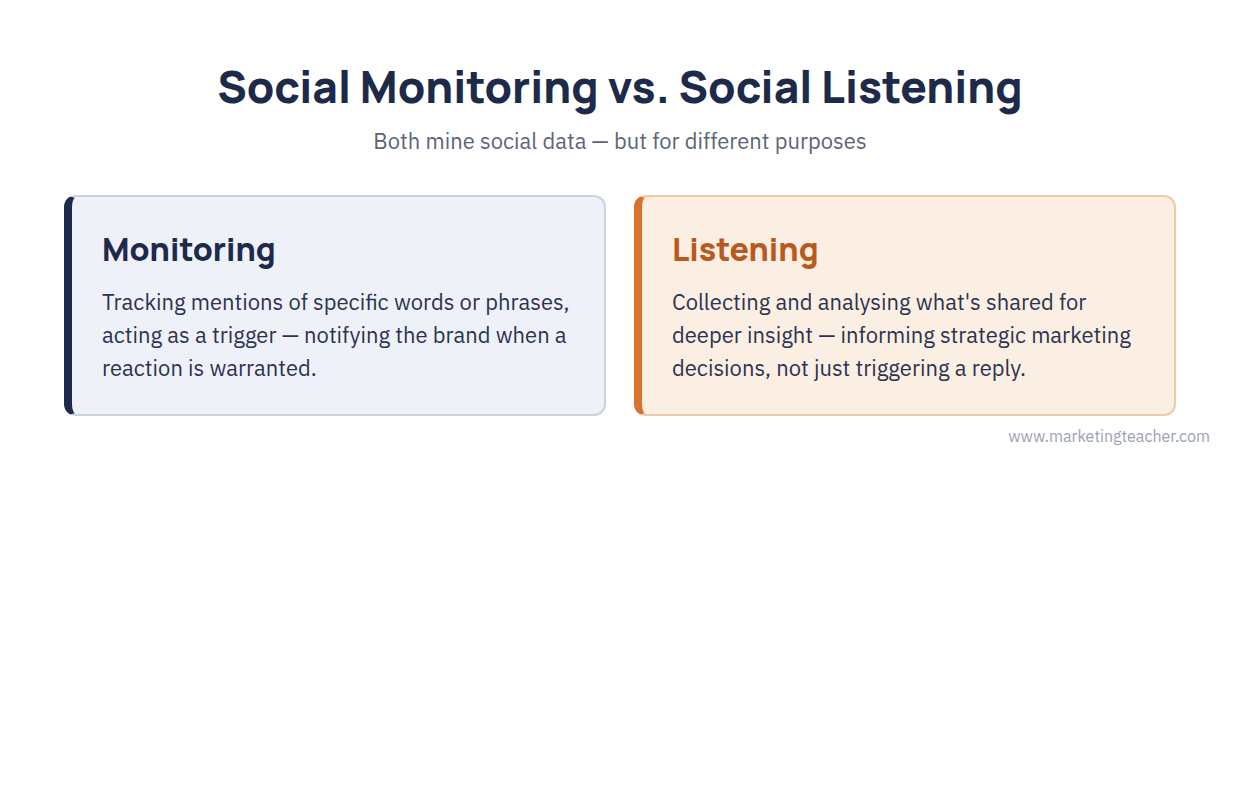
Tuten and Solomon (2018) explain that social monitoring and social listening go hand in hand, but they are not the same activity. Monitoring is the process of tracking mentions of specific words or phrases across social media, so a company is notified whenever a mention warrants a reaction — it works like a trigger. Listening also collects what is shared on social media, but the data collected is analysed for insight that informs strategic marketing decisions rather than a single, immediate reply. Monitoring is reactive; listening is proactive. Dan Neely, CEO of Networked Insights, put it memorably: “Monitoring sees trees; listening sees the forest.”
Why Brands Bother: Customer Care, Market Research, and Campaign Assessment
Tuten and Solomon (2018) report that social listening supports several jobs at once: brand monitoring, measuring campaign effectiveness, understanding customers, providing customer service, gathering ideas for future campaigns, spotting risks before they become a public relations crisis, tracking competitors, and surfacing ideas for new products. Customer care is one of the clearest cases for the business value of listening. A J.D. Power study found that 67% of social media users had used a company’s social channels for customer support, and 84% of them expected a response within 24 hours. Customers who get that response spend 20% to 40% more with the company, and 71% of customers who receive a quick, effective reply on social media say they would recommend the brand, compared with just 19% of those who receive no response at all. Yet the Sprout Social Index found that only about one in every ten customer care requests made on social media actually gets a reply — which is exactly the gap that a proper monitoring and listening programme is meant to close.
Turning Raw Conversation Into Insight: Sentiment and Content Analysis
Once conversations are collected, marketers still need to make sense of them. Sentiment analysis, sometimes called opinion mining, analyses text to determine whether the writer’s attitude toward a brand, product, or topic is positive, negative, or neutral (Tuten & Solomon, 2018). Analysts build a word-phrase dictionary of terms associated with each sentiment, then use software to scan conversations for those terms. It sounds straightforward, but language is slippery: a chocolate torte described as “wickedly sinful” would be flagged as negative by a naive dictionary, when the phrase is actually high praise, and a word like “hunger” reads very differently in a comment about a famine appeal than in a comment about a restaurant. Content analysis takes a different route into the same raw material: rather than starting from a sentiment dictionary, it applies a theory or a research question to code text into categories — word by word, phrase by phrase, or theme by theme — so that a researcher can test something specific, such as whether a brand’s own posts lean more toward entertainment or toward information.
Where You Listen Changes What You Hear: Errors and Biases to Watch For
Tuten and Solomon (2018) warn that social media research carries its own particular risks of error, on top of the usual concerns of any market research. Coverage error occurs when the platforms a researcher actually samples don’t represent where the real conversation is happening: a study built entirely on Twitter, for instance, would badly misjudge a community that actually lives on a niche gaming forum. Schweidel et al.’s (2014) research demonstrated this directly, jointly modelling sentiment and the choice of platform and finding that the conclusions researchers draw about brand sentiment depend heavily on which venue they choose to listen to, so relying on a single platform (or blending several without care) can produce misleading results. Two further problems are specific to social platforms: the echo effect, where the same piece of content is shared and reshared until it looks like many independent opinions rather than one opinion travelling widely, and the participation effect, where a small, highly active minority inflates the apparent volume of a conversation while quieter customers go unheard. Add to that nonresponse bias — the risk that the people posting publicly are systematically different from the wider customer base whose views actually matter — and it becomes clear why raw mention counts should never be mistaken for a finished insight.
Summary
Social media monitoring is the reactive tracking of specific mentions, while social listening is the proactive analysis of collected conversations for strategic insight; brands use both for customer care, market research, and campaign assessment. Making sense of that data relies on sentiment and content analysis, and the results are only as good as the research design behind them — coverage error, the echo effect, the participation effect, and nonresponse bias can all quietly distort what a brand thinks it has learned about its customers (Tuten & Solomon, 2018).

