
This lesson is general education, not legal advice. Always check the current guidance from the regulators named below, and take professional advice for real campaigns.
What Is a Hidden Advert?
A hidden advert is marketing that people cannot recognise as marketing. UK rules define the problem from two directions.
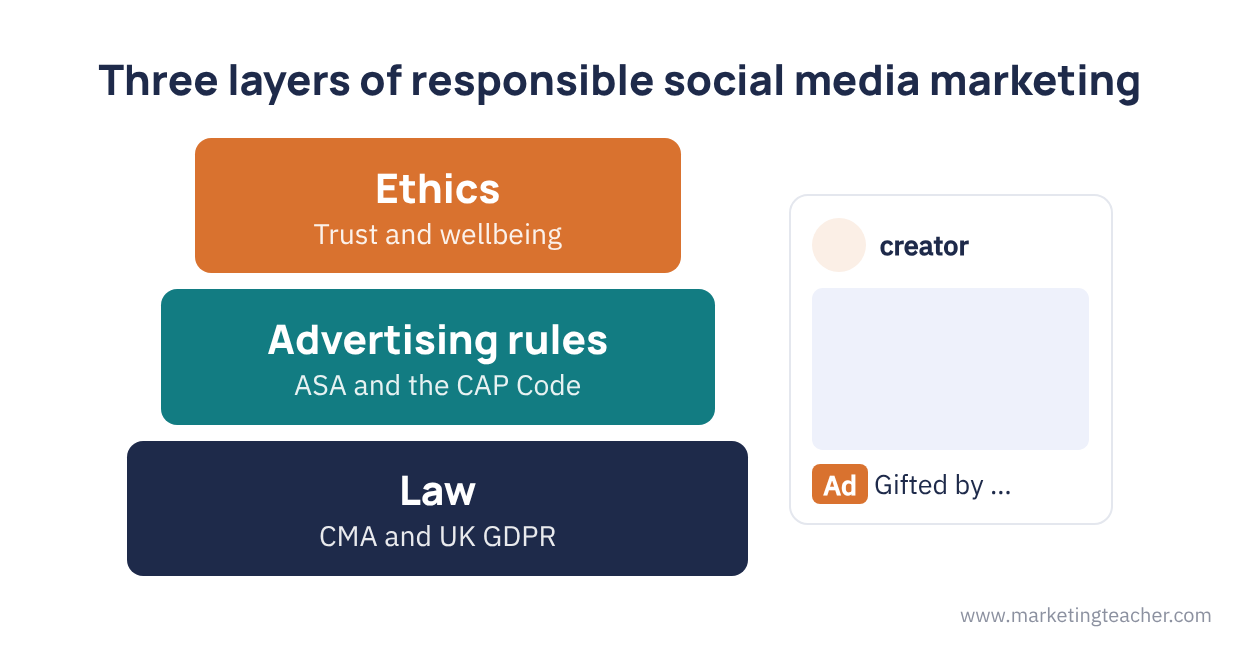
The CAP Code, the UK’s advertising rulebook enforced by the Advertising Standards Authority (ASA), requires that marketing communications must be “obviously identifiable as such” (ASA, 2026). For influencer posts, the ASA says the label should be prominent and visible before people click, expand or watch the content.
The Competition and Markets Authority (CMA), which enforces consumer protection law, takes a wider view. Its guidance for content creators says that if a brand has given you any payment or incentive, including money, commission, free products or gifts you did not ask for, you must label your posts about that brand as advertising (CMA, 2025).
The two definitions differ in focus. The CAP Code asks whether the audience can recognise the content as an advert. The CMA asks whether there is a commercial relationship that people should know about. In practice they lead to the same answer: if you have been paid or rewarded in any way, say so clearly and upfront.
The UK Rules on Influencer Disclosure
The ASA and CMA have published joint guidance for influencers, now in its fourth edition (ASA, 2026). The key points are:
- Use a clear label. “Ad”, “Advert”, “Advertising” or “#ad” are clear. Terms such as “sponsored”, “gifted”, “#collab”, “#spon”, “aff” or “in association with” are unlikely to be acceptable on their own.
- Put it upfront. The label must be visible without scrolling, clicking “more” or checking the bio. For videos and podcasts, disclose at the start.
- Label every post. Each post must stand on its own. Being a known “brand ambassador” is not enough.
- Platform tools may help. A “paid partnership” tag can work if it is clear and prominent, but the regulators recommend adding “Ad” if there is any doubt.
- Affiliate links count. Content with an affiliate link or discount code that earns commission is advertising.
- Brands are responsible too. Both the influencer and the brand can be held responsible.
The ASA enforces these rules through public rulings. In 2024, it upheld complaints against TikTok and Instagram posts by Grace Beverley promoting TALA, the activewear brand she founded. The posts were not obviously identifiable as adverts, even though she owned the brand. The ruling shows that owning a business is a commercial relationship too.
The stakes have risen. Since April 2025, the Digital Markets, Competition and Consumers Act 2024 has allowed the CMA to fine businesses directly for breaking consumer law, up to 10% of global turnover. The Act also bans fake reviews outright. See Influencer Marketing for how brands plan influencer campaigns.
An International Comparison: The FTC
In the United States, the Federal Trade Commission (FTC) sets the rules. It updated its Endorsement Guides in 2023 to cover virtual influencers, fake reviews and tags in social media. Like the UK regulators, it requires disclosures to be “clear and conspicuous”, and it warns that platform disclosure tools may not be enough on their own (FTC, 2023). The principles are much the same as in the UK. A brand running a campaign across countries should meet the strictest standard that applies.
Data, Misinformation and Wellbeing
Disclosure is only one ethical issue. Three others matter to every social media marketer.
Personal data. Social media marketing runs on data: custom audiences, tracking pixels and profiling. Under UK GDPR and the PECR rules, using cookies and similar technologies for online advertising generally requires consent (ICO, 2025). The rules were updated by the Data (Use and Access) Act 2025, so check the latest ICO guidance. See UK GDPR for Marketers.
Misinformation. False or misleading content spreads quickly on social media. Brands should check claims before sharing, avoid placing adverts next to harmful content, and never use fake accounts or fake reviews. The Online Safety Act 2023 gives Ofcom powers to regulate how platforms deal with illegal content and content harmful to children. Brands still need their own standards.
Wellbeing. Ofcom (2026) found that only 36% of UK social media users say platforms are good for their mental health, down from 42% the year before. Two-thirds of adults admit they sometimes spend too long on their devices. Ethical marketers think about pressure, body image and the targeting of young or vulnerable people, not just what is legal.
Summary
UK advertising rules require social media adverts to be obviously identifiable, and consumer law requires any payment, gift or other incentive to be disclosed (ASA, 2026; CMA, 2025). The safest label is a clear “Ad” at the start of every post, and brands share responsibility with influencers. The CMA can now fine firms directly, and the US FTC takes a similar line. Beyond disclosure, marketers must handle personal data lawfully, avoid spreading misinformation and consider user wellbeing. For the wider principles, see Marketing Ethics.
The slides, worksheet, lesson plan and poster for this lesson are free to download and free to use in your course — no sign-up, no permission needed. See the teacher resources →
Assign this lesson to your class:
Using Canvas, Blackboard or Moodle? Copy the link and paste it into your course page or assignment. More ways to add lessons to your LMS.

