
What Is Influencer Marketing?
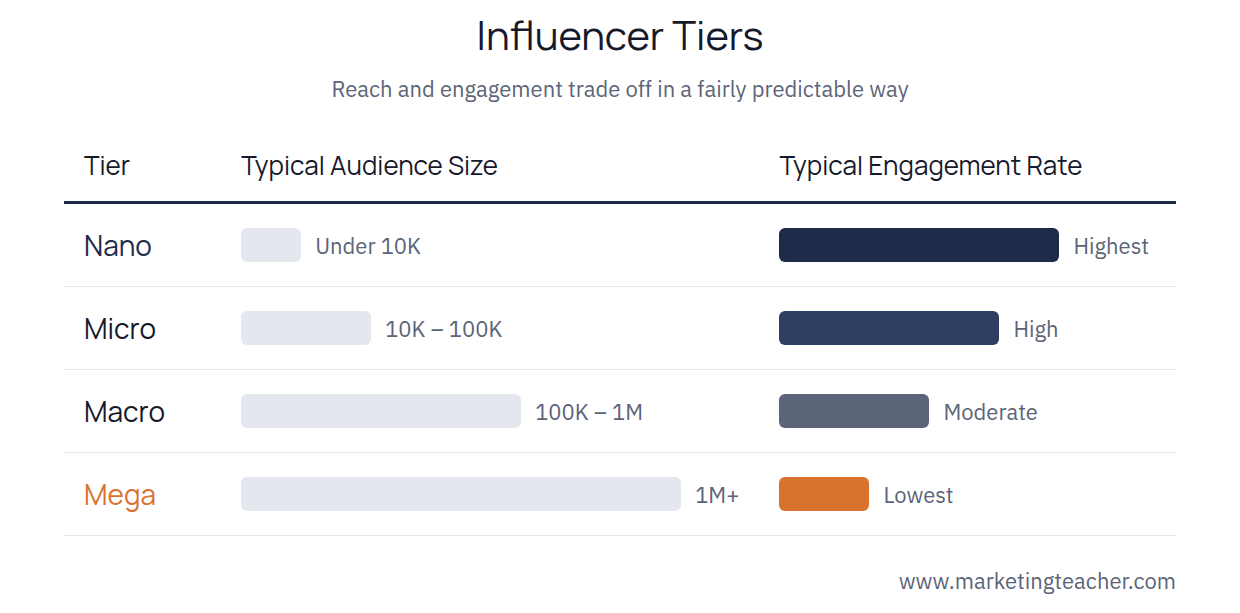
Influencer marketing is the practice of paying or otherwise compensating an individual with an engaged online following to promote a brand’s products or services to that audience. Its appeal is straightforward: an influencer has already done the harder work of building trust and attention within a specific niche, and a brand borrows some of that trust rather than trying to build it from nothing. Research into Instagram influencer campaigns found that both an influencer’s follower count and how closely their usual content matches the promoted product shape how favourably an audience responds to the endorsement (De Veirman, Cauberghe and Hudders, 2017) — bigger isn’t automatically better, and fit with the influencer’s usual content matters as much as reach.
The Influencer Tiers
Influencers are commonly grouped into tiers by follower count, and each tier tends to trade reach for engagement in a fairly predictable way. Mega-influencers and celebrities have the largest audiences but typically the lowest engagement rate per follower, since their audience is broad and less personally connected to them. Macro-influencers sit in the middle, offering solid reach with somewhat stronger engagement. Micro- and nano-influencers have comparatively small audiences, but those audiences are often unusually engaged and loyal, having followed the creator specifically because of a shared interest or community — which is why a single micro-influencer partnership can sometimes outperform a mega-influencer post on a cost-per-engagement basis.
Why Fit Matters More Than Follower Count
A brand choosing an influencer purely by follower count risks paying for reach that never converts, because an audience only responds well to a promotion that feels consistent with why they followed that creator in the first place. A skincare brand appearing in a gaming influencer’s feed, with no obvious connection to their usual content, reads as an ad rather than a recommendation — and audiences are generally good at telling the difference. The research on product-influencer fit backs this up directly: divergence between an influencer’s usual content and the promoted product measurably weakens the audience’s response (De Veirman, Cauberghe and Hudders, 2017), which is why matching a creator’s actual niche and audience is usually a better starting point than simply sorting by follower count.
Disclosure Is a Legal Requirement, Not a Courtesy
In the United States, the Federal Trade Commission requires influencers to clearly and conspicuously disclose any material connection to a brand — payment, free products, or any other compensation — whenever they promote it (Federal Trade Commission, 2019). This isn’t a suggestion left to an influencer’s discretion: a vague or buried disclosure, or none at all, can expose both the influencer and the brand to regulatory action. A disclosure needs to be easy to notice and understand without a viewer having to search for it, which is why a hashtag like #ad placed prominently near the start of a post is treated very differently from one buried at the end of a long string of unrelated tags.
Building a Relationship, Not Just Booking a Post
Treating an influencer partnership as a single transactional post tends to produce content that feels exactly like what it is — a paid insert. An ongoing relationship, where an influencer genuinely uses and talks about a product across multiple posts over time, reads as far more credible to their audience than a one-off sponsored mention, and gives the influencer room to integrate the product into their content in a way that actually fits their usual style rather than following a rigid brand script.
Measuring Whether It Actually Worked
Because influencer marketing sits between advertising and word-of-mouth, it needs its own measurement approach rather than borrowing metrics wholesale from traditional ads. Engagement rate (likes, comments and shares relative to audience size) shows how much an audience actually interacted with the content, which matters more here than raw impressions. Trackable links or unique discount codes assigned to each influencer show which partnerships are actually driving traffic and sales, not just attention. Comparing these numbers across tiers and creators over several campaigns, rather than judging a single post in isolation, is what turns influencer marketing from a one-off experiment into a repeatable channel.
Summary
Influencer marketing pays creators with an established, trusted audience to promote a brand, with tiers ranging from nano and micro-influencers (smaller but often more engaged audiences) up to macro- and mega-influencers (larger but typically less engaged audiences). How closely an influencer’s usual content matches the promoted product measurably affects how an audience responds (De Veirman, Cauberghe and Hudders, 2017), which is why fit generally matters more than raw follower count. Every influencer promotion must also be clearly disclosed under FTC rules (Federal Trade Commission, 2019), and campaigns are best judged on engagement and trackable conversions rather than impressions alone.
The slides, worksheet, lesson plan and poster for this lesson are free to download and free to use in your course — no sign-up, no permission needed. See the teacher resources →
Assign this lesson to your class:
Using Canvas, Blackboard or Moodle? Copy the link and paste it into your course page or assignment. More ways to add lessons to your LMS.

