
Why Basic SWOT Analysis Needs a More Critical Approach
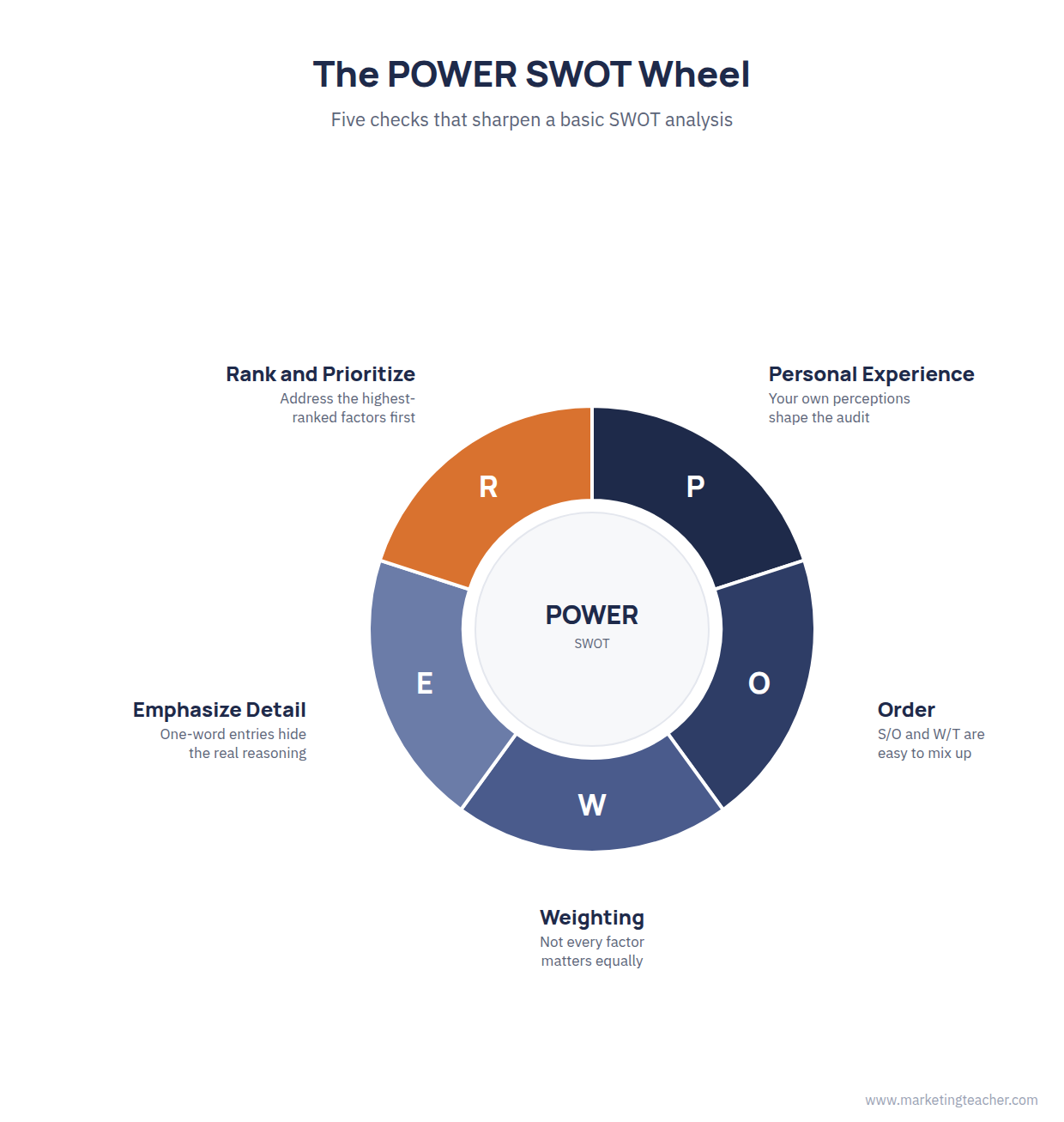
SWOT analysis evaluates a company’s strengths, weaknesses, opportunities, and threats as part of a wider marketing audit (Kotler & Armstrong, 2018). Strengths and weaknesses are internal, opportunities and threats are external, and the goal is to match the company’s strengths to attractive opportunities while eliminating or overcoming its weaknesses and minimizing its threats (Kotler & Armstrong, 2018). That basic structure, covered in our introductory SWOT Analysis lesson, is genuinely useful, and it is one of the most widely used tools in marketing planning — but its biggest strength is also where it runs into trouble. SWOT analysis is flexible enough to be applied to almost any situation, and that same flexibility makes it easy to use carelessly. POWER SWOT is a more critical checklist, built to catch five specific ways a basic SWOT analysis commonly goes wrong.
P Is for Personal Experience
Whoever runs the audit brings their own experience, skills, knowledge, attitudes, and beliefs to it. A SWOT analysis is never a purely objective exercise: a marketing manager’s gut feeling about what counts as a strength or a threat will always colour the result, even when the process itself looks systematic. Being aware of this bias doesn’t remove it, but it does mean a completed SWOT should be treated as one person’s (or one team’s) informed judgement, not an impartial fact sheet, and cross-checked with colleagues who bring a different perspective.
O Is for Order
It’s surprisingly easy to reverse the internal/external and positive/negative logic that separates strengths from opportunities, and weaknesses from threats. A change in the environment — a shift in regulation, a new consumer trend, a competitor’s move — is external, but whether it helps or hurts the company depends on how the company is positioned to respond to it, and that judgement call is exactly where mix-ups happen. A single external trend, such as growing consumer environmental awareness, might get filed under “threat” by a company that sees only compliance costs, when a competitor correctly reads the same trend as an “opportunity” because it can offer a genuinely greener product. Getting the category right isn’t pedantry: an opportunity mistakenly filed as a threat gets defended against instead of pursued.
W Is for Weighting
Not every strength, weakness, opportunity, or threat carries equal importance, but a basic SWOT list often treats every bullet point as if it does. Weighting each factor — even with a rough percentage split, such as Threat A at 10 percent, Threat B at 70 percent, and Threat C at 20 percent — forces a decision about which factors genuinely deserve the most attention, rather than leaving every item looking equally urgent on the page.
E Is for Emphasize Detail
A SWOT analysis that lists single words — “Technology” under opportunities, say — doesn’t actually tell a reader anything useful. What matters is the reasoning behind the entry: technology might enable a company’s marketers to reach customers via mobile devices right at the point of purchase, creating a specific and defensible competitive advantage. Writing that reasoning out, rather than leaving a bare label, is what makes an entry possible to weight, rank, and act on with any confidence.
R Is for Rank and Prioritize
Once every factor has been weighted and given proper detail, the analysis can be given real strategic meaning by ranking factors from highest to lowest and prioritizing accordingly. If Opportunity C scores 60 percent, Opportunity A scores 25 percent, and Opportunity B scores 10 percent, a marketing plan should address Opportunity C first and Opportunity B last, not tackle them in whatever order they happened to be written down. Opportunities generally deserve attention first, since a market-oriented business exists to serve the market’s needs; strengths should then be matched against those opportunities to look for a genuine fit, and any gap between current strengths and future opportunities becomes a target for development. Threats, wherever possible, should be reframed as opportunities in disguise (much like the environmental-awareness example above), and weaknesses addressed with the aim of turning them into strengths. A simple gap analysis — where the business is now, and where it wants to be — is a useful way to turn a ranked SWOT into an actual set of strategic priorities.
Summary
Basic SWOT analysis is a widely used and genuinely useful marketing audit tool, built around matching internal strengths to external opportunities while managing weaknesses and threats (Kotler & Armstrong, 2018). Its flexibility is also its weak point, since the same looseness that makes it adaptable also makes it easy to apply carelessly. POWER SWOT — Personal experience, Order, Weighting, Emphasize detail, and Rank and prioritize — is a more critical checklist that catches the most common ways a SWOT analysis goes wrong, and turns a rough list of strengths, weaknesses, opportunities, and threats into something that can genuinely guide a marketing strategy.
The slides, worksheet, lesson plan and poster for this lesson are free to download and free to use in your course — no sign-up, no permission needed. See the teacher resources →
Assign this lesson to your class:
Using Canvas, Blackboard or Moodle? Copy the link and paste it into your course page or assignment. More ways to add lessons to your LMS.

