
Why a Plain SWOT List Often Goes Nowhere
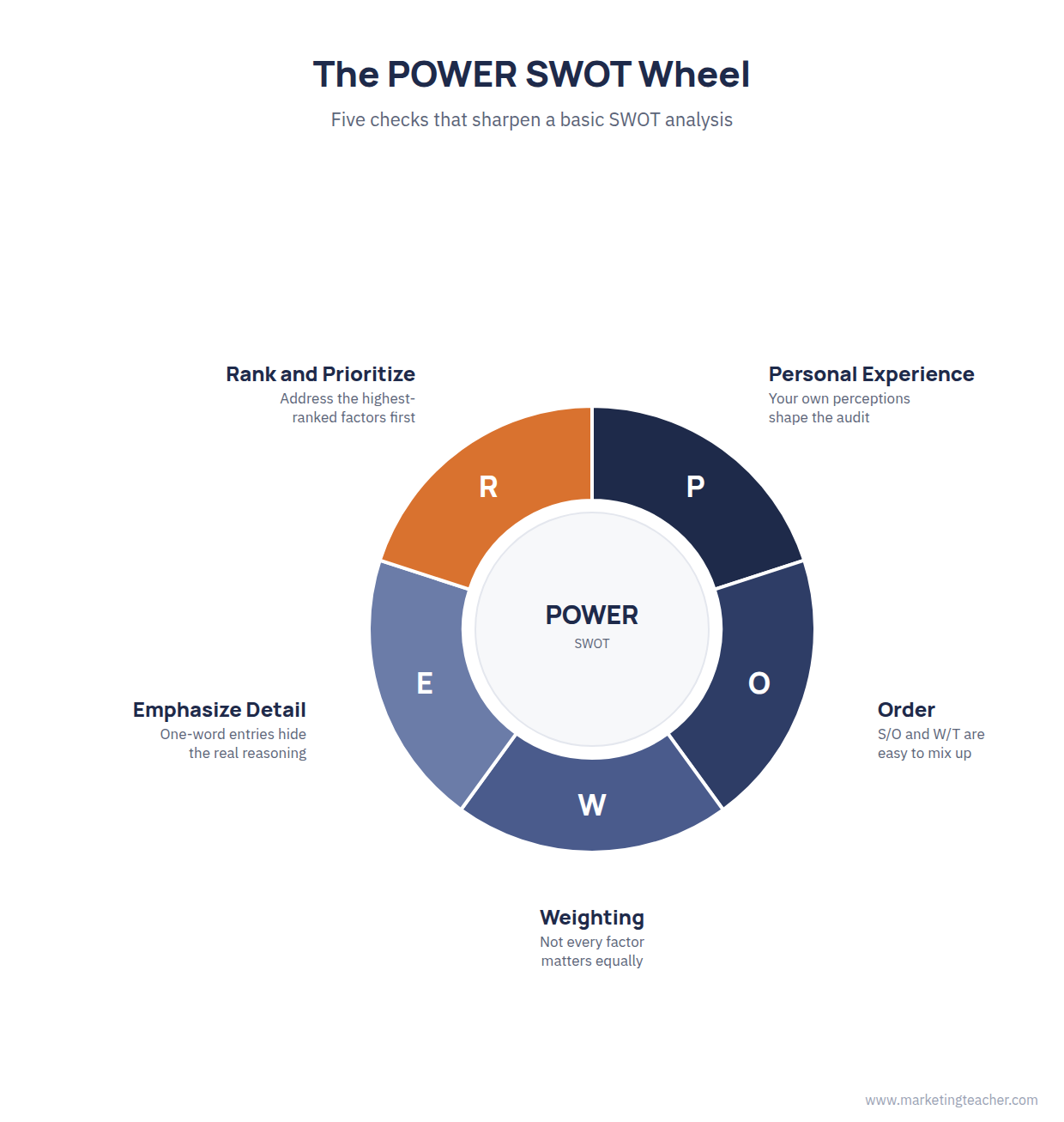
Kotler and Armstrong (2018) describe SWOT analysis as part of a wider marketing audit, used for building on strengths, correcting weaknesses and minimizing threats. A plain list of four categories does not, on its own, tell a manager what to actually do next – which is exactly the gap Colorado Ricardo has run into. The POWER SWOT approach addresses this by ranking items by priority and pairing them into specific actions, rather than leaving each item isolated in its own quadrant.
Prioritising and Pairing Colorado Ricardo’s SWOT
Threat: the declining market for traditional, non-electric mountain bikes.
Paired together, these two items point directly to a single action: use the idle capacity to manufacture the new e-mountain-bike in-house, rather than either leaving the capacity unused or outsourcing e-bike production to a third party. This is a higher-priority pairing than, say, matching “loyal Colorado following” against “no digital presence,” because it converts an underused asset into the direct answer to the company’s biggest threat, rather than addressing a weakness that has a lower cost of inaction.
This prioritised action should be tested against the growth options in the Ansoff’s Matrix exercise.
The slides, worksheet, lesson plan and poster for this lesson are free to download and free to use in your course — no sign-up, no permission needed. See the teacher resources →
Assign this lesson to your class:
Using Canvas, Blackboard or Moodle? Copy the link and paste it into your course page or assignment. More ways to add lessons to your LMS.

