
Learning Outcome: By the end of this lesson, you will be able to explain the three broad eras of the web’s development, describe what changed for marketers at each stage, and apply the framework to understand where current web technology sits.
This lesson is part of our Marketing Planning course. Study the full course and earn a certificate →
Why Marketers Need a Map of the Web’s History
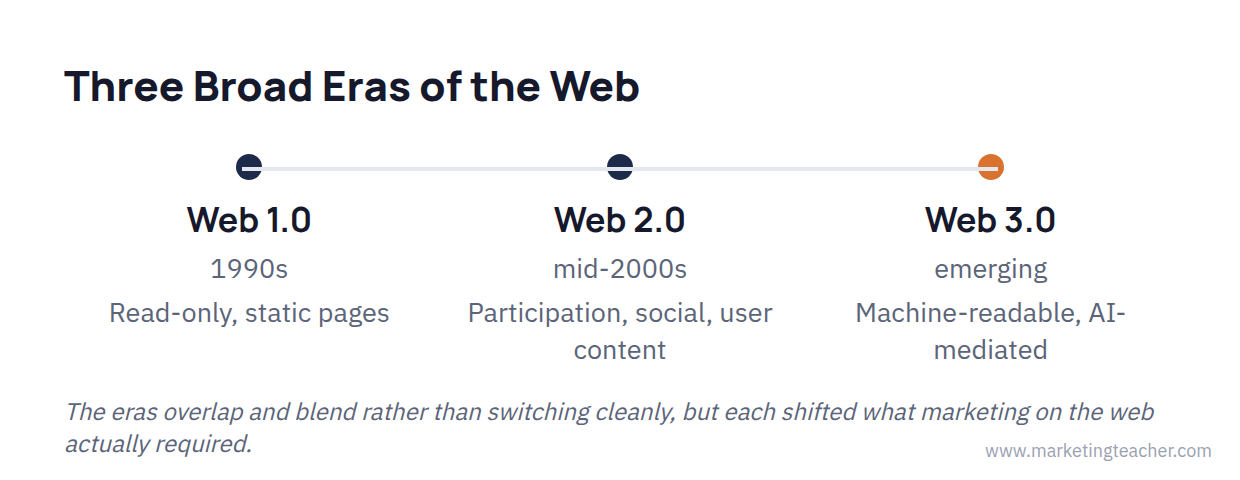
The web a marketer works with today looks nothing like the one that existed when it first became publicly available in the early 1990s, and understanding how it got here helps explain why certain marketing practices exist at all. The web’s evolution is commonly described in three broad, overlapping eras – Web 1.0, Web 2.0, and Web 3.0 – each defined less by a specific date and more by a shift in who could publish content and how machines could understand it.
Web 1.0: The Read-Only Web
The earliest commercial web, roughly the 1990s, was largely a one-way medium. Businesses and individuals published static pages that visitors could read but not meaningfully interact with or contribute to – no comments, no user accounts, no real-time updates. For marketers, this era meant a website functioned much like an online brochure: informative, but not a channel for conversation or feedback. Search engines existed but were rudimentary, and most discovery still happened through directories or word of mouth.
Web 2.0: The Read-Write, Participatory Web
Tim O’Reilly’s influential 2005 essay “What Is Web 2.0” gave a name to a shift already underway: the move from static publishing toward a web built on user participation, social interaction, and services rather than downloaded software. O’Reilly’s own comparison table contrasted the old and new web directly – personal websites gave way to blogging, static directories gave way to tagging, and one-way publishing gave way to participation. This is the web most people recognise today: social media, user reviews, wikis, and platforms whose entire value comes from what users contribute rather than what the platform’s owner publishes. For marketers, Web 2.0 is what made social media marketing, influencer content, and user-generated content possible in the first place – the audience became a co-creator of content rather than only its recipient.
Web 3.0: The Machine-Readable, Intelligent Web
Berners-Lee, Hendler and Lassila (2001), in a widely cited Scientific American article written by the web’s own inventor, set out an early and influential vision for what they called the Semantic Web – a web where data carries enough structured meaning that machines, not just humans, can meaningfully process and connect it, rather than software simply displaying pages for a person to interpret. This vision is often treated as a foundation of what’s now loosely called Web 3.0, alongside more recent additions such as artificial intelligence, decentralised technologies, and an increasingly connected network of everyday devices. For marketers, this era shows up in practical ways already familiar from other lessons on this site: AI-driven personalisation, voice assistants that need structured, machine-readable content to answer a query accurately, and search engines that increasingly try to understand intent and meaning rather than matching keywords alone.
Example: Oldfield Garden Supplies Adapts Across Two Eras
The fictional retailer Oldfield Garden Supplies launched its first website in 1998 as a simple digital catalogue – a Web 1.0 approach, with no way for customers to interact beyond browsing and phoning in an order. By 2010, it had added a blog, a customer review section, and a Facebook page, shifting toward a genuinely Web 2.0 approach where customers actively shaped the site’s content. More recently, Oldfield restructured its product pages with clearly marked-up, structured data describing each plant’s care requirements – a Web 3.0-style change that made its content directly answerable by voice assistants and AI-generated search summaries, driving a measurable share of new traffic from queries the business had never optimised for under the old keyword-matching approach.
What This Means for SEO Practice
Each era’s dominant discovery mechanism has left a lasting mark on how search engine optimisation is practised today. Web 1.0’s reliance on manually curated directories gave way, under Web 2.0, to link-based ranking driven by what other participants chose to link to and share – the origin of much of classic SEO practice. The emerging Web 3.0 layer adds a further requirement on top of both: content also needs to be structured clearly enough for an AI system or voice assistant to extract a direct answer from it, a theme explored further in this site’s lesson on voice search optimisation. A marketer working today is, in effect, still satisfying all three eras’ expectations at once.
Why the Boundaries Are Blurry
These three eras are a useful teaching framework, not a strict technical standard with agreed start and end dates – there’s no single moment the web “became” 2.0 or “became” 3.0, and elements of all three coexist on the web today. A simple static informational page is still, functionally, a Web 1.0 experience even if it’s hosted on a 2026 server. The value of the framework for a marketer isn’t historical trivia; it’s a reminder that the underlying expectations of an online audience keep shifting, and a strategy built entirely around one era’s assumptions eventually falls behind.
Summary
The web has moved through three broad, overlapping stages: a read-only publishing web, a participatory web built on user contribution, and an emerging machine-readable web where structured data and AI increasingly mediate how content is found and understood. Each shift changed what marketing on the web actually involved – from simply informing, to conversing, to being genuinely understandable by the machines now standing between a business and its audience.
Key Idea: Each era of the web changed who – or what – a marketer was really writing for: first a human reader alone, then a human reader and contributor, and now increasingly a machine that needs to understand the content before a human ever sees it.
Teaching this topic?
The slides, worksheet, lesson plan and poster for this lesson are free to download and free to use in your course — no sign-up, no permission needed. See the teacher resources →
Assign this lesson to your class:
Using Canvas, Blackboard or Moodle? Copy the link and paste it into your course page or assignment. More ways to add lessons to your LMS.
Written by Marketing Teacher.
Online course · certificate on completion
Study the full Marketing Planning course — and earn a certificate
Thirteen modules that take you from analysis and objectives through to budgets, implementation and control, written at Level 5, reaching Level 6, with a short quiz after each.

