
What Is Industry 4.0?
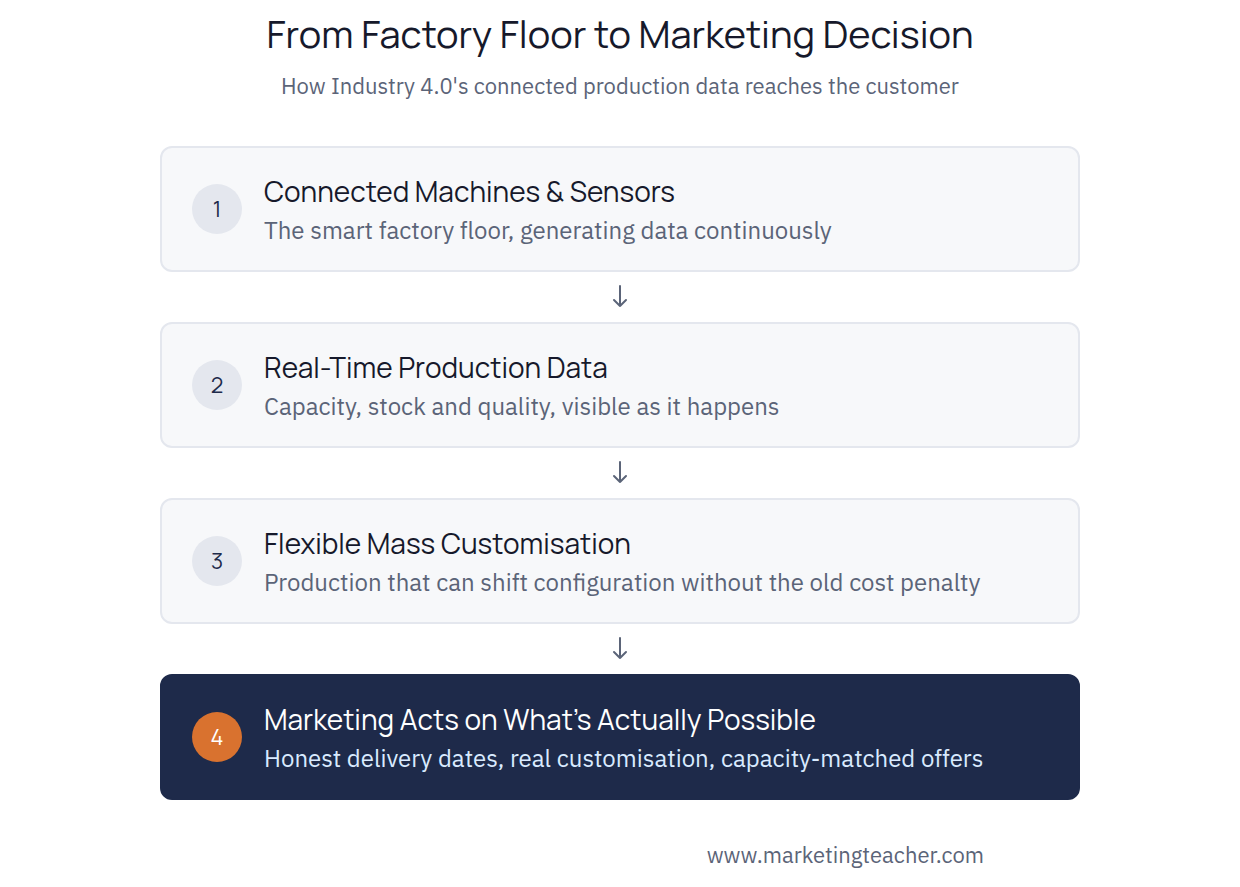
Industry 4.0 refers to what’s often called the fourth industrial revolution: manufacturing built around cyber-physical systems, the Internet of Things, and real-time data exchange between machines, rather than the largely manual or mechanically-automated production of earlier eras (Kagermann, Wahlster and Helbig, 2013). The term was coined to describe smart factories where sensors, connected machinery and data systems talk to each other continuously — and one of the outcomes its original authors envisioned was production flexible enough to make individualised, mass-customised products at something close to standard manufacturing cost.
Why This Matters to Marketers, Not Just Engineers
A factory floor sounds like it belongs entirely to operations, but Industry 4.0 changes something marketers care about directly: how quickly and how precisely a business can actually deliver what it promises. When production data flows in real time rather than being reported weekly or monthly, a marketing team can make offers it used to avoid — a genuinely personalised product configuration, an accurate delivery estimate based on real current capacity, or a promotion timed to inventory levels a marketer can actually see rather than guess at.
Mass Customisation Becomes a Marketing Offer, Not Just a Slogan
Before connected manufacturing, “customise your product” was expensive to deliver at scale — a business either accepted the cost of true customisation or offered only a limited set of pre-built variants dressed up as choice. Kagermann, Wahlster and Helbig (2013) describe a central promise of Industry 4.0 as flexible production that can shift between configurations without the cost penalty traditional manufacturing carries. For marketing, that turns customisation from an expensive premium feature into something that can be offered as a mainstream option, because the production system behind it can actually flex to support it.
Real-Time Data Changes What a Promotion Can Promise
Marketing promotions have traditionally been planned around forecasts and worked around whatever inventory reality shows up later. Connected production data flips that order: a marketing team with a live view of actual output and stock can plan a promotion around what’s genuinely available, adjust messaging the moment capacity shifts, and avoid the credibility damage of advertising a delivery time production can’t actually meet. This tightens the link between what marketing promises and what the business can deliver — a connection that used to run through several slow layers of internal reporting.
What This Doesn’t Solve on Its Own
Connected manufacturing data is only useful to marketing if it’s actually shared across the organisation — a factory generating rich real-time data that never reaches the marketing team changes nothing for customers. Kagermann, Wahlster and Helbig (2013) frame Industry 4.0 as much an organisational shift as a technical one, and that holds especially true at the marketing-operations boundary: the technology creates the possibility of better-informed marketing decisions, but only a genuine data-sharing relationship between the two functions turns that possibility into something a customer actually experiences.
A Side Benefit: Claims a Business Can Actually Verify
Connected production data also strengthens a different kind of marketing claim: the ones about sourcing, sustainability or ethical manufacturing that customers increasingly ask about. A business with real-time visibility into its own production and supply chain can back a sustainability claim with actual traceable data — this batch used this much recycled material, this shipment came from this verified source — rather than a general statement that invites the same skepticism covered in the lesson on sustainability as a core brand value. The data Industry 4.0 generates for operational reasons ends up being exactly the evidence marketing needs to make a credible, checkable claim rather than a vague one.
The B2B Case Is Often Even Stronger
For a business selling to other businesses, connected production data can become the marketing pitch itself rather than just supporting it. A B2B buyer choosing between suppliers increasingly wants to see real capacity and quality data, not just a sales brochure — being able to show a prospective client live throughput figures, defect rates, or on-time delivery performance, all generated automatically by a connected production system, gives marketing and sales material that a purely descriptive pitch never could. This mirrors the shift seen in connected-product marketing more broadly: verified operating data becomes a more persuasive argument than a claim alone.
Summary
Industry 4.0 describes manufacturing built around connected sensors, cyber-physical systems and real-time data exchange, and while it originated as a manufacturing concept, it changes what marketing can credibly offer: genuine mass customisation, delivery estimates grounded in real capacity, and promotions timed to actual inventory rather than forecasts (Kagermann, Wahlster and Helbig, 2013). The value only reaches customers when production data actually flows to the marketing team, which makes the organisational link between operations and marketing at least as important as the underlying technology itself.
The slides, worksheet, lesson plan and poster for this lesson are free to download and free to use in your course — no sign-up, no permission needed. See the teacher resources →
Assign this lesson to your class:
Using Canvas, Blackboard or Moodle? Copy the link and paste it into your course page or assignment. More ways to add lessons to your LMS.

