
Learning outcome
What Is Transformative Marketing?
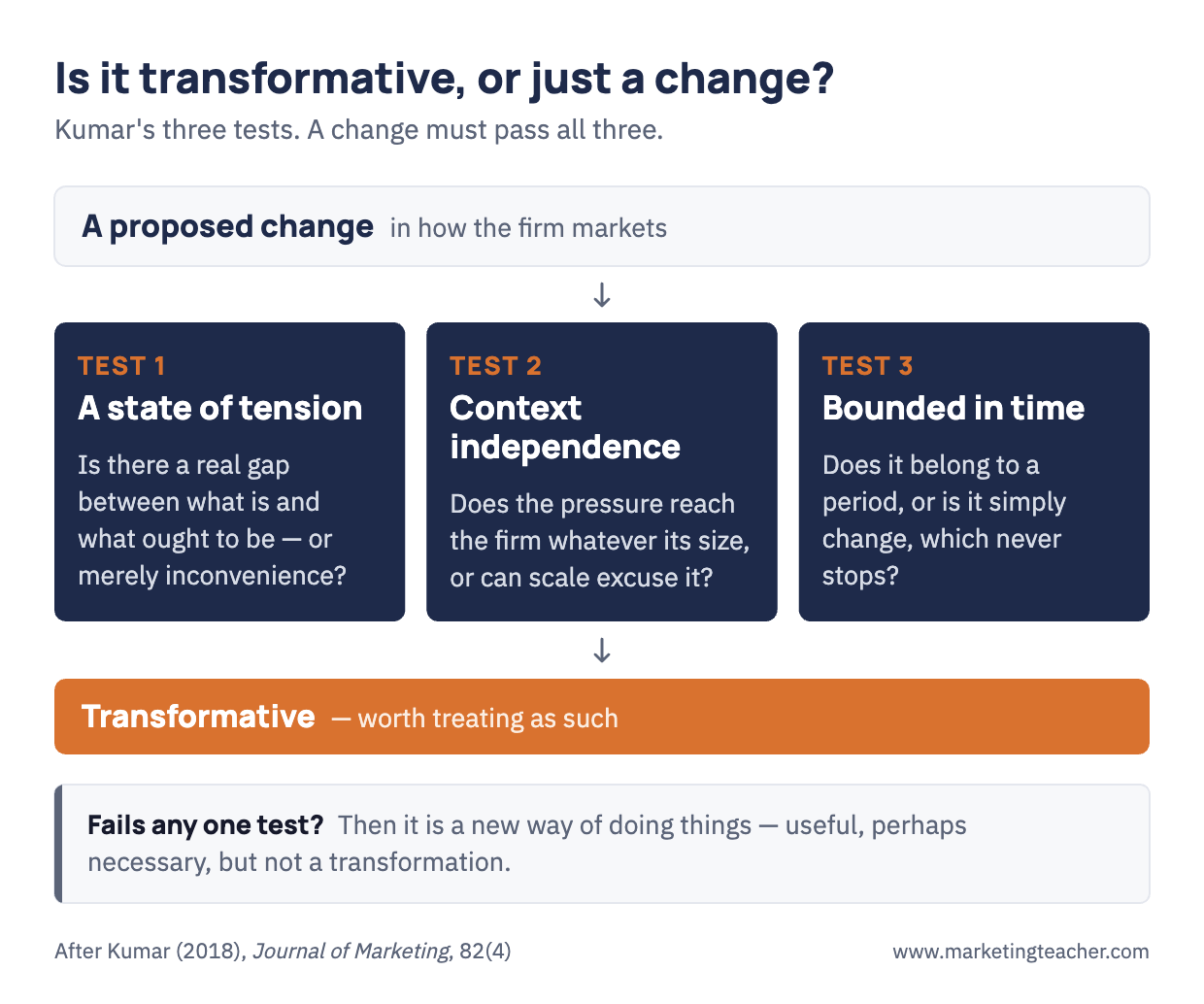
Most changes a marketing department makes are ordinary. It appoints a new agency, adopts a new analytics platform, adds a channel. These are useful and often necessary, but they are not transformations. Transformative marketing is the name V. Kumar gave, in a 2018 editorial in the Journal of Marketing, to something rarer: a change deep enough to alter how a firm competes, not merely how it executes.
Kumar (2018, p. 2) defines it as “the confluence of a firm’s marketing activities, concepts, metrics, strategies, and programs that are in response to marketplace changes and future trends to leapfrog customers with superior value offerings over competition in exchange for profits for the firm and benefits to all stakeholders.”
Three things are doing work in that definition. The creation of a transformation comes from combining marketplace trends with the firm’s existing concepts, metrics and strategies — and Kumar stresses that it needs organisational buy-in, because the process never belongs to one department. The purpose is to reach the intended audience with an offering that beats the competition, which forces a firm out of its functional silos. The procedure matters as much as the result: a change that does not generate profit for the firm and benefit for its stakeholders is unlikely to last.
What Makes a Change Transformative Rather Than Routine?
Kumar sets out three conditions. A change has to meet all three; miss one and what you have is a new way of doing things, not a transformation.
A state of tension. There must be a real gap between what is and what ought to be. Without that tension there is nothing to force a decision, and a change made in comfortable conditions is almost never transformative. Kumar treats this tension specifically as the pressure to generate value for the firm and for its stakeholders at the same time, because a relationship that delivers value to neither will not survive.
Context independence. The pressure does not respect the size or type of the business. Kumar’s example is the connected car: software platforms now sit between drivers, insurers, service providers and regulators, and a firm operating in that ecosystem cannot use its size as an excuse for not delivering value. The same forces reach a single grocery store and a national chain, even though the work each has to do differs enormously.
Bounded in time. Unlike change in general, which never stops, a transformation belongs to a period. Kumar argues the marketing approach of firms has shifted roughly every two decades, and that the transformative era he describes would run for about twenty years from 2018. That is a claim you can hold him to, and it is worth asking a decade in how well it is holding up.
Example: Halstow Builders’ Merchants Applies the Three Tests
What Is Driving the Change?
Kumar identifies six forces acting on firms: technology, economic forces, customer preferences, government regulations, competitive forces, and environmental resources. None is new on its own, and several will be familiar from a PESTEL analysis. What is new is that they now arrive together and at speed, which is why he treats the response as a transformation rather than a series of adjustments. Innovation, in his account, works in the background of all six rather than sitting alongside them as a seventh.
What Does a Firm Get Out of It?
Kumar names four outcomes. Two concern personalisation and two concern performance.
The first is the ability to personalise marketing content. Channel proliferation and customers’ willingness to move between channels give firms far more information about how people communicate, and the opportunity to tailor what they say. The second is the ability to personalise the offering itself — a different and more demanding thing than personalising the message, since it reaches into the product.
The third is higher efficiency: accomplishing more with the same resources, which matters as media fragments and audiences gain the power to avoid advertising altogether. The fourth is higher effectiveness, judged across the organisation rather than campaign by campaign. Varadarajan (2018), commenting on Kumar’s paper, notes that effectiveness and efficiency are the outcomes his own framework shares with Kumar’s — a sign of how central they are to the argument.
Where the Argument Went Next
Two responses were published alongside the original. Meyer (2018) accepted the diagnosis but added a caution worth carrying: firms cannot know which specific technology will win, so the value of the framework lies in understanding why transformations happen rather than in predicting what comes next. Varadarajan (2018) built a complementary framework around a firm’s customer information, its capacity to analyse that information, and the knowledge it produces.
Kumar himself has since restated the argument twice, organised differently each time — around individual technologies in a book with Philip Kotler (Kumar and Kotler, 2024), and around strategy in a later paper. The 2018 framework taught here is the original, and it remains the clearest statement of what makes a change transformative.
Summary
Kumar (2018) defines transformative marketing as a coordinated response to marketplace change that leapfrogs the competition while producing profit for the firm and benefit for its stakeholders. Three conditions distinguish it from routine change: a state of tension, context independence, and a bounded period. Six forces drive it, and four outcomes follow — personalised content, personalised offerings, higher efficiency and higher effectiveness. The framework is a way of judging whether a proposed change is worth treating as a transformation at all, which is a more useful question than asking which technology to adopt.
Quiz

The slides, worksheet, lesson plan and poster for this lesson are free to download and free to use in your course — no sign-up, no permission needed. See the teacher resources →
Assign this lesson to your class:
Using Canvas, Blackboard or Moodle? Copy the link and paste it into your course page or assignment. More ways to add lessons to your LMS.

