
What Is a PESTEL Analysis?
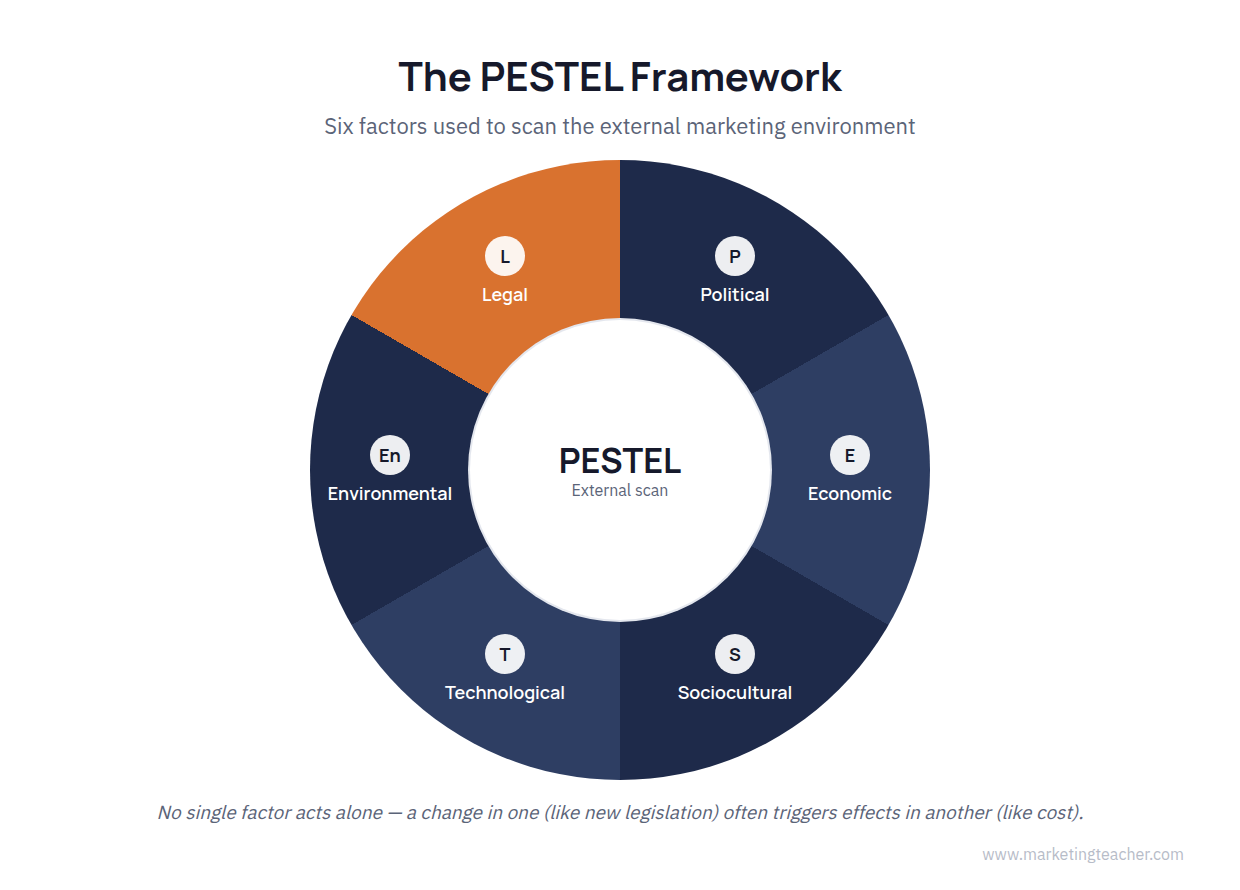
A PESTEL analysis is a tool marketers use to scan the wider external environment a business operates in, separate from the customers and competitors it deals with directly. Aguilar (1967) is widely credited with the original version of this idea, an environmental scanning framework that grouped external forces under four headings; later writers extended it to six, giving the acronym PESTEL: Political, Economic, Sociocultural, Technological, Environmental and Legal. Kotler and Armstrong (2018) describe this wider setting as the macroenvironment, the set of larger societal forces that shape the narrower microenvironment in which a business actually trades. Several close variants exist under different names, including PEST, SLEPT and STEP, but they all cover essentially the same ground; PESTEL is simply the most complete version in common use.
Political and Legal Factors
Political factors cover the actions and priorities of the government in any country where a business manufactures or trades. A government that favours higher public spending is likely to tax more and regulate more heavily, while a more free-market government tends to leave more decisions to businesses and consumers themselves; either way, a change in government can shift the rules a business has been planning around. Legal factors sit close beside political ones, since law is usually how a political decision actually takes effect. A product built for one market often cannot simply be sold unchanged in another: vehicles are built left-hand drive for mainland Europe and the United States but right-hand drive for the United Kingdom and Japan, and speed limits, safety ratings and countless other local codes vary from one country to the next. A business trading internationally has to track these legal differences market by market, not assume home-market rules apply everywhere.
Economic and Sociocultural Factors
Economic factors describe the state of the economy a business is trading in: whether it is growing or in recession, where it sits in the wider business cycle, and how that affects customers’ willingness and ability to spend. These conditions affect every business to some degree, whatever it sells, which is why economics is such a core part of studying marketing in the first place. Sociocultural factors cover the social and cultural make-up of a market: its demographics, the way life expectancy and population structure are shifting, and broader cultural influences on how people actually behave as consumers, from lifestyle and attitude to the generation someone belongs to. A business that ignores sociocultural change risks marketing a product the way it always has, to a population that has quietly moved on.
Technological and Environmental Factors
Technological factors run through almost every part of a modern business, not just its products. Smartphones and fast internet connections have changed how customers research and buy, while inside the business itself, manufacturing, logistics, and customer service all depend on their own layers of technology, from stock-control software to order-tracking systems. A business that falls behind on any of these fronts can find itself outpaced by competitors who haven’t. Environmental factors cover the growing pressure on businesses, from regulators and customers alike, to reduce their impact on the natural environment: cutting manufacturing waste, reducing packaging, and building sustainability into strategy rather than treating it as an afterthought bolted on to existing operations. What starts as a tactical response to environmental pressure, such as switching to recyclable packaging, often ends up reshaping a business’s strategic direction over the longer term. Kotler and Armstrong (2018) list both the technological and the natural environment among the core forces in the marketing macroenvironment, alongside the demographic, economic, political and cultural forces already covered above — a reminder that PESTEL is really a structured way of walking through the same macroenvironment forces marketers have long tracked, rather than a separate idea in its own right.
Summary
A PESTEL analysis breaks the external environment into six factors — political, economic, sociocultural, technological, environmental and legal — that sit outside a business’s direct control but shape almost every decision it makes. Political and legal factors set the rules a business must trade within; economic and sociocultural factors shape what customers can and want to buy; technological and environmental factors shape how a business operates and how it is judged for doing so. Because these six factors interact and change constantly, PESTEL works alongside a wider read of the marketing environment as a continuous scanning habit, not a one-off exercise completed at the start of a planning cycle.

The slides, worksheet, lesson plan and poster for this lesson are free to download and free to use in your course — no sign-up, no permission needed. See the teacher resources →
Assign this lesson to your class:
Using Canvas, Blackboard or Moodle? Copy the link and paste it into your course page or assignment. More ways to add lessons to your LMS.

