
Learning Outcome: By the end of this lesson, you will be able to explain how big data has changed customer relationship management, describe the process from raw customer data to a personalised action, and apply the concept to a realistic business scenario.
Want to go further? Study a full online course and earn a certificate →
How Has Big Data Changed CRM?
Customer relationship management (CRM) has always been about understanding and managing a business’s relationships with its customers, but the scale and type of data available for that purpose has changed dramatically. Anshari et al. (2019), writing in Applied Computing and Informatics, describe how the emergence of big data – data characterised by its volume, velocity, and variety – has brought a new wave of CRM strategy centred on personalisation and customisation, moving well beyond the purchase-history records that defined earlier CRM systems. Where a traditional CRM system might hold a customer’s past orders and contact details, a big-data-enabled CRM system can also draw on browsing behaviour, social media activity, support interactions, and location data, all combined into a much richer picture of who a customer actually is.
From Raw Data to CRM Performance
Zhang, Wang and Zhang (2020), in Industrial Marketing Management, studied how firms assimilate what they call “big data analytical intelligence” and found that this capability improves CRM performance specifically by enabling superior mass-customisation – the ability to tailor an experience to an individual customer at a scale that would be impossible manually. Their research, based on 147 business-to-business companies, also found that a firm’s existing marketing capability strengthens this effect further, suggesting big data doesn’t replace marketing skill so much as amplify it when the two are combined well.
What This Looks Like in Practice
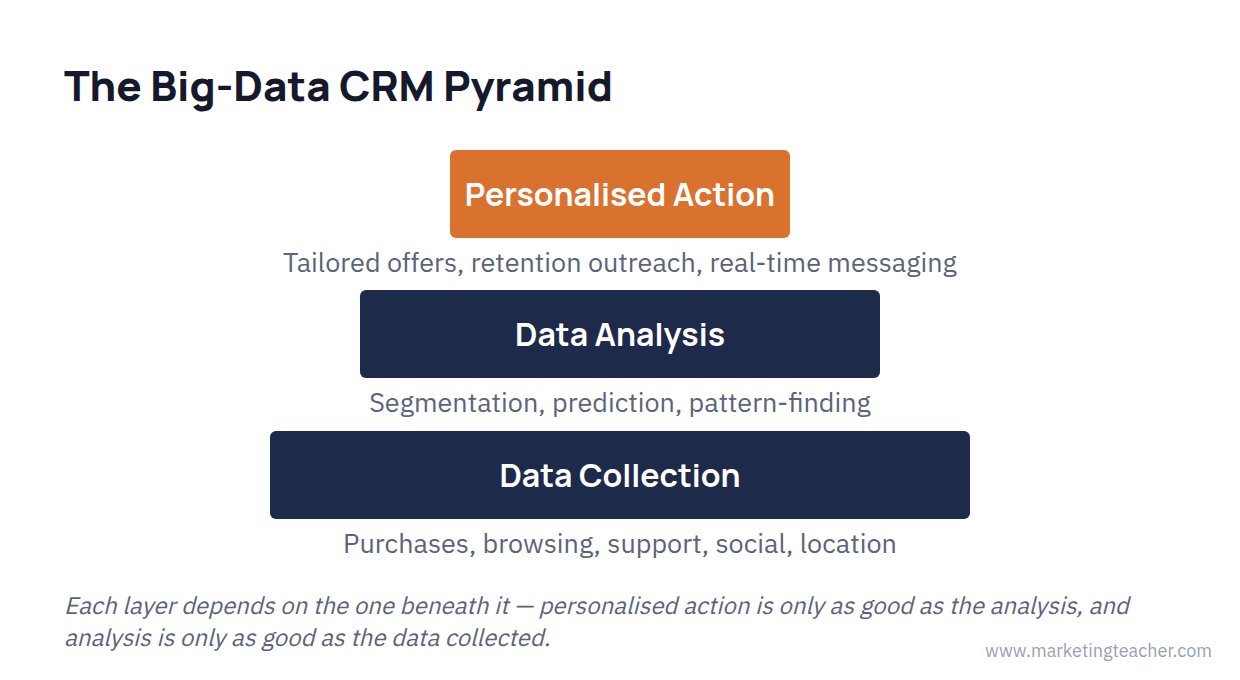
A big-data-enabled CRM system typically supports a business in three connected ways. It enables more accurate segmentation, grouping customers by genuine behavioural similarity rather than broad demographic guesses. It supports predictive modelling, such as flagging which customers show early signs of churn before they actually leave, so a business can intervene while retention is still realistic. And it enables real-time personalisation, adjusting an offer, a message, or a recommendation based on a customer’s most recent behaviour rather than a static profile built up over years.
The Data-Quality Problem
None of this works if the underlying data is poor. A CRM system fed inconsistent, duplicated, or outdated customer records will produce personalisation that feels wrong rather than helpful – a customer who cancelled a subscription still receiving renewal offers is a familiar example of exactly this failure. Del Vecchio et al. (2021), reviewing the academic literature on big data in CRM in the International Marketing Review, note that despite growing research interest, the field remains fragmented, with many businesses still working out how to translate big data’s theoretical promise into a genuinely reliable, well-integrated system.
Example: Pemberton Financial Services Predicts Who Might Leave
The fictional Pemberton Financial Services combined its transaction records, customer service call logs, and app usage data into a single CRM view for the first time, having previously kept these in separate systems that didn’t talk to each other. The combined view revealed that customers who reduced their app log-ins by more than 60% over two months, combined with even a single unresolved support call, cancelled their accounts at nearly five times the rate of other customers. Pemberton built a simple alert flagging this exact combination and began proactively reaching out to flagged customers with a personal call. Within the following two quarters, cancellations among flagged customers fell by close to a third compared with the same group’s prior cancellation rate, before the alert system existed.
Choosing Where to Start
A business new to big-data-enabled CRM rarely needs every capability at once, and Hallikainen et al. (2020), studying 417 B2B firms in Industrial Marketing Management, found that the sales-growth benefit of customer big data analytics appeared regardless of a firm’s existing analytics culture, while the customer-relationship-performance benefit was stronger specifically where that analytics culture already existed. In practice, this suggests starting with a single, well-defined use case – such as the churn-risk alert described below – and building organisational comfort with data-driven decisions before attempting a full-scale, all-at-once CRM overhaul.
Privacy and Ethical Limits
Combining this much customer data raises real privacy obligations, and a business using big data for CRM needs to handle personal information in line with the relevant data protection regulation, being transparent with customers about what’s collected and why. Personalisation that feels helpful when done well can feel unsettling when it goes too far or draws on data a customer didn’t expect to be used this way – a distinction worth actively managing, not assuming will take care of itself.
Where CRM and Big Data Are Headed
The direction of travel in this field points toward CRM systems that act increasingly in real time rather than on a periodic reporting cycle – adjusting a website experience, a support routing decision, or a marketing message the moment new behavioural data arrives, rather than waiting for a weekly or monthly review. This raises the bar for what “using the data” actually means in practice, moving CRM from a system a business consults occasionally toward one that actively shapes each individual customer interaction as it happens.
Summary
Big data has expanded CRM from a record of past transactions into a much richer, real-time picture of customer behaviour, enabling better segmentation, predictive insight, and personalisation at scale. The benefits depend heavily on data quality and on combining data sources that too often sit in separate, disconnected systems, and the approach carries real privacy obligations that a business needs to take seriously rather than treat as an afterthought.
Key Idea: Big data doesn’t just give CRM more information – it changes what CRM can predict, letting a business notice a customer drifting away before they actually leave, rather than only recording that they did.
More in this series: Customer relationship management
Customer Relationship Management (CRM) · CRM and Information Technology · Business Strategy and CRM · Mobile CRM: Best Practices for Getting It Right · Social CRM: Turning Social Media Into Customer Insight · e-CRM: How Electronic Channels Change Customer Relationships · Customer Relationship Management (CRM) and Big Data. · Customer Life Cycle (CLC) and CRM
Teaching this topic?
The slides, worksheet, lesson plan and poster for this lesson are free to download and free to use in your course — no sign-up, no permission needed. See the teacher resources →
Assign this lesson to your class:
Using Canvas, Blackboard or Moodle? Copy the link and paste it into your course page or assignment. More ways to add lessons to your LMS.
Written by Marketing Teacher.
Online course · certificate on completion
Study a full online course — and earn a certificate
Three courses that turn the free lessons into ordered modules, written at university Levels 4 to 6, with a short quiz after each.

