
What Is AI-Driven Hyper-Personalization in Marketing?
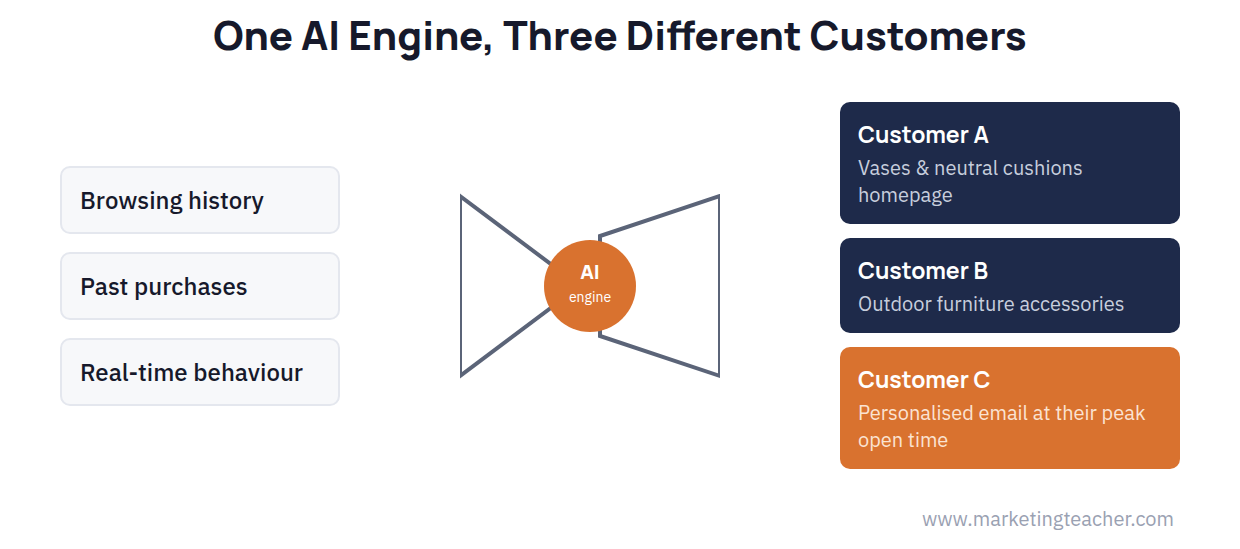
Hyper-personalization means tailoring marketing to a single customer rather than to a broad segment, adjusting the specific products shown, the message used, and even the timing of contact to that one person’s own behaviour. Kumar, Rajan, Venkatesan and Lecinski (2019) describe artificial intelligence‘s role in engagement marketing as narrowing a near-limitless set of possible offers down to the small handful that genuinely fit each individual customer, something no marketing team could realistically do by hand across thousands or millions of customers at once. Ordinary personalization might mean greeting a customer by name or sorting them into a broad group such as “frequent buyers”; hyper-personalization goes further, using an individual’s own browsing and purchase history to shape what they see next.
From Segments to Individuals
Traditional marketing has long relied on segmentation, grouping customers who share similar characteristics and treating everyone in a segment the same way. AI-driven personalization instead builds a model of each individual customer specifically, using their own click history, past purchases, and real-time browsing behaviour rather than the average behaviour of a wider group. This shows up in practical features many shoppers now take for granted: product recommendations that change based on what a customer just viewed, website homepages that rearrange themselves for a returning visitor, and marketing emails whose subject line, timing and content differ for every recipient.
The Data Behind the Personalization
None of this works without data: browsing history, past purchases, time spent on a page, items added to a cart but not bought, and how a customer has responded to previous marketing all feed the model that decides what to show next. Kumar, Rajan, Venkatesan and Lecinski (2019) treat this kind of engagement marketing as an ongoing loop rather than a one-off setup, since every new interaction a customer has becomes more data the system can use to refine its next recommendation. The more consistently a business captures this data across its website, app and email channels, the more accurately the system can tailor what an individual customer sees.
Where Machine Learning Fits In
The models doing this work are usually built using machine learning, algorithms that improve their predictions automatically as more data passes through them, rather than following a fixed set of rules a person wrote in advance. A machine learning model trained on millions of past customer interactions can spot patterns a human analyst would never notice, such as a subtle link between browsing time on a product page and the likelihood of buying a related item three weeks later, and use that pattern to personalize what the next customer sees.
It Is Not Just for Big Retailers
Hyper-personalization is often associated with large e-commerce platforms, but the same underlying idea scales down to smaller businesses using far more modest tools, such as an email platform that automatically varies send time and product suggestions per subscriber, or a booking system that remembers a returning client’s usual preferences. Streaming and subscription services use a similar approach to personalize which content or products are suggested next, based on what a specific subscriber has already watched, listened to or bought, rather than showing every subscriber the same front page. The underlying principle stays the same across all of these: use an individual’s own data to decide what they, specifically, are shown next.
Balancing Personalization With Privacy and Trust
Personalization that goes too far can backfire: a customer who feels a business knows uncomfortably much about them, or who sees an advert that feels like it is following them everywhere, may trust the brand less rather than more. Being transparent about what data is collected and why, and giving customers a genuine way to opt out or adjust their preferences, protects the relationship that hyper-personalization is meant to strengthen in the first place. The most effective personalization tends to feel helpful and relevant rather than intrusive, which is a balance a business has to actively manage rather than something that happens automatically just because the technology is in place.
Summary
Hyper-personalization moves marketing beyond broad customer segments to individually tailored experiences, and Kumar, Rajan, Venkatesan and Lecinski (2019) frame artificial intelligence’s role as narrowing a vast set of possible offers down to the specific handful that fit one customer, using machine learning models that improve continuously as more data flows through them. The technology makes remarkably precise targeting possible, but a business still has to manage the balance between helpful personalization and the kind of over-familiarity that makes customers uneasy, since the data and the models behind it are only ever as trustworthy as the way a business chooses to use them.
The slides, worksheet, lesson plan and poster for this lesson are free to download and free to use in your course — no sign-up, no permission needed. See the teacher resources →
Assign this lesson to your class:
Using Canvas, Blackboard or Moodle? Copy the link and paste it into your course page or assignment. More ways to add lessons to your LMS.

