
What Creates Value for a Customer?
Consumers choose goods and services on the assumption that they will be rewarded with value in return, and consumption is the process by which a good or service is actually used and judged against that expectation. The outcome can be positive, if the customer feels genuinely satisfied, or negative, if they feel the purchase fell short. Marketers have to combine quality, price and customer service in the right proportions to create that positive outcome, since none of the three works well in isolation. A high-quality product sold at a fair price still fails to build a loyal customer if that customer is treated poorly, ignored, or refused a return on a faulty item.
Quality Alone Is Not Enough
A useful way to think about this is as a simple relationship: quality, price and customer service together produce value and satisfaction. A product with low quality sold at a high price obviously fails this test, but so does an excellent product sold at a fair price if the surrounding service experience is poor. Value is judged holistically, not on any single factor, which is why a marketer cannot simply out-engineer a product and ignore everything else a customer experiences around it.
Quality Means Different Things for Products and Services
Quality is a product or service’s ability to meet a customer’s need or want, but it is genuinely difficult to define in general terms, since it varies with the individual customer and, importantly, with whether what is being judged is a physical product or a service experience. Because products and services are evaluated in different ways, as covered in Introduction to Services Marketing, two separate quality frameworks are commonly used: one for tangible products, and one for services.
Garvin’s Dimensions of Product Quality
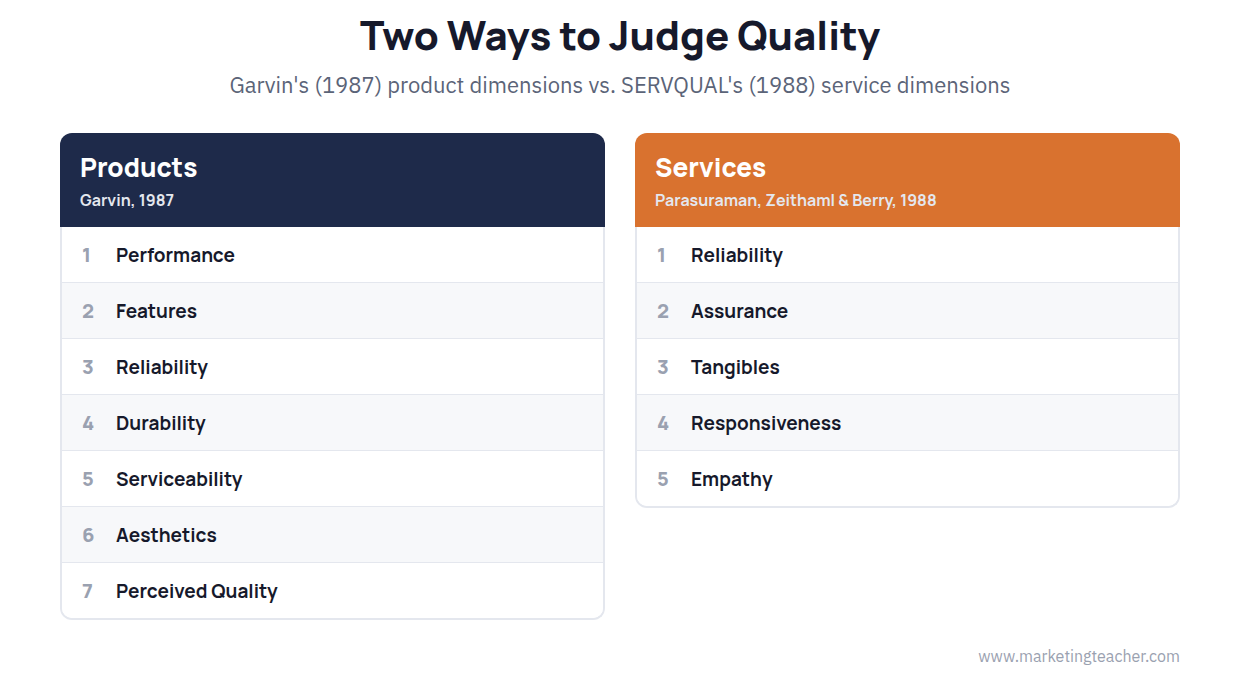
Garvin (1987) identifies eight dimensions that together define how customers judge a physical product’s quality. Performance covers whether the product actually does what it claims to do. Features are the specifications and capabilities it offers beyond the basics, including safety measures. Reliability is whether it performs consistently over repeated use. Durability is whether it holds up under normal wear and use over time. Serviceability reflects how easily it can be maintained or repaired, whether by the customer or under a warranty. Aesthetics covers how the product looks and feels, which contributes directly to brand identity and equity. Perceived quality is the customer’s own subjective impression: even a genuinely well-made product will not sell if customers do not believe it is good.
The SERVQUAL Dimensions of Service Quality
Because a service cannot be inspected the way a product can, Parasuraman, Zeithaml and Berry (1988) propose a different set of five dimensions, often remembered by the acronym RATER, for judging service quality. Reliability is whether the service is performed correctly the first time and every time after. Assurance covers whether staff are knowledgeable, competent and able to inspire trust and confidence. Tangibles are the physical evidence surrounding an otherwise intangible service, a restaurant’s food alongside its cooking service, or a bank’s branch decor and staff appearance. Responsiveness is how promptly a service is delivered and how willingly staff help. Empathy is the individualised, caring attention a customer receives, treatment that makes them feel like more than just a transaction.
Why Employees Matter So Much in Services
Assurance and empathy both point to the same underlying truth: in a service context, customers tend to equate an individual employee’s behaviour with the entire company. A single bad interaction with one staff member can turn a customer against an entire brand, not just that one employee, since the customer has no separate physical product to fall back on as evidence of quality. This is part of why the extended marketing mix treats people as a core element of the services marketing mix rather than an operational detail to manage separately from marketing.
Value and Satisfaction Feed Loyalty
When quality, price and customer service genuinely align, the result is more than a single satisfied transaction; it becomes the foundation of a loyal, ongoing customer relationship. A customer who consistently receives strong value has less reason to shop around, and is more likely to tolerate an occasional service slip because it is judged against a track record rather than in isolation. This is why relationship quality, not just the quality of any one purchase, has become such a central concern for marketers competing in mature, competitive markets.
Summary
Customers judge value through a combination of quality, price and customer service, and any one of these falling short can undermine the other two. Garvin’s (1987) eight dimensions, performance, features, reliability, durability, serviceability, aesthetics and perceived quality, explain how customers judge physical products, while Parasuraman, Zeithaml and Berry’s (1988) SERVQUAL dimensions, reliability, assurance, tangibles, responsiveness and empathy, explain how customers judge services they cannot physically inspect. Understanding both frameworks helps marketers see quality not as a single score but as a set of specific, manageable dimensions, and consistently strong value across those dimensions is what ultimately builds the loyal, lasting customer relationships every business depends on.
The slides, worksheet, lesson plan and poster for this lesson are free to download and free to use in your course — no sign-up, no permission needed. See the teacher resources →
Assign this lesson to your class:
Using Canvas, Blackboard or Moodle? Copy the link and paste it into your course page or assignment. More ways to add lessons to your LMS.

