
What Is Market Targeting?
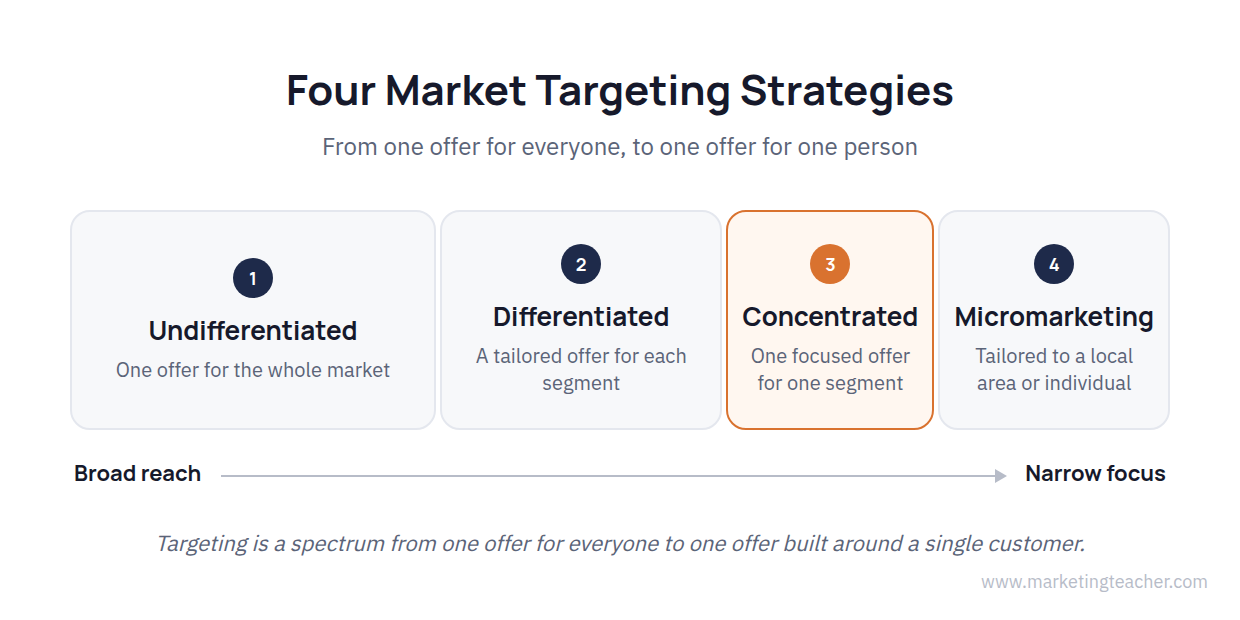
Once a market has been divided into segments, a business faces a choice: which segment or segments should it actually go after? Kotler and Armstrong (2018) describe market targeting as the second stage of the segmentation, targeting, positioning (STP) process — evaluating each segment’s attractiveness and deciding how many, and which, to serve. Getting this choice right matters more than it might first appear: a business that tries to be everything to everyone often ends up standing for nothing to anyone, while a business that targets too narrowly can miss out on real growth.
Undifferentiated Marketing
An undifferentiated, or mass-marketing, strategy ignores the differences between segments and goes after the whole market with one offer. Kotler and Armstrong (2018) note that this approach relies on what buyers have in common rather than what sets them apart, and it can work well when a product genuinely appeals broadly and cost efficiency matters more than a perfect fit for any one group. A budget airline running one basic fare structure across every type of traveller, from business commuters to holidaymakers, is a familiar example of this strategy in action.
Differentiated Marketing
A differentiated, or segmented, strategy targets several segments and designs a separate offer for each one. A car manufacturer that builds economical hatchbacks, family estates, and high-performance sports models under one badge is targeting several distinct segments at once, each with a product built for its own particular buyers. This strategy usually creates stronger sales in each segment and a bigger overall market presence, but it also raises costs, since product development, marketing, and inventory all have to be managed separately for every segment served.
Concentrated Marketing
A concentrated, or niche, strategy goes after a single segment with a single, tightly focused offer. Rather than winning a small share of a large market, a business pursuing this strategy aims for a large share of one small market. A premium airline route built specifically around business travellers who will pay extra for speed and comfort is a classic example: rather than competing on every route for every type of passenger, the business puts all of its resources behind one clearly defined group.
Micromarketing
Micromarketing narrows the focus even further, tailoring products and marketing programmes to the tastes of specific individuals or local areas. Kotler and Armstrong (2018) split this into local marketing, where offers are adapted to particular towns, neighbourhoods, or even individual stores, and individual marketing, where a product or service is tailored to a specific customer — from a made-to-measure suit to a streaming service’s personalised recommendations. Advances in data collection and flexible manufacturing have made micromarketing far more practical than it once was, though it can be costly to run at scale.
Choosing the Right Strategy
There is no single correct targeting strategy — the right choice depends on the business’s resources, the product’s degree of variability, the product’s stage in its life cycle, market variability, and how competitors are targeting the market. A small business with limited resources will usually be pushed toward a concentrated strategy almost by necessity, while a large, well-resourced business has the option to serve several segments differently. Whatever the choice, the strategy needs to genuinely fit the segments identified during segmentation, rather than being picked first and the segments fitted around it afterwards.
Why Getting Targeting Wrong Is Costly
A business that targets carelessly usually finds out the hard way. Trying to serve every segment with one undifferentiated offer often means the product ends up too generic to win any single group’s loyalty, since a rival focused on just one segment can tailor its offer more precisely. Going differentiated without the resources to properly support each segment spreads a business thin, raising costs faster than the extra sales justify. Even a concentrated strategy carries its own risk: putting all of a business’s effort behind one segment leaves it exposed if that segment shrinks, matures, or attracts a larger competitor. This is part of why targeting decisions are usually revisited as a business grows, rather than set once and left alone — the right strategy at launch is not always the right strategy five years later.
Summary
Market targeting is the decision a business makes after segmenting the market: whether to serve the whole market with one offer (undifferentiated), several segments with tailored offers (differentiated), one segment with a focused offer (concentrated), or individuals and local markets directly (micromarketing). None of these strategies is universally “better” — each is a trade-off between reach, cost, and focus. Once a target strategy is chosen, the next step in the STP process is deciding how the business wants to be seen within it, which is exactly what positioning covers.

Segmentation, targeting and positioning are three stages of one process — see segmentation, targeting and positioning for how they fit together.
The slides, worksheet, lesson plan and poster for this lesson are free to download and free to use in your course — no sign-up, no permission needed. See the teacher resources →
Assign this lesson to your class:
Using Canvas, Blackboard or Moodle? Copy the link and paste it into your course page or assignment. More ways to add lessons to your LMS.

