
What Is the Communication Process Model?
Every marketing message, from a television advert to a single Instagram caption, has to survive a journey before it does any good. It has to be put into words or images, sent through a channel, noticed, correctly understood, and acted on — and at almost every step, something can go wrong. The communication process model breaks that journey into its separate working parts, so a marketer can see exactly where a campaign is likely to fail rather than just hoping it lands (Kotler, Armstrong and Opresnik, 2018).
Definitions and a Quick Comparison
The idea of modelling communication as a series of linked steps is older than marketing itself. Writing in 1948, the political scientist Harold Lasswell summed up the whole process in a single, famous question: “Who says what, in which channel, to whom, with what effect?” (Lasswell, 1948). That five-part formula — source, message, channel, audience, effect — is still the simplest way to describe any act of communication, and it works just as well for a politician’s speech as for an advert.
Kotler, Armstrong and Opresnik’s (2018) marketing version keeps Lasswell’s basic shape but fills in two gaps that matter for marketers. First, it splits “who says what” into separate sender and encoding steps, because a brand’s intended meaning and the symbols, words and pictures actually used to carry it are not the same thing. Second, it adds noise and a feedback loop, which Lasswell’s original question does not mention at all. The practical difference is this: Lasswell’s formula is a good checklist for describing a message after the fact, while the marketing model is built to diagnose a campaign in advance — to ask where, specifically, it might break down before any money is spent on media.
The Nine Elements, Step by Step
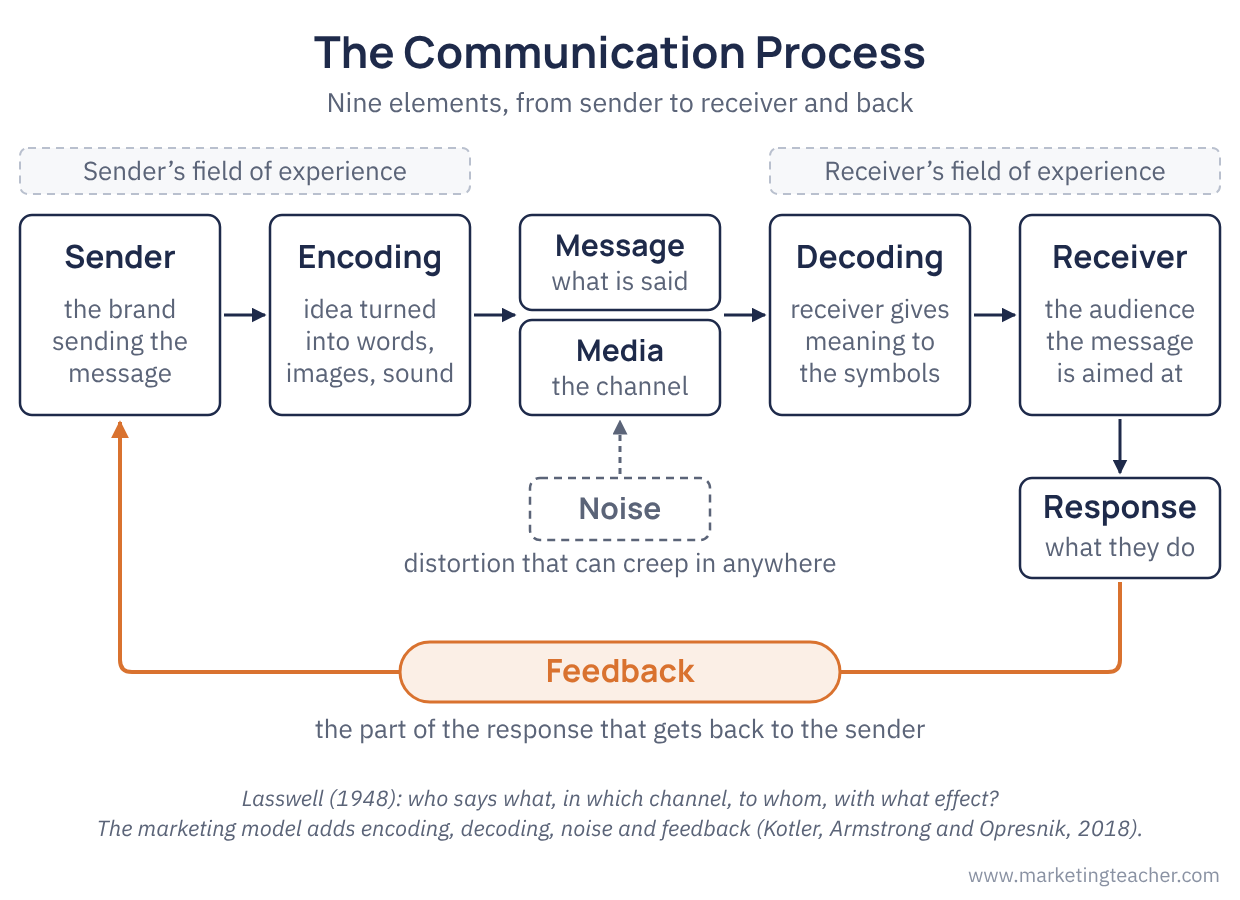
The model sets out nine elements, grouped into three types. Two are the parties in the exchange:
- Sender – the party sending the message (the brand or organisation).
- Receiver – the party the message is aimed at.
Two are the tools used to carry it:
- Message – the actual set of words, images and sounds transmitted.
- Media – the channels the message travels through, such as television, a search ad, or a shop window.
Four are the functions that do the actual work of communicating:
- Encoding – turning an idea into symbolic form (words, pictures, sound).
- Decoding – the receiver assigning meaning to those symbols.
- Response – whatever the receiver does, thinks or feels after being exposed to the message. Models such as AIDA break this response into stages.
- Feedback – the part of that response that gets reported back to the sender.
The ninth element, noise, is the unplanned static or distortion that can creep in anywhere along the chain, so that the receiver ends up with a different message from the one the sender actually sent.
Where Communication Breaks Down: Noise and the Feedback Loop
Two elements of the model do most of the explanatory work when a campaign underperforms. The first is noise. It is not limited to literal interference like a bad signal — a crowded ad break, a distracting background, or simply a message that does not match what the audience already expects all count as noise, because each one changes what the receiver ends up decoding. The second is the gap between encoding and decoding. A message is encoded well when the sender’s choice of words and images overlaps with the receiver’s own field of experience; an advertising copywriter from one background writing for a very different audience is a common way this overlap breaks down, however polished the message looks on its own terms.
Feedback is also where the model has changed most since Lasswell’s time. In 1948, feedback mostly meant slow, indirect signals: sales figures weeks later, or the occasional letter. Today a brand can watch comments, shares and complaints arrive within minutes of a message going out, which is exactly why Kotler, Armstrong and Opresnik (2018) stress that modern marketers increasingly need to flip the process and become good receivers of messages their own customers send back, not only senders of their own.
Summary
The communication process model turns “sending a message” into nine distinct, checkable steps: a sender encodes a message and sends it through media to a receiver, who decodes it and responds, part of that response coming back as feedback, while noise can distort the signal at any point along the way. The idea traces back to a much simpler formula; the marketing version keeps that shape but adds the encoding/decoding split and the feedback loop that let a marketer actually diagnose a campaign rather than just describe it afterwards. Used well, the model is less a piece of theory and more a short checklist: know your receiver’s field of experience, encode for it deliberately, choose media that will actually reach them, and build a real feedback channel so you find out what happened rather than assuming it worked.
The slides, worksheet, lesson plan and poster for this lesson are free to download and free to use in your course — no sign-up, no permission needed. See the teacher resources →
Assign this lesson to your class:
Using Canvas, Blackboard or Moodle? Copy the link and paste it into your course page or assignment. More ways to add lessons to your LMS.

