
What Are Marketing Communications?
Marketing communications is the element of the marketing mix concerned with how a business tells its target audience about its products, services and brand (Fill, 2009). Where the rest of the marketing mix, price, product and place, shapes what is being offered and how it reaches the customer, marketing communications, sometimes shortened to “promotion”, is the piece concerned specifically with the message itself and how it is delivered.
The Marketing Communications Mix
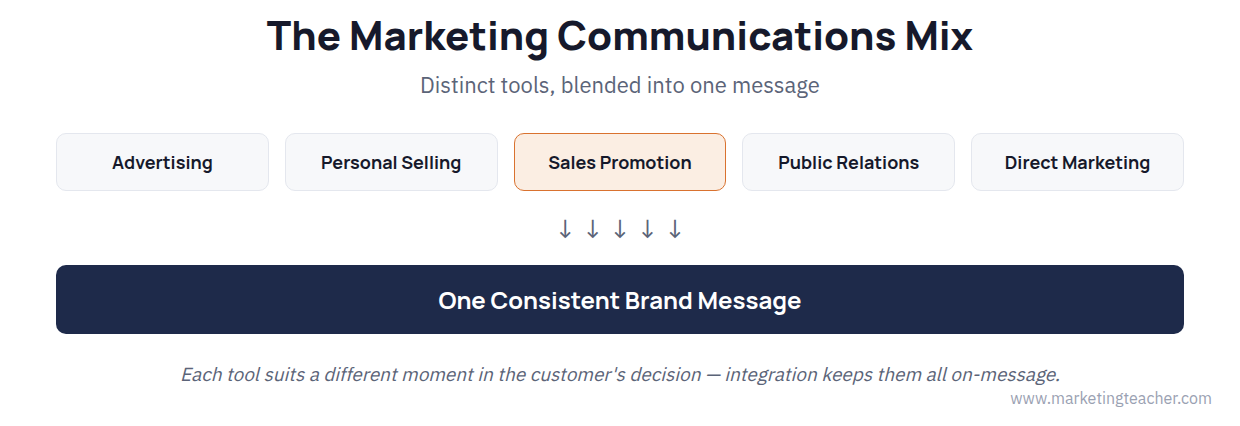
Marketing communications is not one single activity but a mix of several distinct tools, blended in different proportions depending on the campaign and the audience (Belch and Belch, 2021). Advertising reaches a mass audience through paid media. Personal selling uses direct, one-to-one contact to close individual sales. Sales promotion offers a short-term incentive, a discount, a competition, a free sample, to prompt an immediate purchase. Public relations builds and protects reputation through unpaid, third-party coverage rather than paid media space. Direct marketing communicates with named individuals directly, by post, email or phone, rather than through a mass channel. Sponsorship, packaging, merchandising and trade fairs and exhibitions add further channels through which a brand’s message reaches its audience, each suited to a different situation and budget.
Why Integration Matters
Integrated marketing communications means combining the elements of the mix into one coherent whole, so that every channel carries a consistent message, rather than a set of disconnected activities that happen to run at the same time (Fill, 2009). A customer does not experience a brand’s advertising, packaging and sales promotions as separate departments’ work; they experience them as one brand, and inconsistency between channels, different claims, different visual identity, a different tone, confuses that impression and can quietly damage trust. A well-known example of consistent integration is a brand that keeps the same core visual identity and emotional theme running across television, print and point-of-sale material for years at a time, so that any single touchpoint reinforces rather than dilutes the others.
Choosing the Right Mix
There is no fixed formula for how much of each element to use; the right blend depends on the product, the budget, and the stage of the customer’s decision the campaign is aimed at. A new, unfamiliar product often leans on advertising and public relations to build initial awareness, since a customer must know a product exists before anything else can work. A product with lower awareness barriers but slower repeat purchase might lean more heavily on sales promotion and direct marketing to convert existing awareness into actual sales. Some elements also genuinely overlap in practice; whether donating computers to schools in exchange for shoppers collecting vouchers counts as public relations or sales promotion is a fair question, and many real campaigns deliberately blur the line between the two to get the benefits of both.
Who Owns the Message
Because the mix spans so many different specialisms, from media buying to copywriting to customer-list management, marketing communications work is often split across several teams or external suppliers, an advertising agency for media and creative, an in-house team for direct marketing, a specialist consultancy for public relations. Splitting the work this way brings in genuine expertise for each channel, but it also raises the risk that the integration point above breaks down in practice, since no single supplier automatically sees the whole picture. Many businesses solve this by appointing one internal owner, often a marketing communications or brand manager, whose job is specifically to check that every supplier’s output still reads as one consistent brand before it goes out, rather than assuming integration will happen on its own simply because everyone was given the same brief.
Measuring Whether It Worked
Each element of the mix is usually judged against a different measure, reach and recall for advertising, conversion rate for a sales promotion, media coverage and sentiment for public relations, open and response rates for direct marketing, which makes it tempting to judge the whole campaign channel by channel. A more useful approach ties every element back to the same overall communications objective set at the start, whether that is building awareness of a new product, shifting a brand’s image, or driving a specific sales target within a set period, so that the mix as a whole can be judged against one shared goal rather than several disconnected ones.
Summary
Marketing communications is the “promotion” element of the marketing mix, made up of several distinct tools that each suit a different part of the customer’s decision (Belch and Belch, 2021). Integrating these elements into one coherent, consistent message across every channel, rather than treating them as separate activities, is what turns a set of individual campaigns into a genuine marketing communications strategy (Fill, 2009).
The slides, worksheet, lesson plan and poster for this lesson are free to download and free to use in your course — no sign-up, no permission needed. See the teacher resources →
Assign this lesson to your class:
Using Canvas, Blackboard or Moodle? Copy the link and paste it into your course page or assignment. More ways to add lessons to your LMS.

