
What Is the Business Buyer Decision Process?
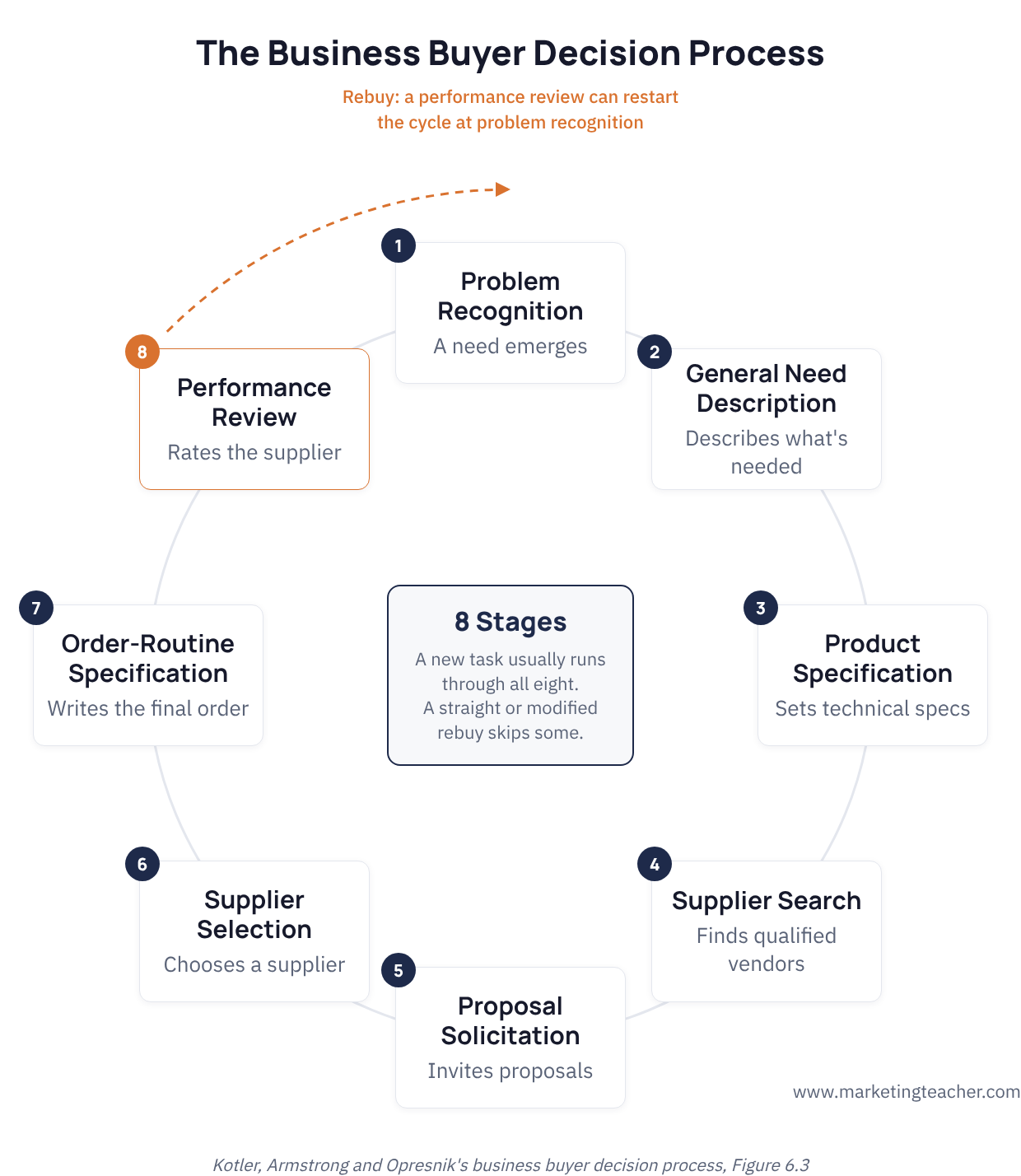
Every organisational purchase, from a box of printer paper to a hospital’s first MRI scanner, moves through some version of the same underlying sequence. Kotler, Armstrong and Opresnik (2018) call it the business buyer decision process: eight stages running from a buyer first recognising a problem through to reviewing a supplier’s performance once the order has been delivered. A buyer facing a complex, unfamiliar purchase usually works through every stage; a buyer reordering something routine often skips straight past several of them. It sits at the centre of business-to-business marketing, and has a consumer-side cousin too: the five-stage buyer decision process an individual shopper works through on their own purchases.
The eight-stage sequence itself is older than Kotler’s textbook. Marketing academics Patrick J. Robinson, Charles W. Faris and Yoram Wind first mapped it as the “buyphases” half of their wider buygrid framework, which crossed these same stages against the three buying situations — straight rebuy, modified rebuy and new task — explored in the previous lesson on buying situations (Robinson, Faris and Wind, 1967). The two framings agree on what the eight stages are; where they differ is emphasis. Kotler, Armstrong and Opresnik (2018) present the eight stages mainly as a simple flow, stage one through stage eight. Robinson, Faris and Wind’s (1967) original grid insists the stages always be read alongside the buying situation, since a straight rebuy can compress all eight into a single afternoon while a genuine new task can stretch them out over months of internal debate.
The Eight Stages, Step by Step
The process opens with problem recognition, the stage at which someone inside the business notices a need that buying something could solve — triggered internally by a machine breaking down or a new product line being planned, or externally by a trade show, a sales call or a rival’s new offer (Kotler, Armstrong and Opresnik, 2018). Once the need is confirmed, the buyer moves to general need description, roughing out what is needed and how much of it, before product specification pins down the exact technical requirements, often worked out with engineers or outside consultants using value analysis to keep costs down. The buyer then runs a supplier search to shortlist qualified vendors, before moving into proposal solicitation, where it invites those vendors to submit a formal written proposal or presentation (Kotler, Armstrong and Opresnik, 2018).
The buying centre reviews what comes back during supplier selection, rating each vendor against attributes such as quality, reliability and price before choosing one supplier or several. Order-routine specification then turns that choice into a final order, listing technical specifications, quantities, delivery dates, returns and warranties. Finally, performance review closes the loop: the buyer rates how the supplier actually performed, a judgement that can lead it to continue, renegotiate or drop the relationship entirely (Kotler, Armstrong and Opresnik, 2018).
Digital Tools Are Reshaping the Later Stages
The later stages of the process are changing fastest. Kotler, Armstrong and Opresnik’s (2018) own example of a business alerting buyers to a problem — a 2016 print-and-display ad campaign — has aged into a reminder of how recently digital buying has taken over. Business software vendor SAP and the consulting firm Capgemini now offer an AI “agent network” that evaluates incoming RFQ responses for a buyer: specialist agents score each proposal on cost, supply-chain risk and delivery reliability, pulling data from multiple internal systems and leaving an audit trail for every decision, cutting claimed RFQ cycle times by up to 70% (SAP and Capgemini, 2026). That speeds up exactly the stages — proposal solicitation, supplier selection, order-routine specification — that used to depend on a purchasing team working through supplier paperwork by hand.
Digital tools do not suit every stage equally, though. Research by Andersson, Aagerup, Svensson and Eriksson (2024) into the digitalisation of the B2B customer journey finds that automated digital marketing works best for straight rebuys, where the buyer already knows what it wants, while genuine new-task purchases still call for personal selling — a human salesperson handling the buyer’s unfamiliar, higher-stakes questions. In other words, which stages a digital tool can usefully take over still depends on the buying situation the purchase falls into in the first place.
Summary
The business buyer decision process breaks an organisational purchase into eight stages: problem recognition, general need description, product specification, supplier search, proposal solicitation, supplier selection, order-routine specification and performance review (Kotler, Armstrong and Opresnik, 2018). The framework traces back to Robinson, Faris and Wind’s (1967) original buygrid model, which paired these same stages with the buying situation covered in the previous lesson. A buying centre works through every stage on a genuine new task, but compresses or skips stages on a rebuy — and, increasingly, digital tools are taking over the stages that suit automation while personal selling still carries the stages that do not.
The slides, worksheet, lesson plan and poster for this lesson are free to download and free to use in your course — no sign-up, no permission needed. See the teacher resources →
Assign this lesson to your class:
Using Canvas, Blackboard or Moodle? Copy the link and paste it into your course page or assignment. More ways to add lessons to your LMS.

