
What Are the Stages of Internationalisation?
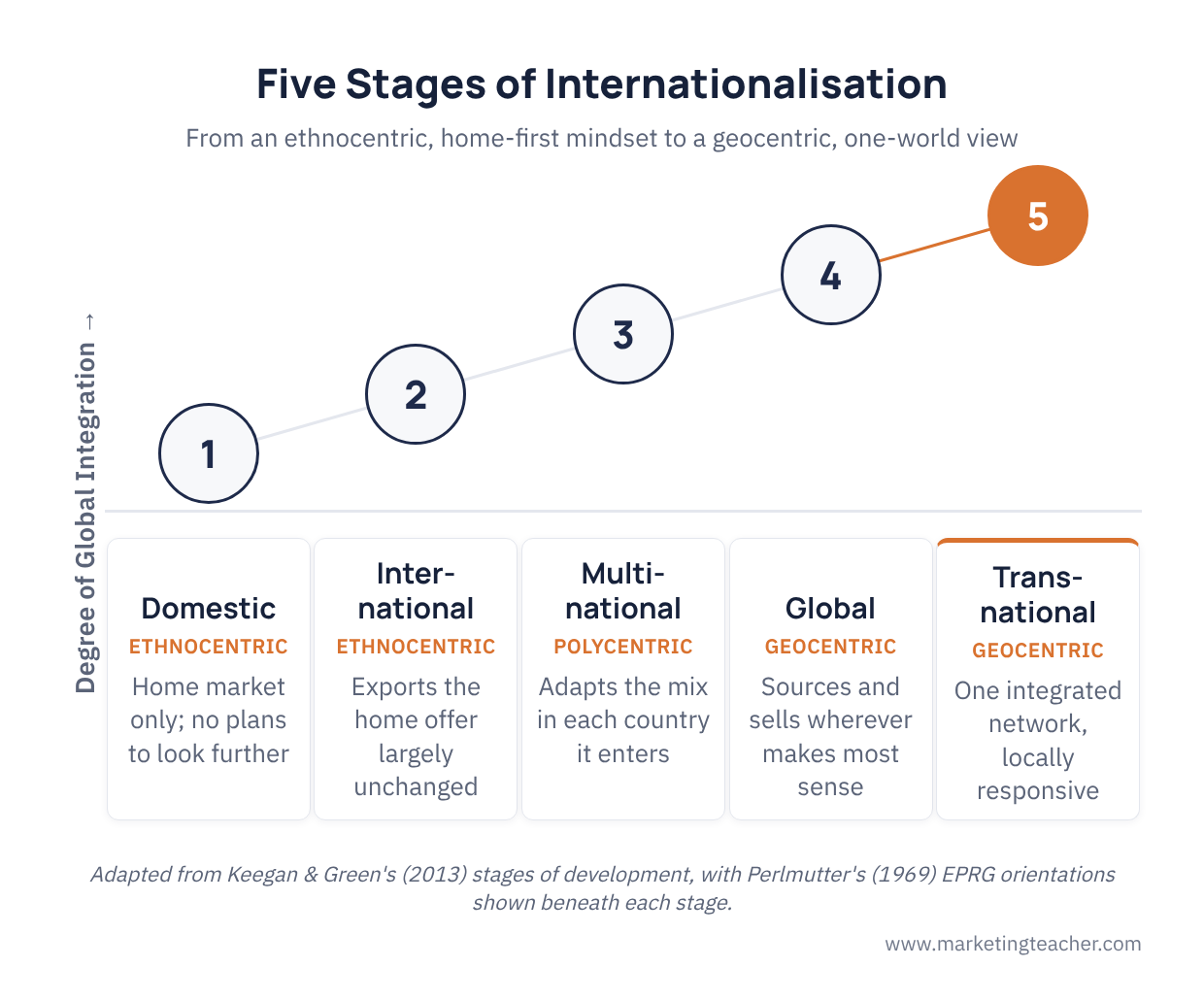
No company wakes up global. Most work through a recognisable sequence of stages as the share of the business done outside the home country grows — and, more importantly, as management’s own assumptions about the world change with it. Keegan and Green (2013) describe this as a shift from an ethnocentric worldview, where whatever works at home is assumed to work everywhere, through to a geocentric one, which treats international marketing as a single world market made up of similarities and differences to be understood on their own terms. The five stages below — domestic, international, multinational, global and transnational — follow that shift one step at a time.
Stage One: Domestic
A domestic company’s planning, environmental scanning and ambitions all stay inside the home market. If it isn’t happening at home, as far as the company is concerned, it isn’t happening at all. This is not a mistake to be corrected — a large home market can support a very successful business built this way. UK bakery chain Greggs is a well-known example: its growth has come almost entirely from opening more shops across the UK, not from expanding overseas, built on convenience, price and a trusted brand at home.
Stage Two: International
A company becomes international once it starts selling outside its home country, usually by exporting what already works at home largely unchanged. Management typically stays ethnocentric at this point, grouping the new activity into a single international division and pursuing a strategy of extension rather than adapting the offer to each market. This is also where Howard Perlmutter’s (1969) EPRG framework begins: his observation that a firm’s management holds an ethnocentric, polycentric, regiocentric or geocentric orientation toward the world, and that this orientation shapes how expansion actually unfolds far more than company size does.
For most of its history, BYD was a domestic Chinese battery and car maker selling almost entirely to Chinese buyers. That changed fast. By 2025, BYD’s overseas sales had passed one million vehicles for the year, with December exports alone up 145% on the year before (Gasgoo, 2026) — and the company is no longer just exporting China-built cars. It now assembles vehicles locally in Thailand and Brazil, adapting models to each market’s own tastes and regulations, and is building a $1 billion, 150,000-vehicle plant in Indonesia alongside a European base in Hungary. In a few years, BYD has moved from a purely domestic company through international exporting to a genuinely multinational, locally-adapting one — with global ambitions clearly next.
Stage Three: Multinational
Companies that stay in international markets long enough usually learn that one product and one pitch do not fit every market equally well. A multinational company adapts its marketing mix country by country, typically run by local or regional managers with real autonomy — a polycentric orientation, in Perlmutter’s own terms. Toyota’s own early US history makes the point: its first export, the 1958 Toyopet, was dismissed by American reviewers as underpowered and unsuited to US roads, and Toyota had to rebuild its whole US line-up around what American drivers actually wanted, rather than what had already sold well at home.
Stage Four: Global
A global company treats where it makes something and where it sells it as two separate questions, sourcing from wherever is most efficient and selling wherever the opportunity is largest, rather than tying production to one country. Some global companies supply the world from a single domestic base; others source globally to supply a domestic market instead — how a firm enters a market in the first place often decides which path is open to it. Either way, the defining shift from stage three is not geography but discipline: decisions about standardising or adapting the offer, across every element of the 7-P framework for international marketing, are made from research into what markets actually need, not from habit.
Stage Five: Transnational
A transnational company goes further still. Rather than choosing between one global strategy and many local ones, it tries to run both at once — adapting to genuine local differences while sharing knowledge, technology and investment across the whole business as a single integrated network (Bartlett & Ghoshal, 1989). Caterpillar’s machinery business is a working example: components are made in several countries, shipped to assembly plants elsewhere, and the finished machines sent on to yet other markets, with engineering knowledge shared worldwide rather than held at head office. This also connects back to the international marketing environment a firm has to read in every market it touches — a transnational company is simply reading many of these environments at once, and acting on all of them together.
Summary
Companies tend to internationalise through five recognisable stages — domestic, international, multinational, global and transnational — each marked less by how many countries a company sells in than by a shift in mindset, from an ethnocentric assumption that home knows best, through a polycentric respect for local difference, to a geocentric view that treats the whole world as one interconnected market. There is no single “right” stage to reach. A domestic company like Greggs can thrive without ever leaving its home market, while others, like BYD, move through several stages within a single decade. What the model offers is a way of naming where a company’s current strategy actually sits, and what kind of decision — extend, adapt, or integrate globally — is driving it.
The slides, worksheet, lesson plan and poster for this lesson are free to download and free to use in your course — no sign-up, no permission needed. See the teacher resources →
Assign this lesson to your class:
Using Canvas, Blackboard or Moodle? Copy the link and paste it into your course page or assignment. More ways to add lessons to your LMS.

