
What Is Social Media Content Planning?
The Content Marketing Institute defines content marketing as “a strategic marketing approach focused on creating and distributing valuable, relevant, and consistent content to attract and retain a clearly defined audience — and, ultimately, to drive profitable customer action” (Content Marketing Institute, n.d.). Tuten and Solomon (2018) place content decisions inside the tactical plan: once a brand knows why it is on social media and who it wants to reach, it must decide what to say and how to say it.
The two views differ in emphasis. The CMI definition is about purpose and audience: content must be valuable and consistent, and must lead to action. Tuten and Solomon are about process: content is one decision in a chain that starts with objectives. Content planning brings the two together. It turns a brand’s goals into a repeatable system for deciding what to publish, where and when.
This lesson builds on two earlier lessons. Tactical Planning: The Five Questions covers the content mix, hygiene/hub/hero content and the basics of a content calendar. The Publishing Zone explains the content value ladder. Here we focus on the practical craft: pillars, formats, hooks, hashtags, algorithms and repurposing.
Content Pillars
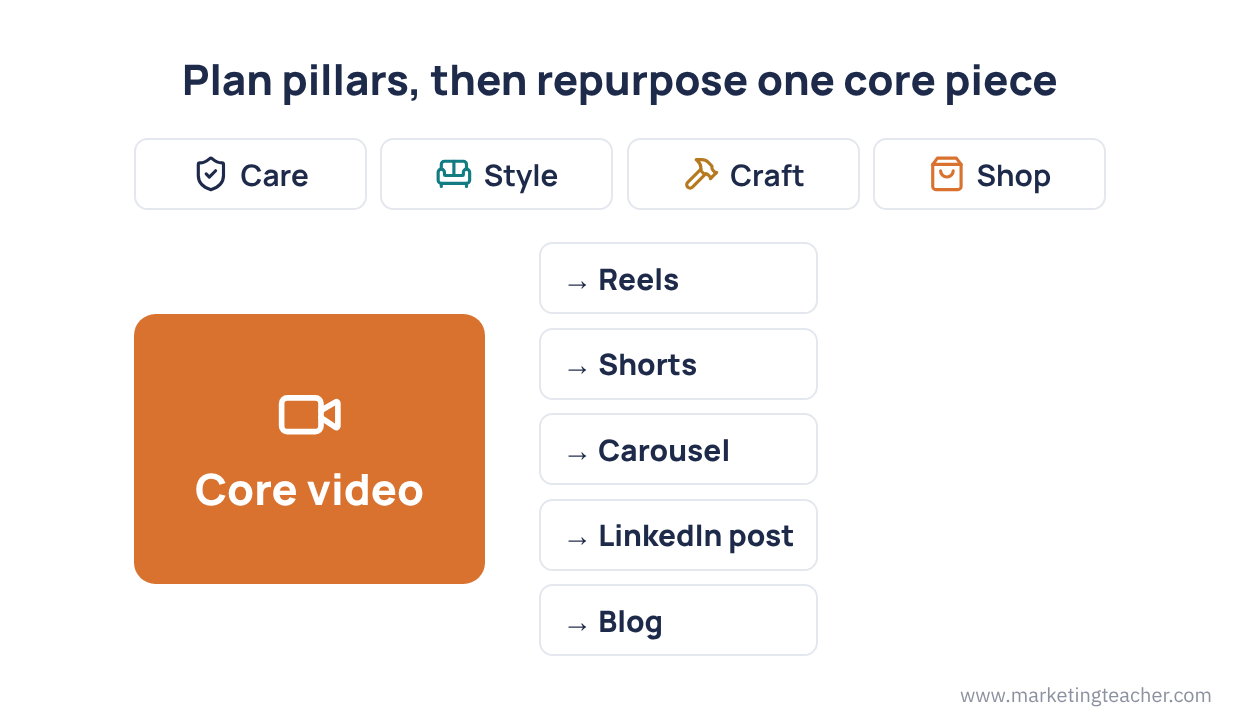
Content pillars are the three to five recurring themes a brand posts about. They keep content consistent and on-brand, and they make planning easier, because every idea must fit a pillar.
Good pillars sit where three things overlap: what the audience cares about, what the brand knows, and what supports the business objective. A useful mix includes:
- Educate: tips, guides and how-tos.
- Inspire: ideas, stories and aspirational images.
- Connect: behind the scenes, team and community.
- Sell: products, offers and launches.
Each pillar should then be planned into a calendar so that no single theme dominates. Research on Facebook brand posts by Lee, Hosanagar and Nair (2018) supports this balance. Posts with humour, emotion or brand personality earned more likes, comments and shares. Posts that only gave prices and deals earned less engagement, though deals did drive more clicks towards buying.
Platform Formats, Hooks and Copy
The same idea must be shaped differently for each platform. Short vertical video suits TikTok, Instagram Reels and YouTube Shorts. Carousels and still images work well on Instagram and LinkedIn. Longer text posts suit LinkedIn, and longer videos suit YouTube.
Whatever the format, the opening matters most. A hook is the first line of text or the first seconds of a video, designed to stop the scroll. Common hooks include:
- A question: “Why does your duvet feel flat by March?”
- A surprising fact or claim, as long as it is true.
- A promise: “Three ways to style a bed in under a minute.”
- Showing the result first, then explaining how.
After the hook, good social copy is short, written in the brand’s voice, and ends with one clear call to action. Put the key point early, because captions are often cut off after a line or two.
Hashtags help people and platforms understand what a post is about. TikTok, for example, lists captions, sounds and hashtags among the “video information” it uses for recommendations (TikTok, 2020). Use a few specific, relevant hashtags rather than long lists of generic ones, and create a branded hashtag if you want to collect customer content.
How Algorithms Affect Organic Reach
Organic reach is the number of people who see a post without paid promotion. On most platforms, an algorithm decides this.
Instagram’s head, Adam Mosseri (2023), explains that Instagram has no single algorithm. Feed, Stories, Explore and Reels each have their own ranking. These rankings use signals such as the viewer’s past activity, information about the post and its popularity, and the viewer’s history with the account. The system then predicts how likely the viewer is to watch, like, comment on or share the post. TikTok (2020) says that follower count is not a direct factor in its recommendations, and that a strong signal, such as watching a longer video to the end, counts for more than a weak one.
The practical lesson is that engagement and watch time drive reach. Content that people watch fully, save, share or reply to will be shown to more people. Content that people scroll past will not. This is why hooks matter so much. To check what is working, use the methods in Social Media Metrics: The DATA Framework.
Repurposing Content
Repurposing means turning one strong piece of content into several pieces for different platforms. (The tactical planning lesson calls breaking content into smaller parts “atomization”.) For example, one long YouTube tutorial can become three short clips, a carousel of key tips, a LinkedIn post about the process and a blog article.
Repurposing saves time and lets a brand reach different audiences with the same core idea. Always adapt rather than copy: change the length, aspect ratio, caption and hook to suit each platform.
Summary
Content planning turns a social media strategy into a working publishing system (Content Marketing Institute, n.d.; Tuten & Solomon, 2018). Content pillars keep posts consistent and balanced, and evidence suggests that emotional, personality-led posts earn more engagement than price-only posts (Lee et al., 2018). Each idea must be adapted to the platform’s format and open with a strong hook. Hashtags should be few and relevant. Because algorithms reward watch time and engagement, attention-earning content reaches more people organically (Mosseri, 2023; TikTok, 2020). Finally, repurposing gets more value from every good idea.
The slides, worksheet, lesson plan and poster for this lesson are free to download and free to use in your course — no sign-up, no permission needed. See the teacher resources →
Assign this lesson to your class:
Using Canvas, Blackboard or Moodle? Copy the link and paste it into your course page or assignment. More ways to add lessons to your LMS.

