
What Do We Mean by Social Media, and Why Does It Keep Changing?
Before looking at trends, it helps to be clear about what is changing. Kaplan and Haenlein (2010) define social media as a group of internet-based applications, built on the ideas and technology of Web 2.0, that allow the creation and exchange of user-generated content. Tuten (2024) offers a broader definition: social media are the online means of communication, conveyance, collaboration and cultivation among interconnected and interdependent networks of people, communities and organisations, enhanced by technological capabilities and mobility. She then defines social media marketing as the use of social media to facilitate exchanges between consumers and organisations.
The two definitions of social media differ in emphasis. Kaplan and Haenlein focus on the technology and the content that users create. Tuten focuses on people and networks, and adds mobility. That difference matters for this lesson. Most of the trends below are not about new technology at all. They are about people changing where, how and with whom they communicate.
Social media is now close to universal. DataReportal (2026) reports 5.81 billion social media user identities worldwide in October 2026, about 69.9 percent of the world’s population. It notes that “user identities” may not equal unique people, because one person can hold several accounts. Growth has slowed to 2.7 percent a year, so the big changes now are in behaviour rather than in raw numbers.
Trends in How People Find and Watch Content
Social search. Many people, especially younger users, now search inside social platforms rather than starting on a search engine. Tuten (2024) lists social search queries on social networks as one of the tools consumers use at the information-search stage of the buying decision. For marketers, this means captions, spoken words in videos, hashtags and profile text all work like keywords.
Short-form video dominance. Short vertical video now shapes most large platforms. In the UK, TikTok reached 27.3 million adults in May 2025, 56 percent of online adults, up 14 percent in a year (Ofcom, 2025). Meta’s Reels and YouTube Shorts follow the same format. The challenge is that short video rewards constant output, and attention won in a few seconds can be lost just as fast.
AR filters and lenses. Augmented reality (AR) filters let users place branded effects over their own faces or surroundings. Tuten (2024) gives the example of Spotify Wrapped offering a personalised Snapchat Lens based on each user’s “listening personality”. AR works best when the effect is fun to share, not when it is simply an advert in disguise. The site’s separate lesson on metaverse marketing looks at immersive virtual worlds in more depth, and AI in social media is covered in its own lesson in this series.
Trends in How People Buy and Share
Social commerce growth. Social commerce means buying within, or directly from, social platforms, through shoppable posts, in-app shops and live shopping. It shortens the path from seeing a product to buying it. The site’s lesson on the social commerce zone explains how reviews and ratings shape these decisions.
Private and “dark” social. Much sharing now happens in messaging apps, group chats and direct messages, which analytics tools cannot see. Tuten (2024) calls this “dark social”, a term first used by the journalist Alexis Madrigal in 2012. UK data supports the shift towards quieter use. Ofcom (2026) found that 49 percent of adult social media users actively posted, shared or commented, down from 61 percent in 2024. People are still on social media, but more of their real conversation is private.
Trends in Who Holds Power
Decentralised platforms. Threads (launched by Meta in 2023), Bluesky and Mastodon all offer alternatives to X. Mastodon and Bluesky are built on open, decentralised protocols, so no single company controls every part of the network. Their audiences are smaller and more scattered than the big platforms, so most brands treat them as places to test and listen rather than as main channels.
Creator-led brands. Creators increasingly launch their own products and brands, using the audience they have built as a ready-made market. This turns some creators from brand partners into competitors. The next lesson in this series looks at personal branding and the creator economy in detail, and the site’s lesson on influencer marketing covers working with creators.
Evaluating Trends Critically
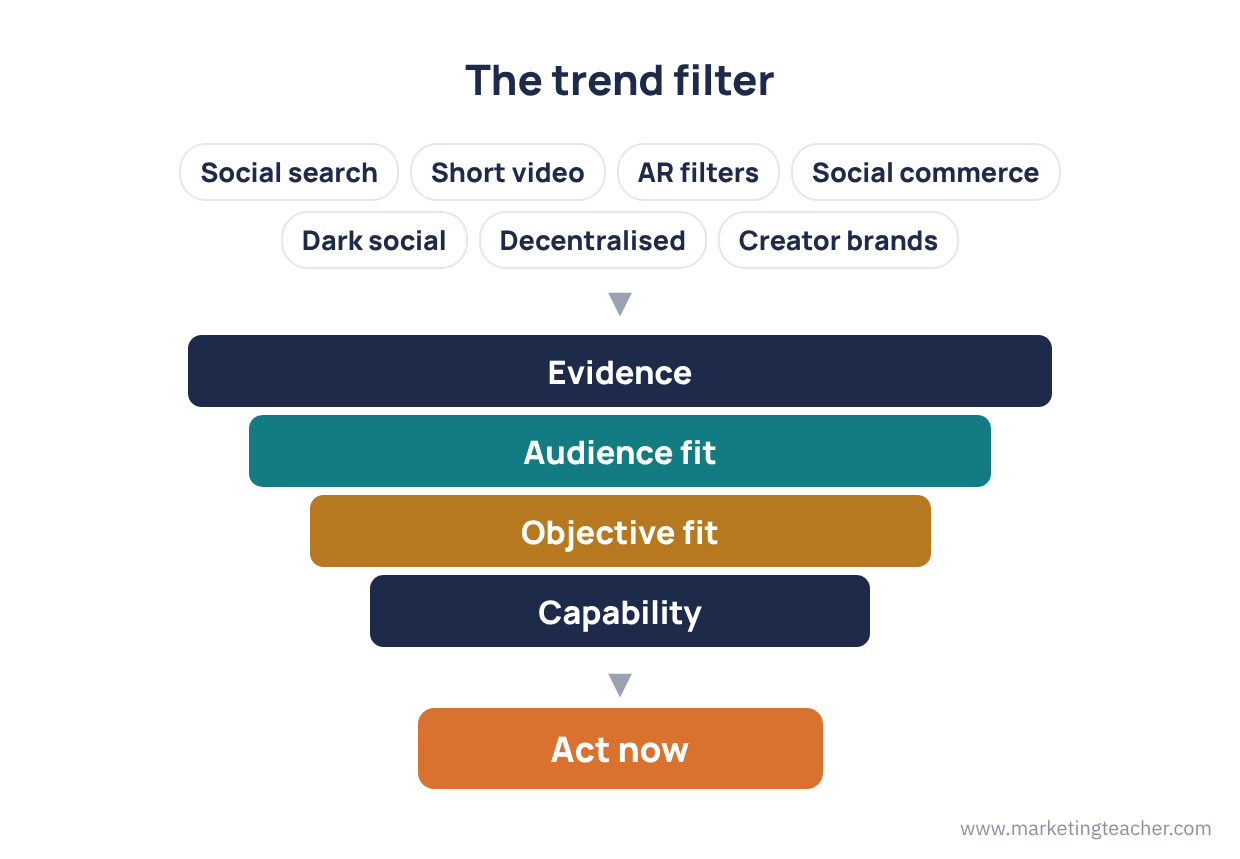
Trend reports are often written by platforms, agencies and tool vendors who benefit from the hype. A useful habit is to ask four questions of any trend.
- Evidence. Is the claim backed by independent data, such as Ofcom, DataReportal or peer-reviewed research, or only by a vendor survey?
- Audience fit. Is our target audience changing its behaviour, or only a different group?
- Objective fit. Which marketing objective would this trend help us meet?
- Capability. Do we have the skills, time and budget to do it well over time?
These questions fit naturally into the situation analysis stage of the seven-step social media strategic planning process. Trends are part of the external environment, alongside competitors and customers, and should be judged in the same disciplined way.
Summary
Social media is now used by about seven in ten people worldwide, so the most important changes are in how people use it rather than how many people use it. Seven trends stand out: social search, short-form video, AR filters, social commerce, private and dark social, decentralised platforms and creator-led brands. Each brings opportunities and risks. Marketers should test every trend against independent evidence, audience fit, objectives and capability before committing budget, and treat trend-spotting as part of an ongoing situation analysis.
The slides, worksheet, lesson plan and poster for this lesson are free to download and free to use in your course — no sign-up, no permission needed. See the teacher resources →
Assign this lesson to your class:
Using Canvas, Blackboard or Moodle? Copy the link and paste it into your course page or assignment. More ways to add lessons to your LMS.

