
Is Television Advertising Right for a Small Business?
Is Television Advertising Right for a Small Business?
Television has always been a distinctive advertising medium because it combines sight, sound and motion in a way most other channels cannot match. Belch and Belch (2012) point to this ability to demonstrate a product in actual use, rather than simply describe or picture it, as one of television’s genuine strengths: a highly visual or innovative product can show exactly what it does and how it benefits a customer, in a way a print advert or a radio spot cannot.
What Television Does Better Than Other Media
Beyond demonstration, television lets an advertiser build an emotional response through music, pacing and storytelling across a short, controlled span of time, and it still reaches very large, broad audiences in a single airing. For a business with a genuinely visual or emotionally driven product, story or brand, these strengths can justify television’s cost in a way they would not for a plainer product that could just as easily be described in text.
Why National Television Is Usually a Stretch for a Smaller Business
The production and airtime costs of a national television campaign put it out of reach for most smaller businesses, and the budget step of a small business advertising plan will usually rule it out immediately. Local and regional television slots, and advertising placements on streaming platforms and connected TV services, bring the same visual and audio strengths at a fraction of the cost, and are a far more realistic starting point for a business testing whether television suits it at all.
The DVR and Streaming Problem: Skipped Adverts
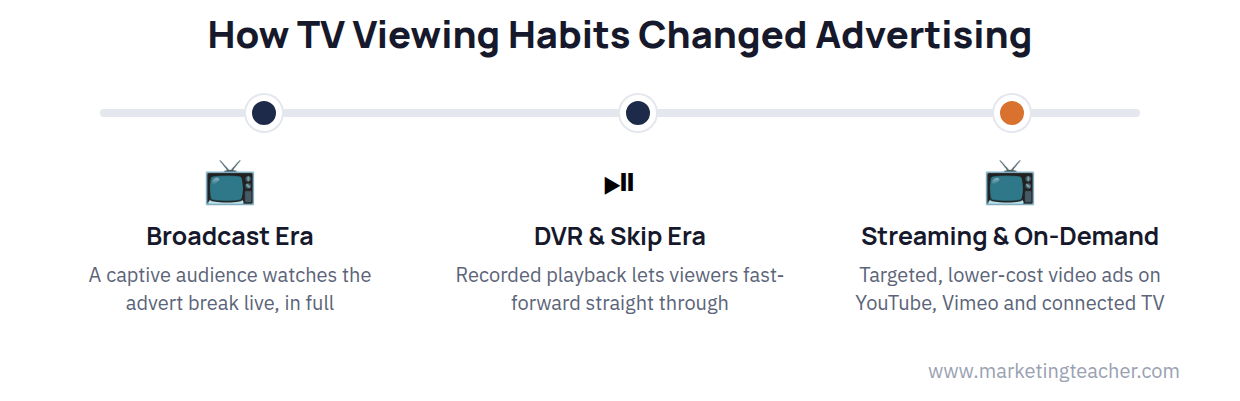
Digital recording and on-demand viewing have changed how audiences actually watch television, and Belch and Belch (2012) identify viewers fast-forwarding through recorded advert breaks as a real challenge for advertisers who assume their message will simply be watched in full. An advert that relies on a slow build-up to reveal its message risks being skipped entirely; opening with the most memorable or recognisable moment in the first few seconds gives an advert a chance of registering even when a viewer is skimming through at speed.
New Opportunities From On-Demand and Online Video
The same technology that lets viewers skip adverts has also opened up new, more accessible ways to advertise on video. Platforms such as YouTube and Vimeo let a business keep an advert running indefinitely rather than paying for a single broadcast slot, and connect it directly to other channels such as the business’s own social media accounts and website. These platforms typically also allow far more precise audience targeting than a broadcast slot, and at a considerably lower cost of entry, which makes video advertising newly accessible to businesses that could never have justified a broadcast television budget.
Alternatives to a Standard Advert Break
A standard advert slot is not the only way onto a screen. Sponsoring a segment of a local programme, arranging a brief product placement within a show a target audience already watches, or partnering with a presenter for a short on-air mention can all reach the same audience while sidestepping the advert-break skipping problem entirely, since a viewer engaged with the programme itself is far less likely to fast-forward through it. These placements are often available at a lower cost than a full advert slot, which makes them worth investigating alongside, or instead of, a conventional advertising spot.
Deciding Whether Television Advertising Fits Your Business
The right test is not whether a business can afford television advertising in the abstract, but whether its product or story genuinely benefits from being seen and heard in motion, rather than simply described. A business selling something highly visual, demonstrable or emotionally resonant has a real case for testing a local, regional or online video placement; a business whose offer is more easily explained in text or a still image is usually better served putting that same budget into a channel built for exactly that.
Summary
Television advertising offers strengths, demonstration, emotion, and mass reach, that Belch and Belch (2012) identify as genuinely unique among media, but its cost and the modern reality of skipped recordings mean a small business needs to think carefully about whether and how it uses the medium. Local and regional broadcast slots, and video advertising on platforms such as YouTube and Vimeo, bring much of television’s strength within reach of a smaller budget, provided the advert itself is built to register quickly rather than assuming a captive, patient audience.

