
What Is the Social Entertainment Zone?
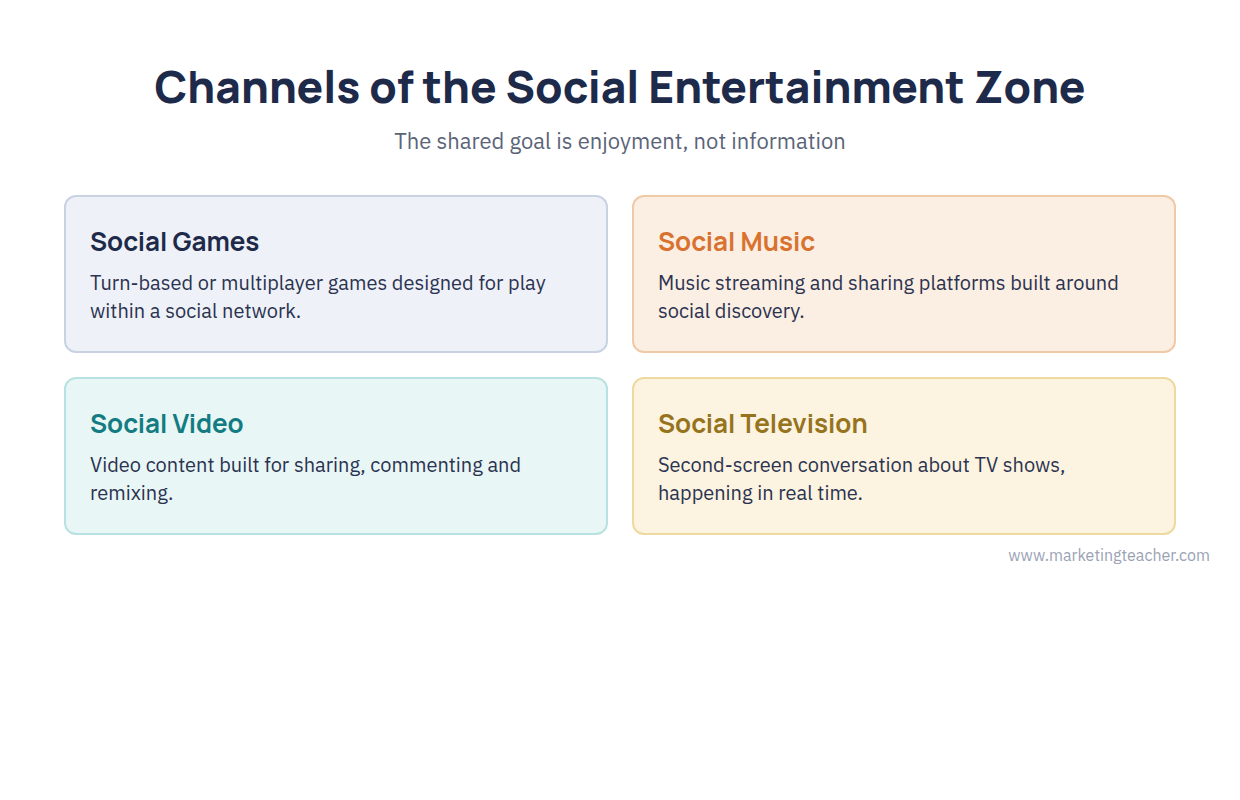
Tuten and Solomon (2018) define the social entertainment zone as events, performances, and activities experienced and shared through social media, designed purely to provide pleasure and enjoyment. Where social publishing (see Lesson 7) is oriented around knowledge-sharing, social entertainment is oriented around entertainment-sharing — the same digital, participatory, and shareable qualities, but aimed at fun rather than information. The zone spans social games, social music, social video, and social television, and brands can engage with any of them along a continuum from low investment (buying advertising space around existing entertainment) through sponsorship and product integration to high investment (building entirely original, branded entertainment).
Why Do People Actually Engage With Social Entertainment?
Tuten and Solomon (2018) frame social entertainment through the lens of play, identifying four motivations that draw people in: power (a competitive challenge to win or master), identity (self-expression that signals interests and affiliations, particularly relevant to social music and film), fantasy (creative, imaginative escape), and frivolity (simple, low-stakes fun). Understanding which of these motivations a given audience is chasing helps a brand choose an entertainment format that actually fits rather than fighting against what people came there to do.
Social Games: The Largest Slice of Social Entertainment
Tuten and Solomon (2018) describe a social game as a multi-player, goal-oriented activity with defined rules and online connectivity that lets a community of players interact with each other, typically featuring leaderboards, achievement badges, and friend lists. Games are broadly split into casual games (low barrier to entry, short sessions, mass appeal) and core games (long sessions, high skill requirements, dedicated audiences), though social platforms have blurred that old divide — today’s casual gamer skews far more mixed by age and gender than the old stereotype of a teenage boy suggests. What makes games especially attractive to marketers is sustained attention: unlike most media, players rarely multitask while gaming, giving a brand message a rare moment of undivided focus.
How Brands Actually Use Social Games
Tuten and Solomon (2018) outline a ladder of options for brands entering social games. At the lightest touch, around-game advertising appears during loading screens or natural breaks. In-game advertising places branded content inside someone else’s game — as static display ads, short branded mini-games, or dynamic ads served through an ad network. Product placement goes further still, embedding a real brand directly into the game world, from a visible logo in the background (a screen placement) to a character actually using or mentioning the brand (a script placement). At the top of the ladder, a brand can build its own advergame entirely from scratch.
Tuten and Solomon (2018) note that in-game advertising consistently earns stronger engagement than typical online ads — higher click-through rates, higher video completion rates, and stronger recall — in part because value-exchange offers reward players with virtual goods or in-game currency for engaging with a brand, a trade players tend to view positively rather than as an interruption.
Gaming Has Outgrown Its Old Stereotype
Tuten and Solomon (2018) report that a majority of American households now play computer and video games, and the gender split on casual social games no longer skews male the way core gaming once did — women show a particular preference for puzzle and trivia formats, and older female players are one of the fastest-growing segments in casual gaming. This matters for targeting: a brand assuming that “gamers” means young men would miss most of the actual audience for a casual social game. Games also vary enormously in stickiness, the ratio of daily to monthly players, which tells a marketer how habitual play actually is for a given title, and therefore how often a brand message inside it will genuinely be seen.
Brand integration carries some risk alongside its reward. Tuten and Solomon (2018) note that research on in-game brand placements finds recall and recognition are reliably strong, but attitudes toward the brand and the game itself can go either way: players respond well to integrations that feel realistic and consistent with the game’s own world, and respond badly when a brand placement feels forced or purely commercial. The lesson for marketers is the same one that runs through every zone of social media — fit the platform’s own culture, or the audience will notice the mismatch.
Social Music, Video, and Television
The same brand-presence continuum applies across the other three channels. Social music platforms let brands sponsor playlists or artists and tap into the identity-driven motivations of listeners who use music to express who they are. Social video platforms, built for content that is watched, commented on, and reshared, let brands range from simple pre-roll ads to fully original branded video series. Social television captures the modern habit of “second-screen” conversation — people posting and reacting in real time while watching a broadcast — giving brands a live conversation to join rather than just an ad slot to buy.
Summary
The social entertainment zone spans games, music, video and television, unified by a shared goal of enjoyment rather than information. Brands can engage at almost any level of investment, from buying space around existing entertainment to building their own branded games and video, but the strongest results come from integrations that respect why people are playing in the first place (Tuten & Solomon, 2018).

