
This is the suggested answer to the Ansoff’s Matrix exercise on Colorado Ricardo Mountain Bikes. There is no single “correct” answer to this kind of exercise – what matters is that each option sits in the right quadrant and its risk level is justified.
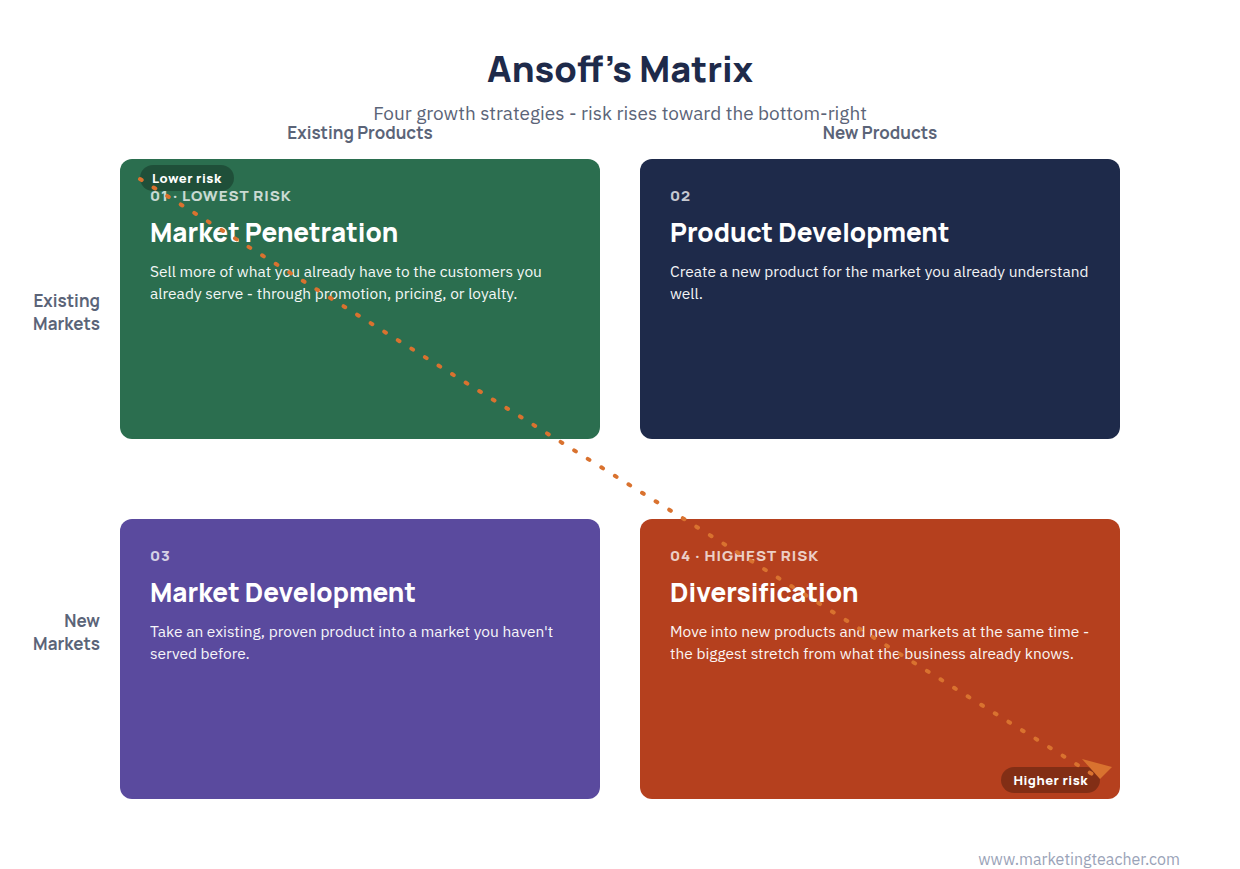
Market Penetration
Colorado Ricardo could sell more of its existing off-road bike to its existing Colorado market – for example through a loyalty or referral scheme for existing riders, more visible sponsorship of local off-road events, or short-term promotional pricing to win back lapsed customers. This is the lowest-risk option: it changes neither the product nor the market, and simply asks the business to compete harder for demand it already understands.
Market Development
The existing off-road bike could be sold into markets Colorado Ricardo does not currently reach – other US states with strong off-road cycling communities, or new customer groups within Colorado such as cycling clubs and bike-hire operators. This carries more risk than penetration, since it means building distribution and brand awareness somewhere new, even though the product itself needs no change.
Product Development
Colorado Ricardo could develop new products for its existing, loyal Colorado market – most obviously an e-mountain-bike version of its off-road frame, or branded apparel and accessories sold to the same riders. This uses the brand’s existing trust and distribution, but it carries real product-development risk and cost, since a new product has to be designed, tested and manufactured before it earns a single sale.
Diversification
The highest-risk option is a genuinely new product for a genuinely new market – for example, a guided off-road cycling tourism business, or a bike-repair franchise sold to other regions. Diversification asks Colorado Ricardo to succeed at something it has no track record in, with no existing customers to fall back on, which is why it is normally treated as a last resort rather than a first choice.
As you can see, there are several strategic options open to Ricardo. As a marketer, you now have to decide which strategy – or combination of strategies – the company should actually pursue. That decision depends on factors such as competitive activity, the resources actually available, and a certain amount of informed judgement. Once you have a shortlist of options, tools such as the Boston Matrix can help track how each one performs against the rest of the business over time.
The slides, worksheet, lesson plan and poster for this lesson are free to download and free to use in your course — no sign-up, no permission needed. See the teacher resources →
Assign this lesson to your class:
Using Canvas, Blackboard or Moodle? Copy the link and paste it into your course page or assignment. More ways to add lessons to your LMS.

