What a Marketing Plan Actually Does
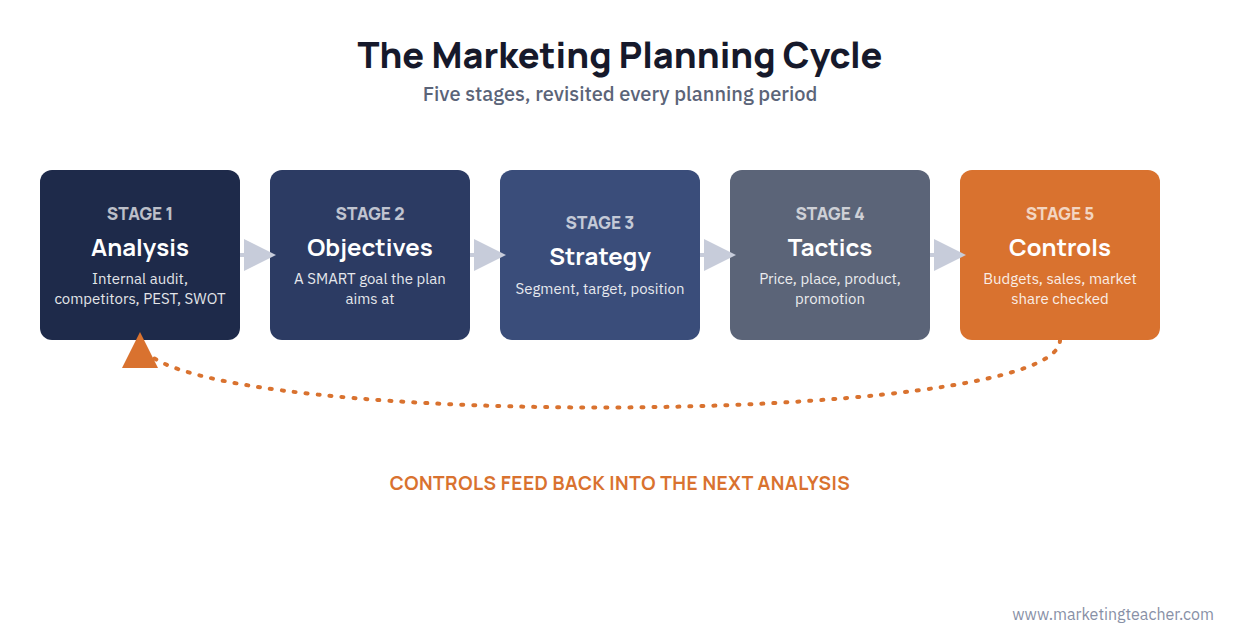
Kotler and Armstrong (2018) describe a marketing plan as a written document setting out how a company intends to achieve its marketing objectives, moving through analysis, objective-setting, strategy, tactics and control in sequence. Each stage depends on the one before it: a strategy chosen before the objective is set has nothing to be judged against, and tactics chosen before the strategy risk activity that looks busy but does not actually move Colorado Ricardo toward anything specific.
Setting a SMART Objective
Worked example
Doran (1981) set out the SMART criteria still used to test a marketing objective today: specific, measurable, achievable, relevant and time-bound. A
SMART objective for Colorado Ricardo’s launch: “Sell 500 e-mountain-bikes within the first six months of launch, generating at least $1.5 million in revenue, without discounting below the planned $2,999 launch price.” This is specific (a named product and revenue figure), measurable (unit sales and revenue can be tracked), achievable (roughly 40% of the original bike’s current annual volume), relevant (directly addresses the declining core business), and time-bound (six months).
Key point
Kotler and Armstrong (2018) frame the marketing plan as a sequence where each stage depends on the one before it. Doran’s (1981) SMART objective gives Colorado Ricardo’s board something concrete to approve, and something concrete to hold the launch team to afterward – which is exactly what a list of good intentions cannot provide.
This objective should be checked against the pricing decision made in the Pricing Strategies exercise, and against the tougher planning conditions covered in the Marketing in a Credit Crunch exercise, which also uses this same Lesson page.
Teaching this topic?
The slides, worksheet, lesson plan and poster for this lesson are free to download and free to use in your course — no sign-up, no permission needed. See the teacher resources →
Assign this lesson to your class:
Using Canvas, Blackboard or Moodle? Copy the link and paste it into your course page or assignment. More ways to add lessons to your LMS.
Online course · certificate on completion
Study a full online course — and earn a certificate
Three courses that turn the free lessons into ordered modules, written at university Levels 4 to 6, with a short quiz after each.


