
What Is Data-Driven Marketing?
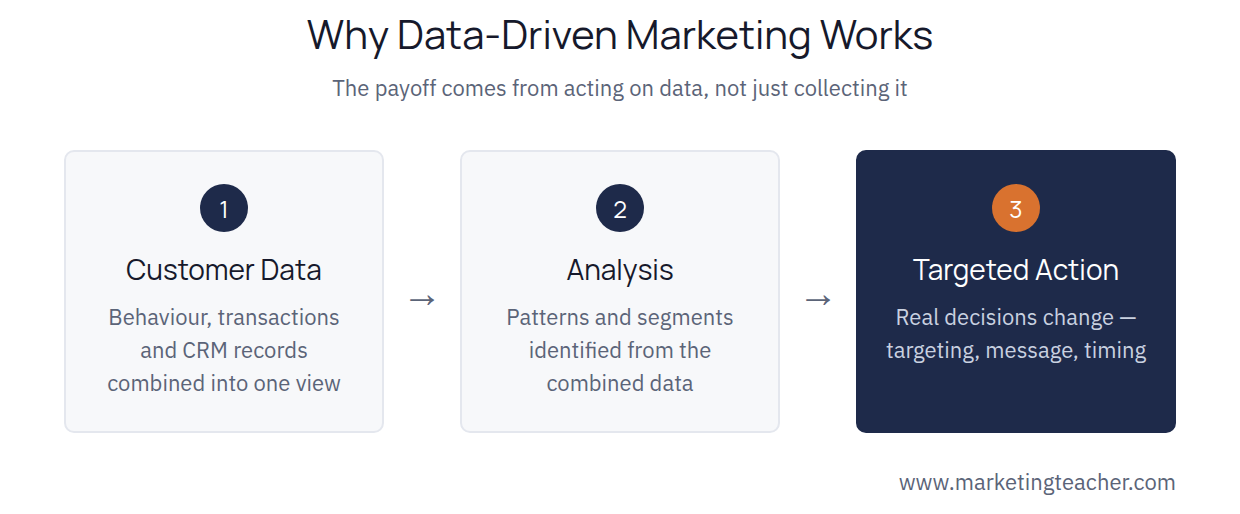
Data-driven marketing is the practice of using data about customer behaviour, preferences and characteristics to guide marketing decisions, rather than relying mainly on intuition or broad, one-size-fits-all messaging. Instead of sending the same offer to an entire customer list, a data-driven approach segments that list by past purchase behaviour, browsing activity or demographic profile, and tailors the message, timing or channel to what the data suggests will work best for each group. The appeal is straightforward, but the payoff isn’t automatic: a study of marketing analytics deployment across firms found that using analytics to guide decisions was associated with meaningfully better business performance, but only for firms that also had the organisational capability to actually act on what the data showed (Germann, Lilien and Rangaswamy, 2013).
Where the Data Comes From
Data-driven marketing typically draws on several sources at once, and the value tends to come from connecting them rather than looking at any single source in isolation. Website and app behaviour shows what people actually do when they interact with a business digitally — pages viewed, products browsed, carts abandoned. Transaction data from past purchases shows what people have actually bought, which is often a stronger predictor of future behaviour than stated preferences. Customer relationship management (CRM) systems tie these signals to an individual customer record over time, and marketing automation platforms use that combined record to trigger the right message at the right moment rather than on a fixed, one-size-fits-all schedule.
Having the Data Isn’t the Same as Using It Well
Collecting data is the easy part; the harder and more decisive part is having the organisational structures to actually act on it. The research on analytics deployment found that the performance benefit of using marketing analytics didn’t show up automatically just because a firm had the data and the tools — it appeared specifically in firms that also had strong analytics-driven decision-making processes in place, meaning the insights actually reached the people who could act on them and were built into real decisions rather than sitting in a dashboard nobody used (Germann, Lilien and Rangaswamy, 2013). A business can own excellent customer data and still market exactly as it always has, if that data never actually changes a targeting or messaging decision.
Testing Keeps Data-Driven Marketing Honest
A data-driven approach isn’t just about segmenting an audience once and moving on — it depends on continually testing whether a given targeting rule or message actually performs better than the alternative. Running two versions of a campaign against comparable groups and comparing the results directly is far more reliable than assuming a data-informed decision was correct just because it was based on data; the data itself can be incomplete, outdated, or simply not predictive of the behaviour a campaign is trying to influence, and testing is what catches that.
Bad Data Is Worse Than No Data
A data-driven decision is only as good as the data behind it, and duplicate customer records, outdated contact information, or inconsistent category tagging can quietly steer a campaign in the wrong direction while still looking rigorous because it’s “based on data.” A customer whose purchase history is split across two duplicate profiles might get miscategorised as a low-value, infrequent buyer when they’re actually a strong repeat customer, leading to exactly the wrong message being sent. Regular data cleaning and validation isn’t a glamorous part of data-driven marketing, but skipping it undermines every decision built on top of that data.
Privacy and Responsible Data Use
Because data-driven marketing depends on collecting and using personal information, it carries a responsibility that a generic, non-personalised campaign doesn’t: customers need to understand what data is being collected and have a genuine ability to opt out, and that data needs to be stored and used in line with applicable privacy regulations. Treating privacy compliance as a box-ticking afterthought, rather than something built into how data is collected and used from the start, is one of the more common ways data-driven marketing programmes run into real legal and reputational trouble.
Summary
Data-driven marketing uses customer behaviour, transaction, CRM and automation data to guide targeting and messaging decisions instead of relying on broad, undifferentiated campaigns. The evidence shows this improves performance specifically for organisations that build analytics into their actual decision-making, not simply for those that collect the most data (Germann, Lilien and Rangaswamy, 2013). Ongoing testing and responsible, transparent handling of customer data are what keep a data-driven approach both effective and trustworthy over time.
The slides, worksheet, lesson plan and poster for this lesson are free to download and free to use in your course — no sign-up, no permission needed. See the teacher resources →
Assign this lesson to your class:
Using Canvas, Blackboard or Moodle? Copy the link and paste it into your course page or assignment. More ways to add lessons to your LMS.

