
How Does the Internet Change Product Decisions?
Product, another of the four elements of the digital marketing mix, does not need a completely new set of tools once a business moves online. Chaffey and Ellis-Chadwick (2019) note that established product tools such as the Product Life Cycle and the Three Levels of a Product still apply directly to a product sold over the internet: an online-only product still moves through introduction, growth, maturity, and decline in the same unpredictable way a traditional product does, and it still has a core benefit, an actual physical or digital form, and an augmented layer of extras such as a warranty or a support subscription. What genuinely changes online is not the tools themselves but the range of businesses now using them, since a brand-new start-up with no trading history can launch a product using exactly the same digital channels as a business that has been operating for decades.
Two Dimensions: The Business and The Product
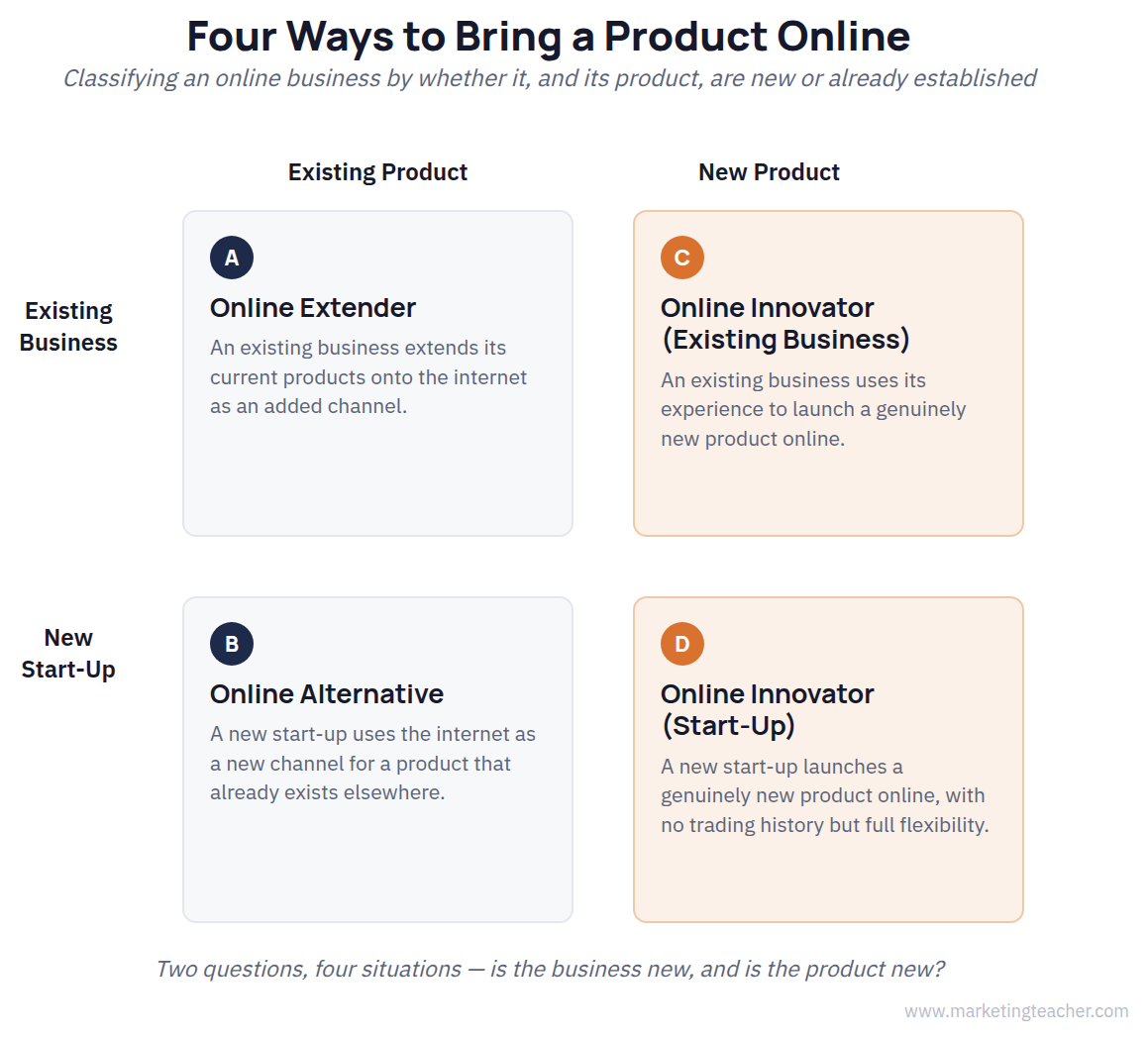
Ansoff (1957) set out a simple but powerful idea for thinking about growth: separate whether something is new from whether it already exists, and look at the combinations. Ansoff applied this to markets and products; the same underlying logic is just as useful for classifying who a business is and what it is selling online. Every business bringing a product to the internet can be placed against two separate questions: is this an existing, already-trading business or a brand-new start-up, and is this an existing product already sold elsewhere or a genuinely new one being launched for the first time. Answering both questions together produces four distinct types of online business, each facing a different mix of advantages and risks.
Four Ways Businesses Bring Products Online
An Online Extender is an existing business that simply extends its current products onto the internet as an additional channel, alongside the traditional channels it already uses. An Online Alternative is a new start-up that uses the internet purely as a new channel for a product that already exists elsewhere, often targeting a market segment, such as a remote or fragmented one, that existing channels serve poorly. An Online Innovator (Existing Business) is an established business that uses its existing knowledge and resources to launch a genuinely new product or service online, benefiting from experience but sometimes moving cautiously. An Online Innovator (Start-Up) is a brand-new business launching a brand-new product online at the same time, with no trading history to fall back on but the flexibility to move quickly and take risks an established business might avoid.
Where the Product/Business Matrix Fits Alongside Other Frameworks
The four-way classification above is a useful audit tool precisely because it sits alongside, rather than replaces, the product tools already in use. Timmers (1998) separately classified e-commerce business models by the function they perform in a market, a reminder that the “existing versus new” question here is only one lens among several a marketer can apply to the same online business. A single Online Innovator (Start-Up), for example, still needs its own Product Life Cycle analysis once its new product is launched, and its own Three Levels of a Product breakdown to plan what core benefit, actual form, and augmentation it will offer, exactly as an Online Extender would for a much longer-established product.
Summary
Digital marketing product decisions build on tools that already exist rather than replacing them: the Product Life Cycle and the Three Levels of a Product apply just as well to a product sold purely online. What the internet adds is a wider range of businesses using those tools, from long-established companies extending existing products online to brand-new start-ups launching entirely new products at the same time as launching the business itself. Classifying a business along the existing/new business and existing/new product dimensions, an application of the same logic Ansoff used for growth strategy, helps identify which of these four situations a marketer is actually in before choosing how to apply the rest of the product toolkit.

The slides, worksheet, lesson plan and poster for this lesson are free to download and free to use in your course — no sign-up, no permission needed. See the teacher resources →
Assign this lesson to your class:
Using Canvas, Blackboard or Moodle? Copy the link and paste it into your course page or assignment. More ways to add lessons to your LMS.

