
What Is a Digital Marketing Situation Analysis?
A situation analysis answers a single question before any digital marketing plan is written: where are we now? Chaffey and Ellis-Chadwick (2019) place this “where are we now” stage at the start of the digital marketing planning process, bridging an internal audit of the business’s own resources and performance with external research into competitors and the wider market. A situation analysis is not simply a traditional marketing audit relabelled for the internet; it specifically considers the fit between a business’s internal digital capability and the external digital environment it is competing in, since a business can have excellent products but a website, mobile experience, or online customer service that badly lags its competitors, or the reverse.
The 5 Ss: A Framework for Assessing Digital Marketing Impact
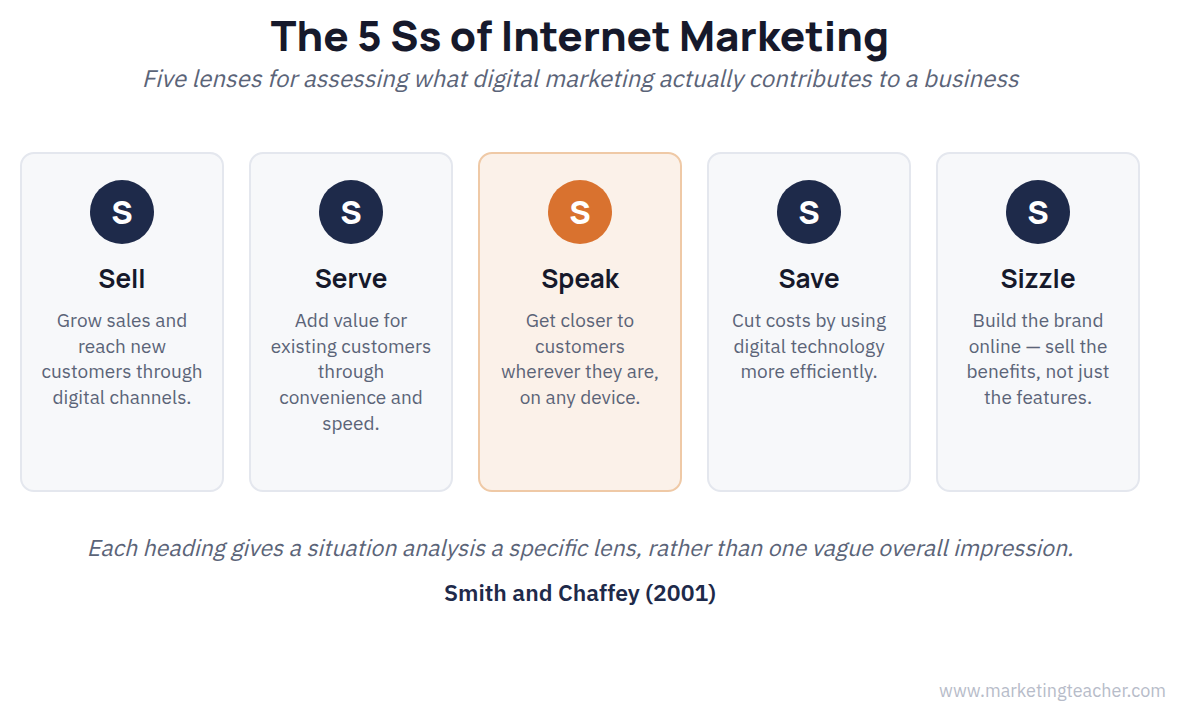
Smith and Chaffey (2001) distilled what digital marketing actually contributes to a business into five headings, widely known as the 5 Ss. Sell covers growing sales and reaching new customers through digital channels. Serve covers adding value for existing customers through the practical benefits of the internet, such as convenience and speed. Speak covers getting closer to customers by making the business reachable wherever they are, at home, at work, or on a mobile device. Save covers reducing costs by using digital technology to make a business more efficient, from automated customer service to lower-cost distribution. Sizzle covers building or extending a brand online, a reminder that a business is still selling the benefits, appeal, and value of a product rather than a bare list of its features, only now through a digital medium. Together the 5 Ss give a situation analysis five separate lenses to check a business’s digital marketing against, rather than one vague overall impression.
Where the Customer Life Cycle and SWOT Fit In
The 5 Ss are not the only tool used at the “where are we now” stage. The Customer Life Cycle (CLC) looks at the products and services a customer needs across their whole relationship with a business, and is market oriented rather than product oriented, focusing on the key stages of that relationship rather than on a single product’s own life span. A SWOT analysis, examining strengths, weaknesses, opportunities, and threats, is a further audit tool commonly applied alongside the 5 Ss and the CLC, since it is flexible enough to apply to almost any business situation. That same flexibility is also its main weakness: a SWOT built too loosely can produce a list of generic points that could apply to almost any company, rather than sharp, prioritised conclusions specific to this one. A Power SWOT, which ranks and weights each point by how important and how urgent it actually is, helps keep the analysis specific enough to be useful for the plan that follows.
From Situation Analysis to a Digital Marketing Plan
None of these tools are an end in themselves; they exist to feed directly into the next stage of planning. Once a business knows its weakest of the 5 Ss, understands where it sits across the Customer Life Cycle, and has a ranked SWOT rather than a generic one, it has a specific, evidenced starting point for setting digital marketing objectives, rather than guessing at priorities. A gym chain that has identified Speak as its weakest heading, for example, now has a clear candidate objective, improving how often and how well it reaches members between visits, that a SWOT or CLC review alone might never have surfaced so precisely. Treating the situation analysis as a first, necessary step rather than a one-off report is what keeps a digital marketing plan grounded in evidence about the business’s actual position, rather than in assumptions about where it probably stands.
Summary
A digital marketing situation analysis bridges internal audit and external research to answer where a business stands right now. The 5 Ss, Sell, Serve, Speak, Save, and Sizzle, give five specific headings to assess digital impact against, rather than one vague impression. The Customer Life Cycle adds a market-oriented view of the whole customer relationship, and a ranked, weighted SWOT analysis turns a flexible but easily generic audit tool into a focused, prioritised starting point for the digital marketing plan that follows.
The slides, worksheet, lesson plan and poster for this lesson are free to download and free to use in your course — no sign-up, no permission needed. See the teacher resources →
Assign this lesson to your class:
Using Canvas, Blackboard or Moodle? Copy the link and paste it into your course page or assignment. More ways to add lessons to your LMS.

