
What Is Digital Marketing Competitor Research?
Digital marketing competitor research is the systematic process of gathering and interpreting information about how rival businesses operate online, so a business can understand its position before deciding where to invest its own digital marketing effort. Porter (1980) established that a clear-eyed analysis of competitors, not just an internal review of a business’s own strengths, is essential to building a defensible strategy, and that principle applies just as directly to a website and a social presence as it does to a factory or a product line. In a digital context this means asking a specific version of Porter’s broader question: where does this competitor rank in search, what does its site do well that ours does not, and how is it winning attention on the channels that matter to our shared audience. Digital competitor research also has one advantage over researching an offline rival: far more of a digital competitor’s behaviour is directly observable. A competitor’s public website, its search rankings, its social posts and the reviews customers leave about it are all visible without any special access, which means even a very small business with no research budget can build a genuinely useful picture of the competitive landscape using nothing more than its own web browser and a little discipline about recording what it finds.
Where to Look for Digital Competitor Intelligence
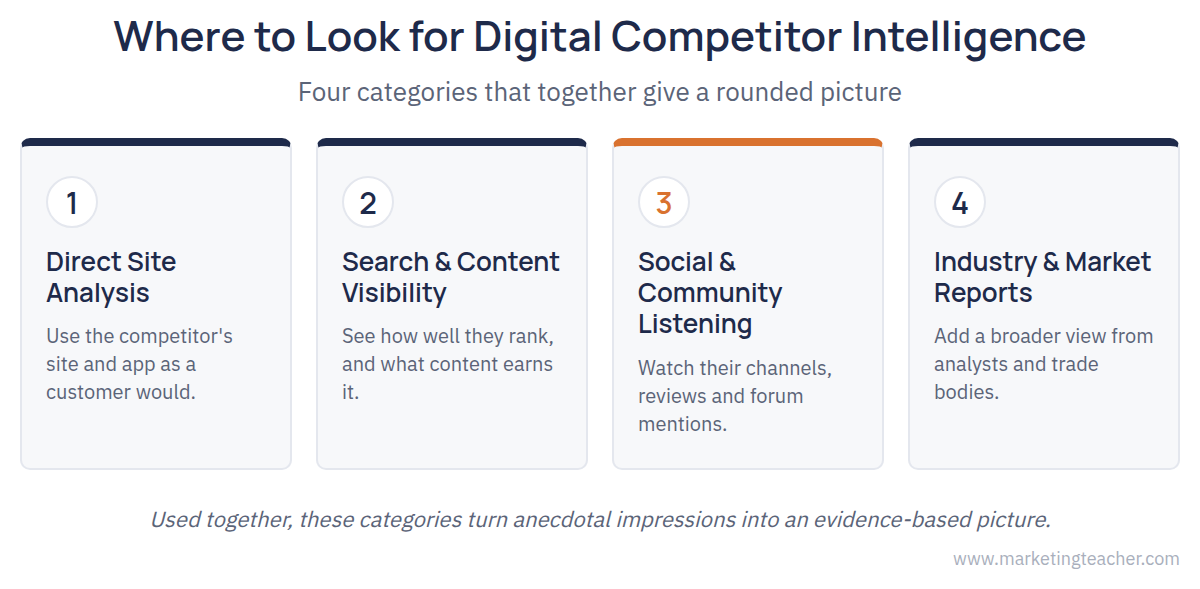
Chaffey and Ellis-Chadwick (2019) group digital competitor research into a small number of practical categories that together give a rounded picture without requiring specialist tools. Direct site analysis means simply using a competitor’s website and app as a customer would, noting what its navigation, messaging, and calls to action do differently. Search and content visibility covers how well a competitor ranks in search engine optimization for the keywords a shared audience actually searches, and what kind of content earns that ranking, information that free tools and a business’s own search results can reveal without any paid subscription. Social and community listening involves watching a competitor’s own social accounts as well as the conversations happening around them, including reviews, forum threads, and comments, which often reveal customer complaints a competitor has not addressed. Industry and market reports, published by analyst firms and trade associations, add a broader view of market share and emerging trends that a single competitor’s own channels cannot show. Used together, these categories move a business from anecdotal impressions of a rival to a structured, evidence-based picture of the competitive landscape.
Turning Research into Action
Gathering information is only useful if it changes a decision, so competitor research should end with a short benchmarking step rather than a folder of screenshots. A simple approach is to list the two or three areas where competitors are strongest, rate how far behind or ahead the business currently is on each, and pick one gap that is both realistic to close and likely to matter to the shared audience. Research should also be repeated on a regular schedule rather than treated as a one-off exercise, since a competitor’s site, pricing, and messaging can all change within a single quarter, and a picture gathered once at the start of a plan can go stale well before that plan is finished. It helps to give this repeat check a fixed owner and a fixed interval, such as a short review at the start of each quarter, so that it survives beyond the initial burst of enthusiasm that usually accompanies a new marketing plan and becomes a genuine ongoing habit rather than a task that quietly stops once the plan itself is written.
Summary
Digital marketing competitor research is the structured gathering of information about how rival businesses perform online, covering direct site analysis, search and content visibility, social and community listening, and broader industry reports. Building on Porter’s foundational case for competitor analysis, Chaffey and Ellis-Chadwick’s digital-specific categories give a business a practical, repeatable way to see where it stands. The research only earns its keep once it is turned into a short list of ranked gaps and a decision about which one to close next, repeated regularly rather than done once and filed away.

The slides, worksheet, lesson plan and poster for this lesson are free to download and free to use in your course — no sign-up, no permission needed. See the teacher resources →
Assign this lesson to your class:
Using Canvas, Blackboard or Moodle? Copy the link and paste it into your course page or assignment. More ways to add lessons to your LMS.

