
What Makes International Marketing Communications Different?
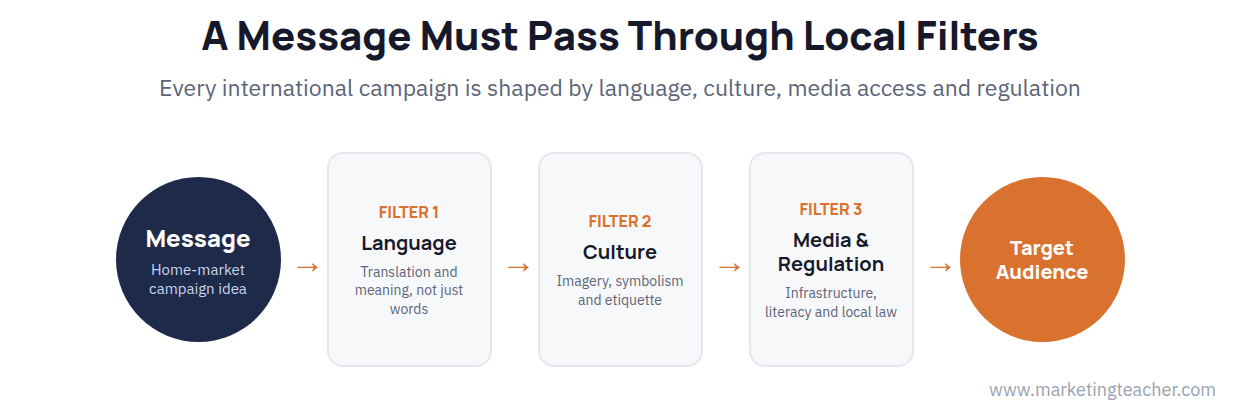
The core promotional tools, personal selling, advertising, and a growing range of digital and other media, are the same ones used domestically. What changes internationally is the sheer range of conditions a campaign has to work within. Cateora, Money, Gilly and Graham (2023) note that literacy levels, media infrastructure, cultural norms and local regulation can all vary sharply between markets, so a communications approach that performs well at home may need substantial rethinking, not just translation, before it travels abroad.
Personal Selling in International Markets
Personal selling carries its own trade-offs internationally. Keegan and Green (2002) point out that in markets with lower average wages, a larger local sales force can be genuinely cost-effective compared with the same approach at home. Where a market has many languages in use, a company needs sales staff who can convey its message accurately in each one, alongside a support structure of administration staff to handle enquiries, literature and quotations. Companies also have to decide whether to place expatriate staff into a foreign market or recruit locally, local hires generally bring a stronger grasp of language, culture and buyer behaviour, and this local knowledge usually outweighs the coordination advantages of using staff from the home market.
Advertising and Media Choice
Advertising decisions abroad are shaped heavily by the media actually available in a market and by how the local population consumes it. Where literacy is lower, a more visual, less text-dependent campaign generally performs better than one built around dense written copy. The mix of national and regional press, the type and reach of television infrastructure, and which broadcast or streaming channels a target segment actually watches all need investigating market by market rather than assumed to match the home market’s media habits. Radio, cinema and outdoor advertising each carry their own local strengths and limitations too, and a channel that barely matters in one market can be a primary route to a target audience in another.
Regulation and Market Access
Local law and industry regulation can constrain what a campaign is allowed to say or show at all, restrictions on specific imagery, language or product claims vary by country and sometimes by region within a country, and a message designed for one market can simply be unusable in another without modification. The overall level of economic development in a market matters here too, in areas with limited infrastructure, some media channels may not reach the target audience at all, which can force a rethink of the entire communications plan rather than just its content.
Digital and Other International Media
Web-based marketing adds another layer of choice: a company can extend its existing domestic site internationally, or build a version tailored specifically to a target market, and design conventions for a website can vary as much as those for a television advert, a layout that reads as clean and modern in one market can feel sparse or unfinished to an audience used to a denser, more visually busy style. Affiliate marketing and pay-per-click advertising are available in many, though not all, markets. Beyond digital channels, international trade shows, trade missions, event sponsorship and public relations activity remain well-used tools for reaching business and consumer audiences that a straightforward advertising campaign might not reach on its own, and the right balance between these options depends heavily on the objectives behind a specific international campaign.
Cultural Influences on the Message
Language is rarely a simple word-for-word swap. A phrase, name or slogan that works cleanly at home can carry an unintended or even embarrassing meaning once translated, which is why brand names and taglines need dedicated local-language review rather than a direct translation. Visual design, symbolism and aesthetics also do not automatically transfer between cultures, imagery, colour choices and even humour that read as appealing in one market can seem confusing or unappealing in another. Dress, appearance and etiquette shown in marketing materials can carry cultural weight too, what looks like a neutral, professional presentation in one culture may read as overly formal, overly casual, or simply unfamiliar in another.
Summary
International marketing communications rely on the same core tools as domestic promotion, but success depends on adapting them to local literacy, media infrastructure, regulation and culture rather than exporting a home-market campaign unchanged (Cateora, Money, Gilly and Graham, 2023). Personal selling and advertising each carry distinct international trade-offs around staffing, language and media access (Keegan and Green, 2002), and cultural review of language, imagery and etiquette is essential before any campaign reaches a new market.
The slides, worksheet, lesson plan and poster for this lesson are free to download and free to use in your course — no sign-up, no permission needed. See the teacher resources →
Assign this lesson to your class:
Using Canvas, Blackboard or Moodle? Copy the link and paste it into your course page or assignment. More ways to add lessons to your LMS.

