
Standardization Versus Adaptation: The Core Product Debate
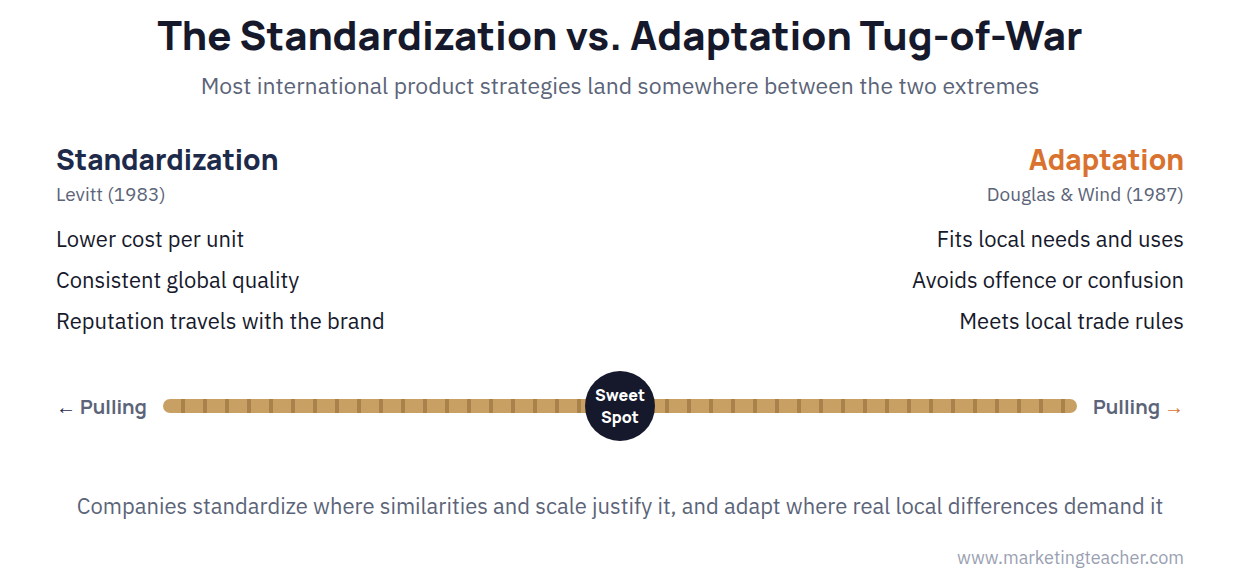
When a company sells a product in more than one country, it faces a fundamental choice: market the same, standardized product everywhere, or adapt it to suit the tastes, regulations and conditions of each local market. This decision touches far more than the physical product itself, it can extend to customer service, marketing communications, pricing and distribution, so a company rarely standardizes or adapts everything at once, and usually settles somewhere between the two extremes for any given market.
The Case for Standardization
Levitt (1983), in one of the most influential and widely cited arguments in international marketing, contends that global communication and travel are steadily converging consumer tastes worldwide, making a single standardized product and marketing approach increasingly viable and, in his view, preferable. Standardization offers real advantages: customers who travel internationally know they will get the same reliable product wherever they buy it, a strong single-product reputation reinforces positive word of mouth, and manufacturing at scale reduces the cost per unit while supporting greater investment in research, development and quality control, since effort is concentrated on one offering rather than split across many variants.
The Case for Adaptation
Douglas and Wind (1987) directly challenge Levitt’s argument, describing full global standardization as a myth that oversimplifies real and persistent differences between markets. A standardized product is, by definition, undifferentiated, leaving an opening for competitors to design a tailored offering that better fits local needs. Products can also serve genuinely different purposes in different cultures, a bicycle used for daily transport in one country might be purely a leisure item in another, meaning a single product design may satisfy neither market as well as two adapted versions would. Trade barriers can force adaptation regardless of a company’s preference, since limits on economies of scale or local content requirements sometimes make a fully standardized global product impractical to manufacture and sell everywhere.
Branding as a Product Decision
Branding is one of the clearest places the standardization versus adaptation choice plays out in practice. A single global brand name and identity make it easier to build recognition that carries across borders and to run marketing campaigns with minimal local rework, which is why many companies fight hard to keep one consistent name and visual identity everywhere they sell. But a name, colour or symbol that carries a positive association at home can carry a confusing, awkward or even offensive one elsewhere, and a company that discovers this only after launch faces a much more expensive fix than one that checks local meaning during product development. Packaging language, required warnings and labelling formats also often have to change for legal reasons even when a company would otherwise prefer to keep everything else about the product identical, and checking these requirements early is considerably cheaper than reprinting packaging after a shipment is already held at customs.
Applying Existing Product Models Internationally
The same product marketing models used domestically still apply once a company operates internationally, they simply need to be run separately for each market rather than assumed to give the same answer everywhere. The Product Life Cycle can place the same product at very different stages in different countries, a product declining at home might still be in growth in a market that adopted it later, creating a genuine opportunity rather than a problem. Ansoff’s Matrix treats entry into a new country with an existing product as a form of market development, a lower-risk growth option than developing an entirely new product. Considering the Three Levels of a Product, core, actual and augmented, separately for each market helps clarify exactly which level needs adapting: the core benefit a product provides may travel well internationally even where its packaging, branding or support services need local adjustment.
Summary
International product decisions centre on the standardization versus adaptation debate, weighing the cost and consistency benefits of a single global product (Levitt, 1983) against the real local differences in needs, uses and regulation that often make some adaptation necessary (Douglas and Wind, 1987). Applying familiar models such as the Product Life Cycle, Ansoff’s Matrix and the Three Levels of a Product separately to each market helps a company decide exactly where to standardize and where to adapt, rather than defaulting to one extreme for the entire product line.
The slides, worksheet, lesson plan and poster for this lesson are free to download and free to use in your course — no sign-up, no permission needed. See the teacher resources →
Assign this lesson to your class:
Using Canvas, Blackboard or Moodle? Copy the link and paste it into your course page or assignment. More ways to add lessons to your LMS.

