
Why Are People a Separate Element of the Marketing Mix?
Booms and Bitner (1981) extended the original four-element marketing mix with three additional factors designed specifically for service businesses: people, process and physical evidence. People earned a place of their own because a service, unlike a physical product, is usually produced and consumed at the same moment, which means the employee delivering it is not just supporting the offer, they are part of it. Zeithaml, Bitner and Gremler (2017) describe front-line staff as effectively the service itself in the eyes of a customer, since a hotel receptionist, a waiter or a call-centre adviser is often the only part of the business a customer ever actually meets. A business can design a flawless product on paper, but if the person delivering it is rude, poorly trained or simply having a bad day, the customer’s experience of the whole offer is coloured by that one interaction.
The Many Roles a Salesperson Can Play
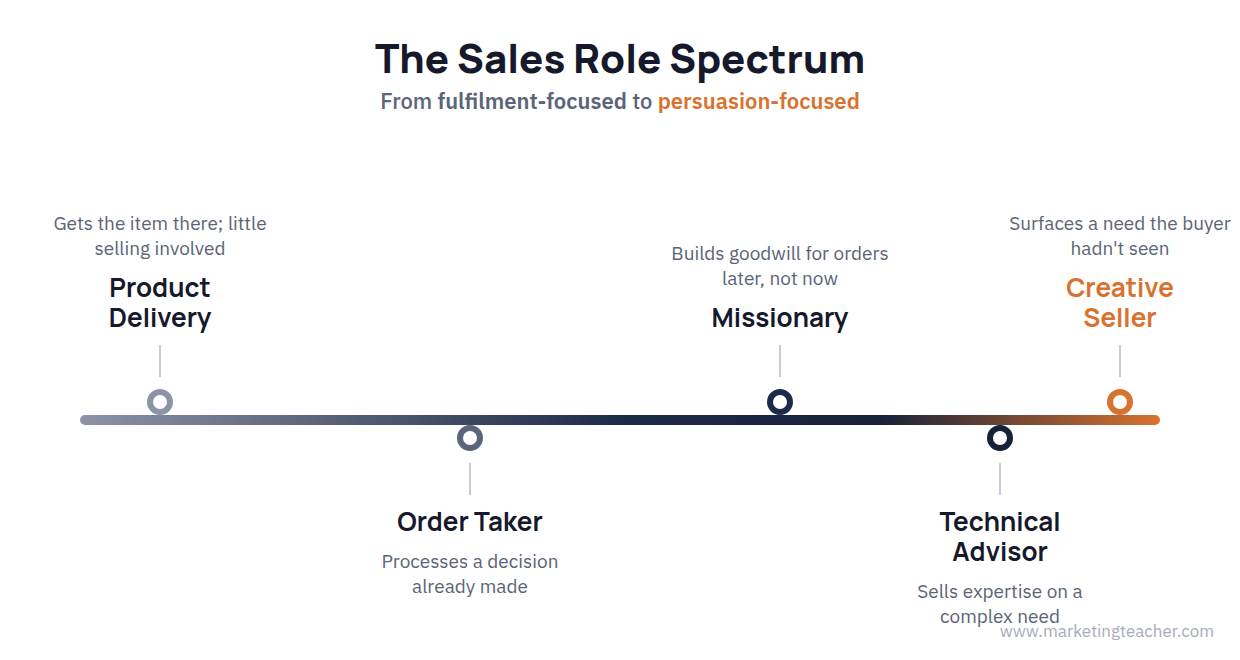
Not every sales role looks the same, and treating them as interchangeable is a common mistake. A product-delivery salesperson’s main job is simply getting the product to the customer, with little actual selling involved, as with a delivery driver or a counter assistant in a fast-food outlet. An order taker, whether working the phone, email or a counter internally, or visiting customers externally, mostly processes requests that have already been decided rather than persuading anyone to buy. A missionary salesperson takes a longer view, building goodwill and relationships with the aim of generating orders over time rather than closing a sale on the spot, in the same way a pharmaceutical representative might spend years building trust with a prescriber. A technical salesperson relies on genuine specialist knowledge to advise a customer on the best option for a complex need, such as a sales engineer specifying industrial equipment. A creative seller does the hardest job of all: identifying a need the customer had not previously recognised and persuading them to satisfy it, which is why this role usually carries the highest incentives.
Customer Service: The Boundary Between the Business and Its Customers
Zeithaml, Bitner and Gremler (2017) use the term boundary spanners for staff who sit at the interface between a company and the outside world, and customer service teams are the clearest example. They provide expertise, such as guidance on a financial product, technical support, such as software troubleshooting, and coordination between a customer and the rest of the business, such as scheduling an engineer’s visit. How a complaint is handled can decide whether a customer stays or leaves, and increasingly that interaction happens face-to-face, by phone, by chat or through social media rather than through any single fixed channel. Because customers tend to buy from people they like, a business that invests in the disposition and attitude of its customer-facing staff, not only their technical competence, usually sees that investment reflected directly in retention.
Training and Development for Consistent Service
Consistent service rarely happens by accident. Training typically begins with an induction, which introduces a new employee to the organisation’s culture and its day-to-day policies and procedures, and continues with a development plan setting out personal goals linked to future appraisals. Most training is either on-the-job, learned while the role is actually being performed, such as a new bartender shadowing an experienced colleague during a shift, or off-the-job, delivered at a college, training centre or conference away from day-to-day duties. Many organisations also expect staff to treat learning as an ongoing process rather than a one-off event, often described as continuing professional development, since customer expectations and the products or services on offer both keep changing after the initial induction is complete.
People and the Long-Term Customer Relationship
People are usually the transactional interface between a company and its customers: a waiter greets a table, takes an order, serves the food and finally takes payment, completing the full transaction from first contact to close. But the relationship a customer builds with the people they deal with also underpins something longer-lasting than any single transaction. Zeithaml, Bitner and Gremler (2017) tie this directly to customer relationship management, arguing that the quality of front-line interactions is one of the strongest levers a business has for recruiting a customer, retaining them, and encouraging them to keep coming back, often more powerful than price or product features alone once a market has matured and competitors look similar on paper.
Summary
People became a distinct element of the marketing mix because services are produced and consumed together, which puts the employee delivering a service on full display to the customer experiencing it (Booms & Bitner, 1981). Sales roles range from simple delivery and order-taking through to missionary, technical and creative selling, each demanding a different skill set, while customer service teams act as boundary spanners who can make or break a customer relationship in a single interaction (Zeithaml, Bitner & Gremler, 2017). Training, empowerment and a genuine investment in staff attitude turn this element of the mix from a cost into one of a service business’s most reliable sources of competitive advantage, and it works alongside process and physical evidence to complete the extended marketing mix for services.
The slides, worksheet, lesson plan and poster for this lesson are free to download and free to use in your course — no sign-up, no permission needed. See the teacher resources →
Assign this lesson to your class:
Using Canvas, Blackboard or Moodle? Copy the link and paste it into your course page or assignment. More ways to add lessons to your LMS.

