
What Is Physical Evidence?
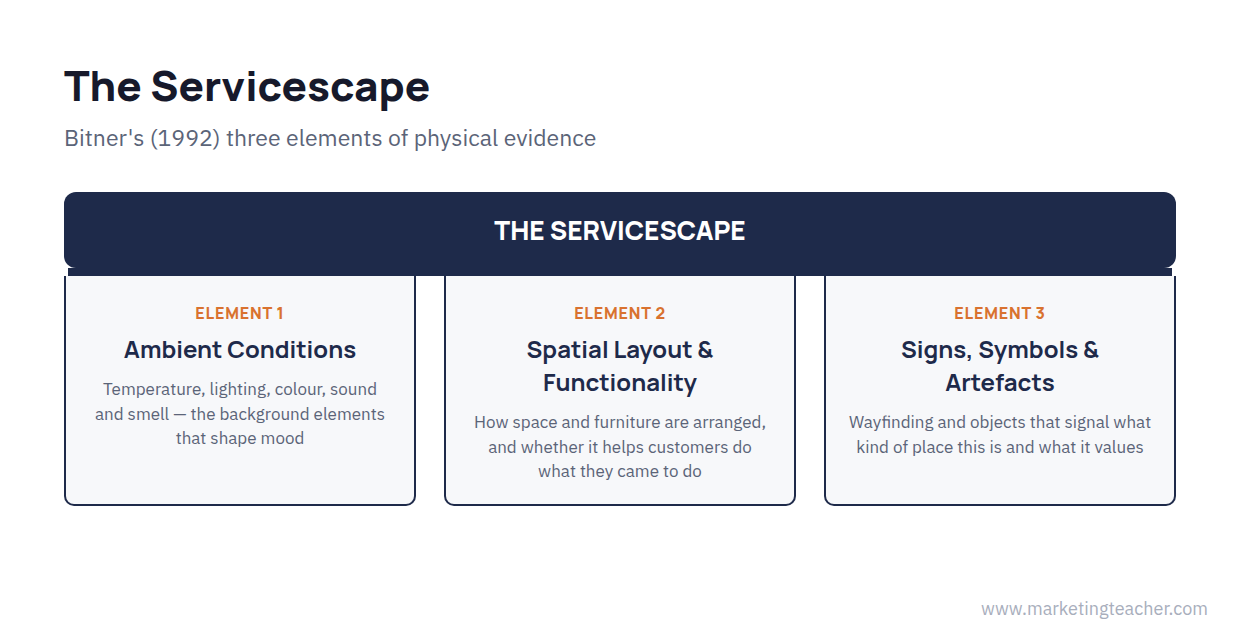
Services are largely intangible, which creates a problem for both marketers and customers: a customer cannot pick up a haircut or a flight before buying it the way they can inspect a physical product. Physical evidence is one of the three additional Ps that Booms and Bitner (1981) added to the marketing mix to address this gap, alongside people and process, since services need their own extended framework beyond the original 4Ps. Physical evidence refers to the tangible cues a business provides to help customers judge the quality of a service before, during and after they experience it, from the cleanliness of a restaurant to the design of a boarding pass.
The Servicescape: What Physical Evidence Actually Covers
Bitner (1992) described the physical surroundings of a service as the “servicescape,” breaking it into three elements that together shape how a customer experiences the space. Ambient conditions cover temperature, lighting, colour, sound and smell, the background elements that a customer often notices only subconsciously but which shape mood throughout the visit. Spatial layout and functionality cover how furniture, equipment and space are arranged, and whether that arrangement actually helps a customer do what they came to do, such as whether a cinema seat is comfortable or a supermarket aisle is easy to navigate with a full trolley. Signs, symbols and artefacts cover the explicit and implicit cues that communicate what kind of place this is, from wayfinding signage to the objects on display that signal a brand’s values and positioning.
Digital and Indirect Physical Evidence
Physical evidence is not limited to a building a customer physically enters. A well-designed app interface, a professionally printed invoice, or the packaging a subscription box arrives in are all physical evidence, since they give a customer tangible cues about quality even when the core service itself, such as a streaming subscription or a consulting engagement, has no physical location at all. A budget airline’s minimalist, no-frills boarding pass and cabin signal low cost through their plainness just as deliberately as a luxury hotel’s thick, textured stationery signals premium service; both are physical evidence choices that reinforce a specific brand positioning rather than accidents of design.
High-Contact Versus Low-Contact Services
How much physical evidence matters depends on how much direct contact a customer has with the service environment. A high-contact service such as a hotel, a hospital or a restaurant puts the customer inside the servicescape for an extended period, so every element of it is doing marketing work continuously throughout the visit. A low-contact service such as an online bank or a software subscription has far less physical environment for a customer to experience directly, which shifts the weight onto the smaller number of tangible touchpoints that do exist, such as the app’s interface, the emails it sends, or the packaging of any physical materials a customer receives. Neither type can ignore physical evidence entirely; the difference is in how concentrated its effect is.
Matching Physical Evidence to the Brand Promise
The central task for a marketer is making sure physical evidence matches, rather than contradicts, what the service actually promises. A service that markets itself as fast and efficient but makes customers wait in a cluttered, disorganised space undermines its own positioning before the actual service has even started, since customers form judgements about competence from the physical environment before a single staff interaction occurs. Conversely, an over-designed, expensive-looking space around a genuinely low-cost service can create a mismatch that makes customers suspicious about hidden costs. The goal is coherence: every tangible cue, from signage to seating, should reinforce the same story the service is trying to tell.
Summary
Physical evidence, one of the three Ps Booms and Bitner (1981) added for services marketing, covers the tangible cues customers use to judge a service they cannot physically inspect in advance. Bitner’s (1992) servicescape framework breaks this into ambient conditions, spatial layout and functionality, and signs and symbols, all of which shape a customer’s experience whether the service is delivered in a physical space or through a digital interface. As Marlin Cove’s redesign shows, aligning these cues with the service’s actual promise can measurably change how customers feel about an otherwise unchanged service.
The slides, worksheet, lesson plan and poster for this lesson are free to download and free to use in your course — no sign-up, no permission needed. See the teacher resources →
Assign this lesson to your class:
Using Canvas, Blackboard or Moodle? Copy the link and paste it into your course page or assignment. More ways to add lessons to your LMS.

