
What Is a PEST Analysis?
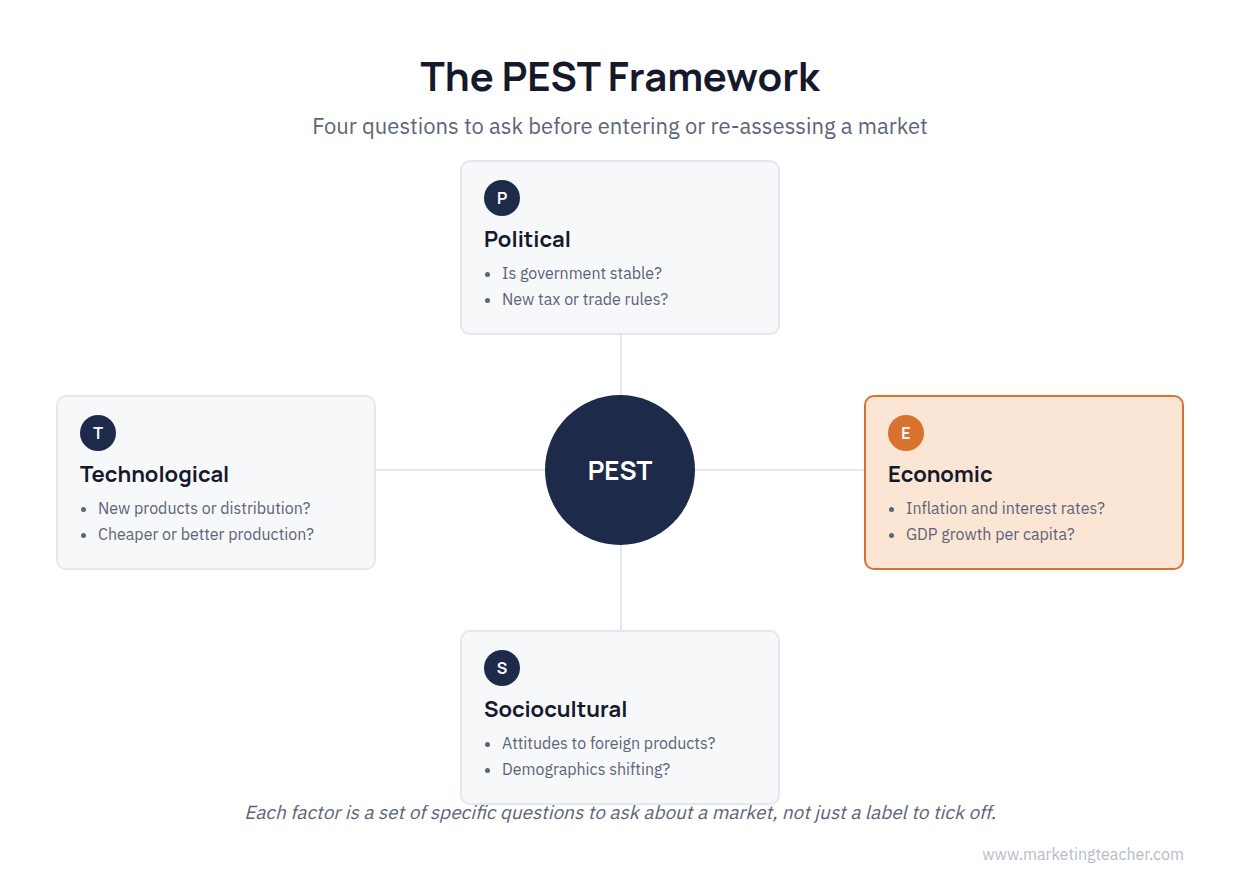
A PEST analysis is a way of scanning the external environment a business trades in, using four headings: Political, Economic, Sociocultural and Technological. Aguilar (1967) is credited with the original version of this idea, an environmental scanning framework built around four forces; PEST is the name that stuck once later writers reordered and renamed it. Kotler and Armstrong (2018) place these same four forces within the macroenvironment, the wider set of societal conditions that sit outside a business’s direct control but still shape almost every decision it makes. PEST works best not as a one-off checklist to complete before a plan is written, but as a continuous habit: the environment it scans keeps moving, so the analysis needs revisiting as conditions change. A later, six-factor version of this same idea, PESTEL, adds environmental and legal factors on top of these original four; the four covered here are the foundation everything else builds on.
The Questions a Political and Economic Scan Should Ask
A political scan asks how stable the government of a target market is, whether new policy is likely to change the tax or regulatory burden on the business, what stance the government takes on marketing ethics and consumer protection, and whether the country belongs to trading blocs or agreements, such as the EU or ASEAN, that affect how easily goods can move across its borders. These questions matter because a government that favours heavier taxation and regulation creates a very different trading environment from one that leaves more to the free market, and a business that hasn’t asked the question can be caught off guard by a change either way. An economic scan asks a parallel set of questions: what are current interest rates and inflation doing to costs and consumer spending, where does the economy sit in its business cycle, and what do employment levels and GDP per capita suggest about how much disposable income is actually available. Both scans matter most before entering a new market, when a business has the least first-hand experience of the answers, but they matter almost as much in a market a business already trades in, since political and economic conditions rarely stay fixed for long once a business has settled in.
The Questions a Sociocultural and Technological Scan Should Ask
A sociocultural scan asks what a market’s dominant attitudes and habits actually are: how consumers view foreign products, what role religion and language play in how a product is received, how much leisure time people have to spend, and how population trends such as an ageing or growing population are likely to shift demand over time. A technological scan asks whether new technology lets a business make its product more cheaply or to a higher standard, whether it opens up new products and services worth offering, such as banking or new devices, and how it is reshaping distribution and communication with customers, from selling entirely online to reaching them through new channels the business hasn’t tried before. Kotler and Armstrong (2018) note that these forces sit alongside the political and economic environment as part of the same wider macroenvironment scan, rather than as a separate exercise, which is exactly why all four are usually assessed together rather than one at a time, with any single factor read in light of what the other three are doing at the same moment.
Summary
A PEST analysis scans a business’s external environment across four factors: political, economic, sociocultural and technological. Each factor works best as a set of specific questions rather than a general label, whether that is asking about trade agreements and tax policy, interest rates and GDP, cultural attitudes and demographics, or how new technology is changing products and distribution. Because PEST only covers four of the forces shaping the wider marketing environment, many businesses now use the extended six-factor PESTEL version, which adds environmental and legal factors to the same four covered here.

The slides, worksheet, lesson plan and poster for this lesson are free to download and free to use in your course — no sign-up, no permission needed. See the teacher resources →
Assign this lesson to your class:
Using Canvas, Blackboard or Moodle? Copy the link and paste it into your course page or assignment. More ways to add lessons to your LMS.

