
What Is Planned Obsolescence?
Planned obsolescence is the practice of designing or marketing products so that they need replacing sooner than they otherwise would. The economist Jeremy Bulow (1986) defined it as producing goods with “uneconomically short useful lives so that customers will have to make repeat purchases.”
Critics see it as a cause of waste and unfair cost to consumers. Marketers reply that much of it is really innovation and customer choice. This lesson sets out both sides so that you can make up your own mind.
A Short History: The Lightbulb Cartel
The classic early case is the Phoebus cartel. In December 1924, leading lightbulb makers, including Osram, Philips and General Electric (through its subsidiaries), met in Geneva and agreed a standard life of 1,000 hours for household bulbs. Bulbs at the time commonly lasted 1,500 to 2,000 hours. Factories had to send samples to a central testing laboratory in Switzerland, and firms whose bulbs lasted too long could be fined. It shows that short product life can be a deliberate business decision.
The Main Types of Planned Obsolescence
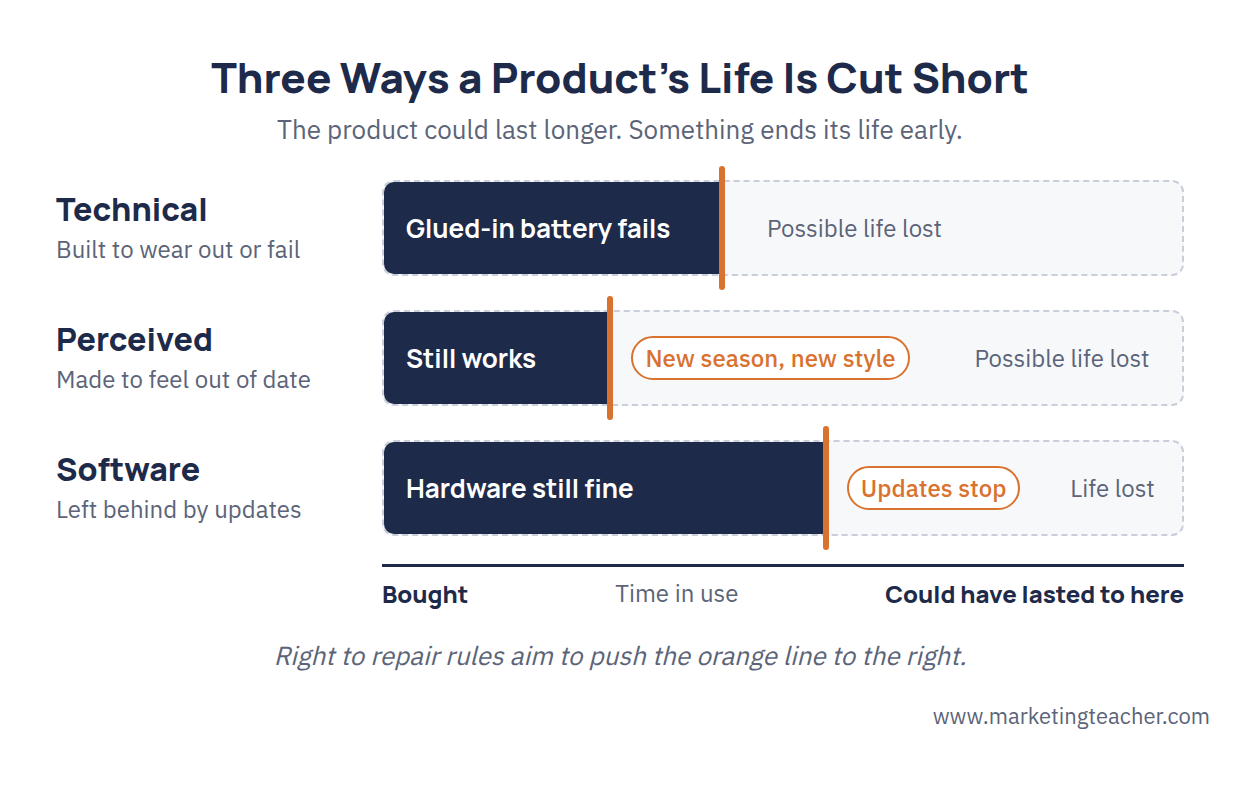
1. Technical (or functional) obsolescence. The product is built to wear out or fail. Examples include batteries that cannot be replaced, parts that are glued rather than screwed together, or components chosen because they are cheap rather than durable.
2. Perceived (psychological or style) obsolescence. The product still works, but the customer is persuaded that it is out of date. New colours, new designs and yearly model launches make last year’s version feel old. Fast fashion is the clearest example, and it is closely linked to the product life cycle, which firms can shorten on purpose.
3. Software (or systemic) obsolescence. The hardware is fine, but the product stops being useful because software updates end, new updates slow it down, or it no longer works with other systems.
The Critics’ Case
It creates waste. According to the UN’s Global E-waste Monitor 2024, the world produced a record 62 million tonnes of electronic waste in 2022, and only about 22% was formally collected and recycled. The UN Environment Programme estimates that the equivalent of a rubbish truck full of clothing is burned or sent to landfill every second.
It harms consumers. The best-known recent case involves Apple. Software updates released in 2017 (iOS 10.2.1 and 11.2) slowed some older iPhones with worn batteries. Apple said this was to stop the phones shutting down suddenly, but it had not told users clearly. In February 2020, France’s consumer authority (the DGCCRF) fined Apple €25 million for a misleading commercial practice by omission. In the US, Apple agreed in 2020 to settle a class action for up to $500 million, worth about $25 per eligible iPhone. Later that year it paid a further $113 million to settle claims from more than 30 US states. Apple did not admit wrongdoing.
It is an ethical and environmental problem. Guiltinan (2009) argues that constant new-product development encourages shorter replacement cycles with “troublesome environmental consequences.” He suggests that product designers and marketing strategists carry real ethical responsibility for this. It is a good example of marketing ethics in practice.
The Marketers’ Response
Marketers do not accept that all short product lives are sinister. Kotler, Armstrong and Opresnik (2018) set out the defence. Consumers often like change: they get tired of old styles and want the newest look or features. No one is forced to buy the new model. Much of what is called planned obsolescence is really the result of competition and technological progress, which lead to better and cheaper products over time.
Economic theory adds nuance to this debate. Bulow (1986) showed that a monopolist has a rational incentive to make goods that last less long than is efficient, and that competing firms can gain by colluding to reduce durability, as the Phoebus cartel did. This suggests the problem is most serious where competition is weak.
The fairest conclusion is that both sides have a point. Innovation is real, but so is deliberate short-lifing. The task for marketers is to tell the difference and to avoid marketing myopia, where short-term sales matter more than long-term customer trust.
The Regulatory Response: Right to Repair
Governments are now stepping in. In Great Britain, right to repair regulations came into force on 1 July 2021. Makers of washing machines, dishwashers, fridges and TVs must make spare parts available, mainly to professional repairers, for 7 to 10 years after a model is last sold.
The EU has gone further. From 20 June 2025, smartphones and tablets sold in the EU must have spare parts available for at least 7 years, receive operating system updates for at least 5 years, and have batteries that keep at least 80% of their capacity after 800 charge cycles. Their energy label also shows a repairability class from A to E. The EU Right to Repair Directive (2024/1799) had to be written into national law by 31 July 2026. It gives consumers an extra year of legal guarantee when they choose repair over replacement, and obliges manufacturers to offer repairs for products such as phones, washing machines and fridges.
• Machine B: costs £450, is expected to last 10 years, and needs one £80 repair in year 6. Total cost: £530. Cost per year: £530 ÷ 10 = £53.
Summary
Planned obsolescence means designing or marketing products so that they are replaced sooner. It can be technical (built to fail), perceived (made to feel out of date) or software-based (left behind by updates). Critics point to rising e-waste, fast fashion and cases such as Apple’s iPhone slowdown fines. Marketers reply that most product change reflects innovation and real consumer demand. Regulators in the UK and EU are now requiring spare parts, software support and repairability information. For marketers, longer-lasting products are becoming part of sustainability and marketing, not an optional extra.
The slides, worksheet, lesson plan and poster for this lesson are free to download and free to use in your course — no sign-up, no permission needed. See the teacher resources →
Assign this lesson to your class:
Using Canvas, Blackboard or Moodle? Copy the link and paste it into your course page or assignment. More ways to add lessons to your LMS.

