
What Is the Product Life Cycle?
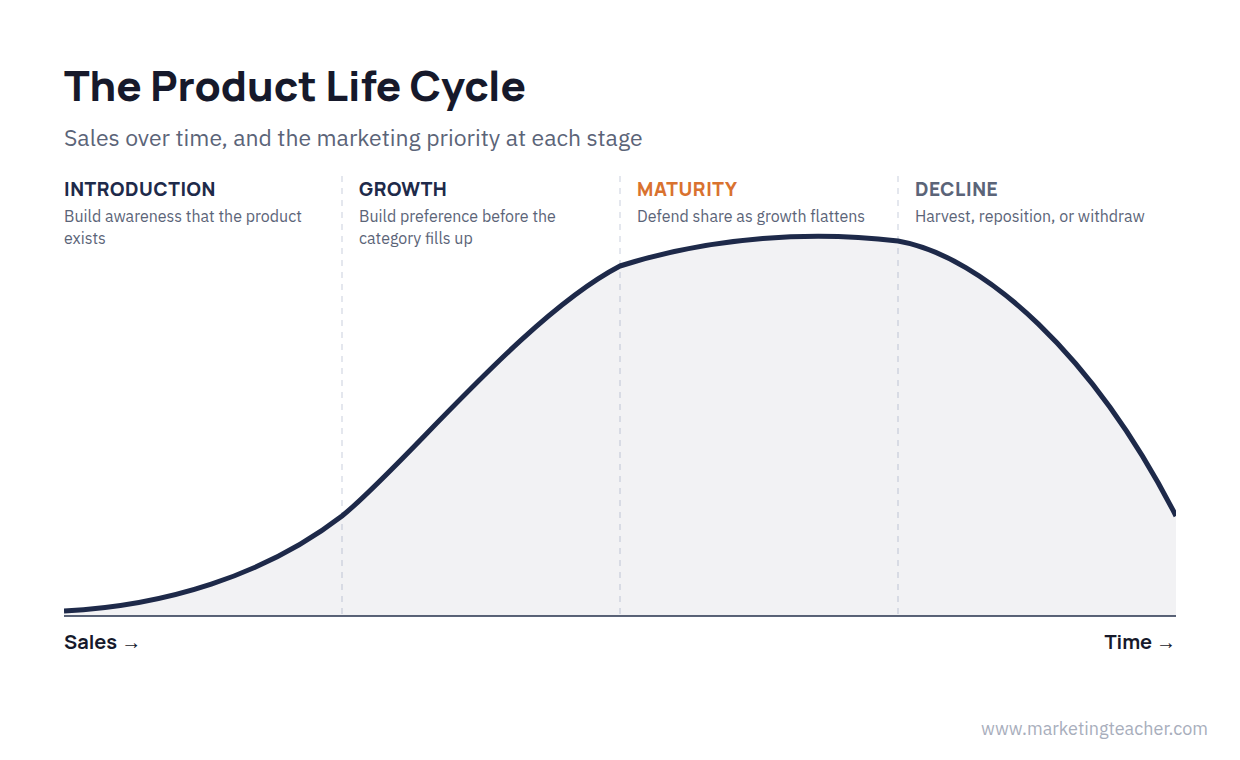
The Product Life Cycle (PLC) describes the pattern a product’s sales tend to follow over time, borrowing the shape of a biological life cycle: introduction, growth, maturity and decline. Theodore Levitt (1965) popularised the model in his influential article “Exploiting the Product Life Cycle,” arguing that recognising which stage a product is in should directly shape marketing strategy, since the tactics that work when a product is new are rarely the tactics that keep an ageing product profitable. The PLC is not a prediction of exactly how long each stage will last, it is a framework for asking the right strategic question at the right time.
The Four Stages
Introduction covers a product’s launch, when sales are low, marketing spend is high relative to revenue, and the priority is building basic awareness that the product exists at all. Growth follows once the product finds a market: sales rise quickly, competitors start to notice and enter, and the focus shifts toward building brand preference before the category gets crowded. Maturity is typically the longest stage, where sales growth slows and then flattens as the market becomes saturated, competition intensifies, and marketing spend often shifts toward defending market share rather than winning new customers. Decline follows as sales fall, usually because a newer alternative has emerged or customer tastes have moved on, and the marketing question becomes whether to cut costs and harvest remaining profit, reposition the product, or withdraw it from the market entirely.
Why Marketing Priorities Shift by Stage
The practical value of the PLC is that it warns against running the same playbook at every stage. Spending heavily on broad awareness once a category is mature usually wastes budget that would work harder building loyalty or defending price, and cutting marketing spend too early, during growth, can hand the category to a competitor willing to invest while the market is still expanding. Recognising the current stage, even roughly, helps a marketing team ask whether the goal right now is awareness, share capture, share defence, or a managed exit, rather than defaulting to whatever campaign type worked last time.
Extension Strategies: Stretching Maturity
Rather than accepting decline as inevitable, many companies use extension strategies to stretch out maturity or restart growth. Common approaches include finding new markets for an existing product, such as selling a domestic product internationally; finding new uses for it, the way baking soda expanded from a cooking ingredient into a deodoriser and cleaning product; modifying the product itself with new features, flavours or formulations; or repositioning it toward a different audience entirely. Each of these buys a product more time, but none of them changes the underlying pattern indefinitely, since a market can only be extended so many times before genuine decline sets in.
Where the Model Breaks Down
In practice, very few products move through a clean, predictable curve. The length of each stage varies enormously between categories and even between competing products in the same category, and marketing decisions themselves can shift a product from one stage to another, for example when aggressive price-cutting can drag a maturing product into decline faster than customer demand alone would have. Kotler and Keller (2016) note that the model describes a pattern rather than a guarantee, and that some products are deliberately relaunched, repositioned or given a new life cycle entirely through reformulation or rebranding rather than being allowed to decline. Treating the PLC as a strict prediction, rather than a rough diagnostic, is the most common way marketers misuse it.
Summary
The Product Life Cycle, popularised by Levitt (1965), describes how a product typically moves through introduction, growth, maturity and decline, with marketing priorities shifting from awareness to share capture, share defence, and finally a decision to harvest, reposition or withdraw. Corrigan Kitchenware’s griddle pan shows how those shifts play out in practice, adjusting its strategy as the market around it changed. The model’s real value lies in prompting a fresh diagnosis of where a product actually stands, since real products rarely follow its stages as neatly as the theory suggests. The same life-cycle logic drives the ADL matrix, which grades the maturity of a whole industry rather than a single product, and feeds the investment decisions compared on portfolio analysis.
The slides, worksheet, lesson plan and poster for this lesson are free to download and free to use in your course — no sign-up, no permission needed. See the teacher resources →
Assign this lesson to your class:
Using Canvas, Blackboard or Moodle? Copy the link and paste it into your course page or assignment. More ways to add lessons to your LMS.

