
What Are the Five Sustainable Marketing Principles?
Sustainable marketing means meeting the needs of today’s customers and businesses while protecting the ability of future generations to meet theirs. Kotler, Armstrong and Opresnik (2018) argue that a company’s marketing should support the best long-run performance of the whole marketing system, not just this quarter’s sales. To do this, they set out five principles that a sustainable business should follow.
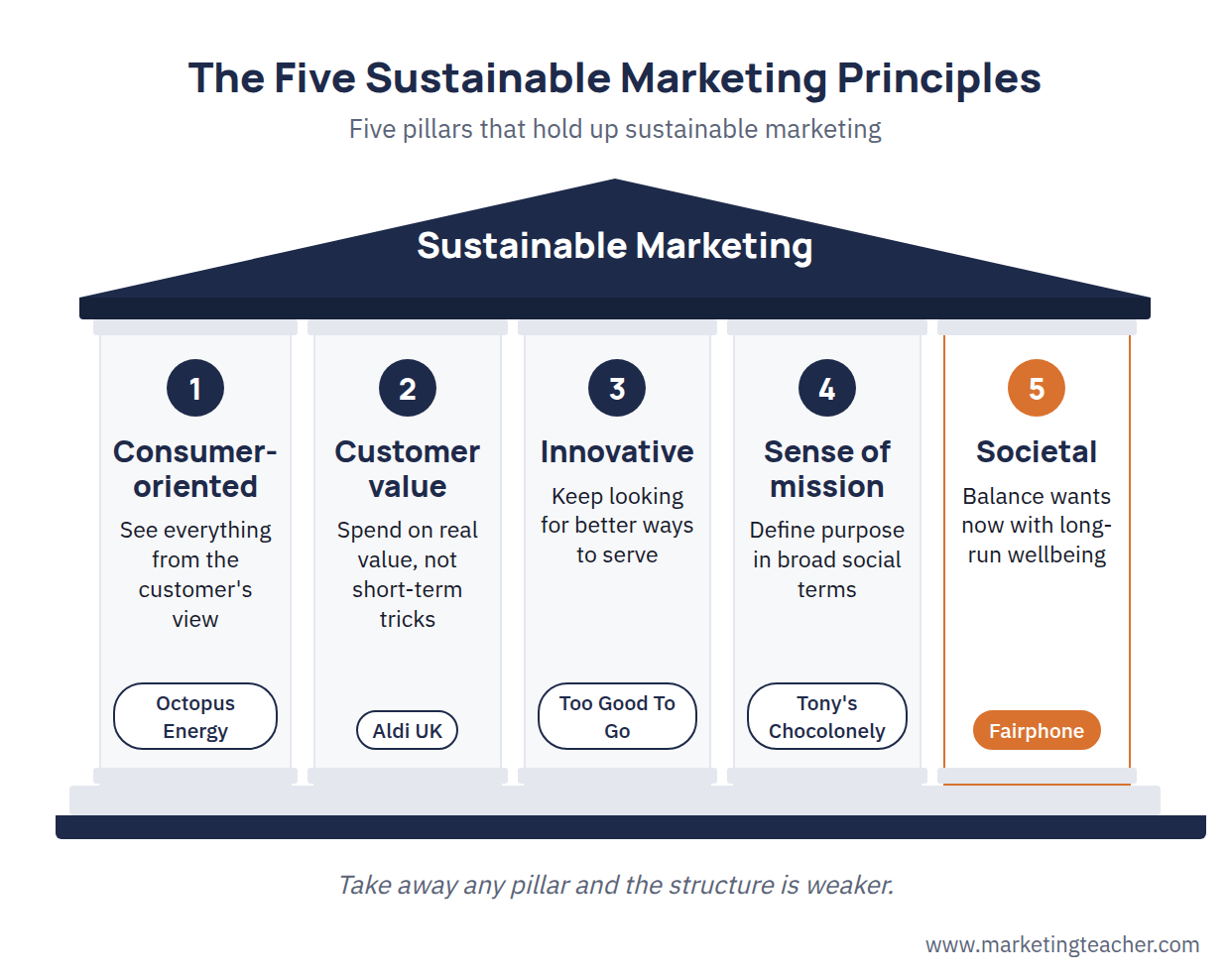
The five principles are consumer-oriented marketing, customer-value marketing, innovative marketing, sense-of-mission marketing and societal marketing. Each one builds on the marketing concept, adding a longer time horizon and a wider view of who is affected.
1. Consumer-Oriented Marketing
Consumer-oriented marketing means viewing and organising everything the business does from the customer’s point of view. The aim is to understand customers so well that the firm builds lasting, profitable customer relationships.
Octopus Energy is a strong UK example. In January 2025, industry data reported by Reuters showed it had overtaken British Gas to become Britain’s largest household energy supplier, with around 12.9 million accounts. In 2025 it won the Uswitch awards for customer service, value for money and overall customer satisfaction, and Which? named it a Recommended Provider for the eighth year running.
2. Customer-Value Marketing
Customer-value marketing means putting most of the firm’s resources into activities that genuinely add value for customers. Short-term tricks may lift sales, but they rarely build loyalty.
Aldi UK shows how a clear value promise can be sustained year after year. Its model relies on a limited range, mostly own-label products and efficient stores, and it passes those savings on through consistently low prices. Consumer group Which? named Aldi the cheapest UK supermarket in 10 of the 12 months of 2025. In December 2025 its basket of groceries cost £123.60, compared with £170.46 at Waitrose.
3. Innovative Marketing
Innovative marketing means continually looking for real improvements in products and marketing. A firm that stops innovating risks being overtaken by one that finds a better way to serve customers. This is closely linked to the warning in marketing myopia: define your business too narrowly and you miss the next big change.
Too Good To Go took an old problem, unsold food, and built a new market around it. Its app lets shops, bakeries and cafés sell surplus food in “Surprise Bags”, usually for half their retail value or less. By August 2024 it had saved 40 million bags from waste in the UK alone, working with more than 40,000 UK partners including Aldi, Greggs and Morrisons. Globally, it reported saving nearly 157 million meals in 2025.
4. Sense-of-Mission Marketing
Sense-of-mission marketing means defining the company’s purpose in broad social terms rather than narrow product terms.
Tony’s Chocolonely, the Dutch chocolate brand widely sold in UK supermarkets, defines its mission as “together, we’ll end exploitation in cocoa”. It pays farmers a higher price and works with long-term partner co-operatives. Its 2024/25 annual results, published in February 2026, reported revenue of €240 million and child labour below 5% in long-term partner co-operatives, compared with an industry average of 46.7%. The mission is also a marketing asset: its bars are split into unequal pieces to symbolise the unequal cocoa supply chain, which gets people talking about fairness.
5. Societal Marketing
Societal marketing means making decisions by considering three things at once: consumers’ wants, consumers’ long-run interests, and society’s long-run interests. Kotler, Armstrong and Opresnik (2018) classify products on two dimensions: immediate satisfaction and long-run consumer benefit.
- Deficient products give neither immediate appeal nor long-run benefit, such as a poorly made gadget.
- Pleasing products give high immediate satisfaction but may cause harm in the long run, such as sugary fizzy drinks.
- Salutary products are good for people in the long run but have little immediate appeal, such as a basic bicycle helmet.
- Desirable products give both immediate satisfaction and long-run benefits. This is the goal.
Fairphone aims for a desirable product. The Fairphone (Gen. 6), launched in June 2025, is a modern smartphone that people want to use. It is also built to last, with a five-year warranty and eight years of software updates. Repair website iFixit gave it a perfect 10 out of 10 for repairability, and Fairphone says more than 50% of its weight comes from fair and recycled materials.
• Customer value: instead of a one-off “50% off” week, the bakery offers a loyalty card: buy nine loaves, get the tenth free.
• Innovative: about 150 unsold items a week are listed on a surplus-food app at half price, recovering around £200 a week.
• Sense of mission: the bakery adopts the mission “real bread for everyone in our neighbourhood” and donates 20 loaves a week to a local food bank.
• Societal: a popular white bloomer is a pleasing product; a new wholegrain version with less salt keeps the taste but adds long-run benefit, moving it towards desirable.
A Critical View
The five principles are useful but not free from criticism. Crane and Desmond (2002) argue that societal marketing is an extension of the marketing concept rather than a real rethink of it. They ask an awkward question: who decides what is in society’s long-run interest? In practice, it is often the company itself, which has a clear interest in the answer.
Kemper and Ballantine (2019) help explain this. After reviewing around 200 academic articles, they identify three views of sustainability marketing. The first focuses on making more sustainable products. The second also tries to change consumer lifestyles. The third calls for deeper change to the economic system itself. Kotler’s five principles sit mainly in the first view. They improve how firms behave, but they do not question whether we should consume less overall. For more on this debate, see sustainability and marketing.
Summary
The five sustainable marketing principles are consumer-oriented, customer-value, innovative, sense-of-mission and societal marketing. Octopus Energy, Aldi, Too Good To Go, Tony’s Chocolonely and Fairphone each show one principle in practice. Societal marketing also classifies products as deficient, pleasing, salutary or desirable. Critics note that the principles improve business behaviour without questioning overall levels of consumption, so they are best seen as a starting point for sustainable marketing rather than the final word.
The slides, worksheet, lesson plan and poster for this lesson are free to download and free to use in your course — no sign-up, no permission needed. See the teacher resources →
Assign this lesson to your class:
Using Canvas, Blackboard or Moodle? Copy the link and paste it into your course page or assignment. More ways to add lessons to your LMS.

