
What Is Cause-Related Marketing?
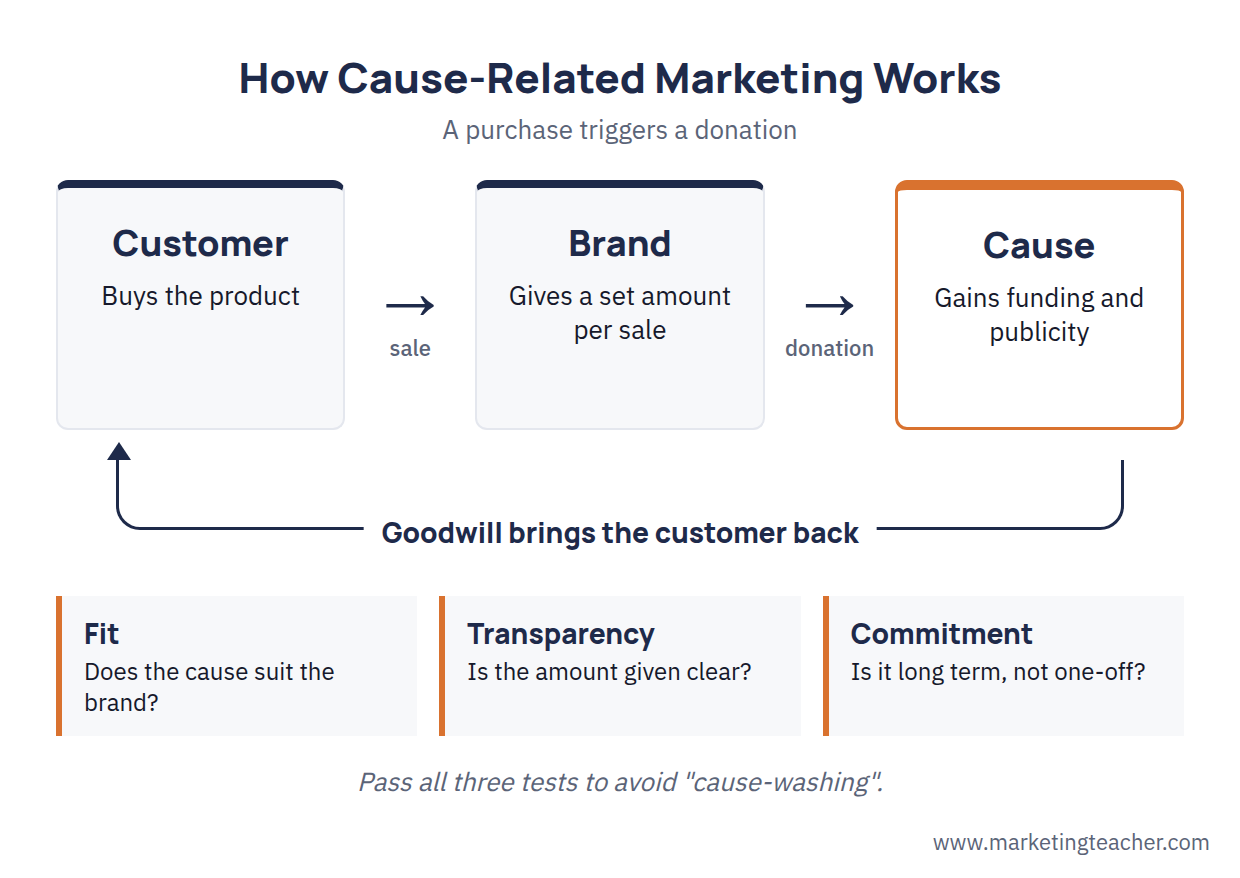
Cause-related marketing (CRM) is when a company links the sale of its product to support for a charity or good cause. The most common version is simple: every time a customer buys, the company gives a set amount to the cause. The customer gets the product, the charity gets money, and the brand gets goodwill.
The classic academic definition comes from Varadarajan and Menon (1988). They described cause-related marketing as marketing activity in which a firm offers to contribute a specified amount to a designated cause when customers engage in revenue-providing exchanges. In plain terms: the donation is triggered by a purchase. That is what separates it from ordinary corporate giving, where a firm simply writes a cheque whatever its sales.
The idea is usually traced back to American Express in 1983. During a three-month campaign it promised one cent to the restoration of the Statue of Liberty for every card transaction, and one dollar for every new card issued. The campaign raised around $1.7 million for the restoration, and card use reportedly rose by 28%, well above the 18% the company had expected. It showed that doing good and selling more could happen at the same time.
Why Brands Use Cause-Related Marketing
There are three main reasons.
Differentiation. In crowded markets, many products are much the same. A cause gives shoppers a reason to choose one brand over another. innocent’s Big Knit is a long-running UK example. Since 2003, volunteers have knitted tiny woolly hats for innocent smoothie bottles, and innocent donates money to Age UK for every “behatted” bottle sold. It has now run for more than twenty years and returns each autumn.
Purchase intention. A cause can tip the decision at the shelf. Barone, Miyazaki and Taylor (2000) found that information about a firm’s support for a cause can change which brand consumers choose, but only under certain conditions. If shoppers must pay more or accept a worse product to support the cause, or if they doubt the firm’s motives, the effect weakens.
Reputation. Long partnerships build trust over years, not weeks. Sainsbury’s has worked with Comic Relief for more than 27 years and has pledged to raise £30 million for the charity by 2030, including matching customer donations made in store and online. Campaigns like this also give the brand positive stories for its public relations work.
For the charity, the benefit is funding and publicity it could not afford alone, which is why many causes see these partnerships as a core part of not-for-profit marketing.
How Well Does It Actually Work?
A large review by Schamp and colleagues (2023) combined the results of 237 studies. It found that cause-related marketing has a moderate positive effect on attitudes towards a brand, but only a weak effect on actual behaviour such as buying. The most effective campaigns made the donation clearly visible, showed sincere commitment and created an emotional connection. Poorly executed or badly explained donation offers could even make attitudes worse. The lesson for marketers: CRM helps, but it is not magic.
The Risks: Cause-Washing
Critics argue that some campaigns are less “cause-related” and more “cause-exploitative”: the cause is used mainly to sell, and the good done is small compared with the publicity gained. This is often called cause-washing, a cousin of greenwashing (see sustainability and marketing).
A widely cited example is KFC’s “Buckets for the Cure” in the USA in 2010. KFC gave 50 cents to a breast cancer charity for each pink bucket of fried chicken sold. The campaign group Breast Cancer Action called it “pinkwashing in its most egregious form”, arguing that it promoted food that did little for health while mainly benefiting KFC’s brand. The problem was a poor fit between the product and the cause.
Even well-loved models can be questioned. TOMS became famous for “One for One”: buy a pair of shoes and a pair is given to a child in need. By 2019 it had given away more than 95 million pairs, but critics argued that free shoes did little to tackle the causes of poverty. In 2019 TOMS announced it would move away from the model, and it now commits at least one-third of its annual net profits to grassroots organisations instead. This shows how a brand can rethink its cause strategy when the original promise no longer holds up.
How to Do It Credibly
Three tests help separate genuine campaigns from cause-washing.
1. Fit. The cause should make sense for the brand. Pampers’ long partnership with UNICEF, which began in the UK in 2006 under the “1 pack = 1 vaccine” promise, linked a baby product with protecting mothers and newborns from tetanus. UNICEF reports that Pampers has donated 300 million tetanus vaccines. The logic was obvious to shoppers.
2. Transparency. Customers should know exactly what their purchase gives. In the UK this is not just good practice. The advertising code (CAP Code, rule 8.33 onwards) says charity-linked promotions must name the charity and state the actual amount or percentage donated, such as “10p per purchase”. A vague “we donate with every sale” is not acceptable.
3. Commitment. One-off campaigns can look opportunistic. Partnerships that last years, like the Big Knit or Sainsbury’s and Comic Relief, are more believable. This links to the wider questions in marketing ethics: is the brand doing the right thing, or only being seen to?
• Expected uplift: the team hopes for 10% more sales, so 44,000 sandwiches.
• Donation: 44,000 × 10p = £4,400.
• Share of price: 10p ÷ £3.50 = about 2.9% of each sale.
Summary
Cause-related marketing links a purchase to a donation, an idea made famous by American Express in 1983. Brands use it to stand out, nudge buying decisions and build reputation, and research shows it improves attitudes more reliably than it changes behaviour. The risk is cause-washing, where the cause is exploited for sales. Credible campaigns pass three tests: good fit, full transparency about the donation and long-term commitment. The strongest examples treat the cause as part of who the brand is, not a short-term promotion.
The slides, worksheet, lesson plan and poster for this lesson are free to download and free to use in your course — no sign-up, no permission needed. See the teacher resources →
Assign this lesson to your class:
Using Canvas, Blackboard or Moodle? Copy the link and paste it into your course page or assignment. More ways to add lessons to your LMS.

