
What Is Values and Lifestyles (VALS) Segmentation?
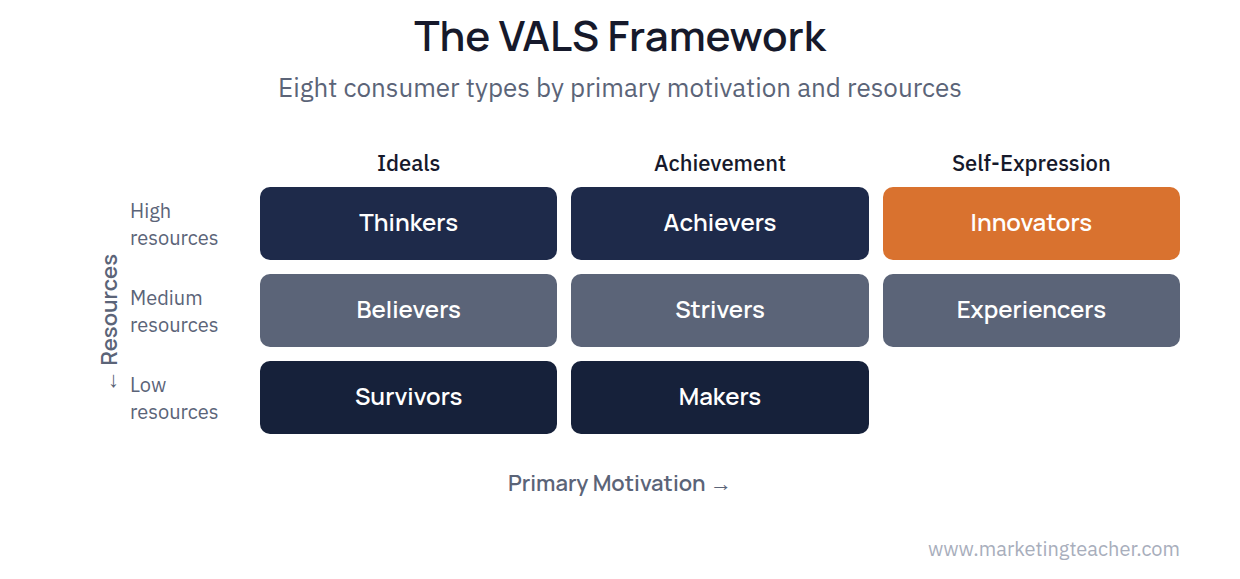
Alongside geographic, demographic and behavioral segmentation, marketers also segment audiences by psychology: what people value, how they see themselves, and what motivates their choices. The best-known framework for this is VALS (Values and Lifestyles), developed at SRI International and now maintained by Strategic Business Insights. VALS groups consumers into eight types based on two dimensions: primary motivation (whether a person is driven mainly by ideals, achievement, or self-expression) and resources (a composite of income, education, self-confidence, energy and eagerness to try new things, not income by itself).
The Two Dimensions Behind the Eight Types
It is worth being precise about what VALS actually measures, since a common misconception is that it simply ranks consumers by wealth. The “resources” dimension is broader than income: two people with identical salaries can land in very different VALS types depending on their confidence, curiosity and openness to new ideas, while VALS does not publish fixed income brackets for any of its eight types. Understanding this distinction matters, because appealing to a VALS type on income assumptions alone misses the values and motivations that actually drive that group’s decisions.
High-Resource Consumers
Innovators sit at the top of the resources scale: successful, sophisticated, and receptive to new products and technologies, they see image as an expression of taste and independence rather than pure status. Thinkers are also high-resource but motivated primarily by ideals: mature, satisfied, and reflective, they value knowledge, responsibility and functionality, and tend to be practical, well-informed consumers who research a purchase before making it. Achievers, motivated by achievement rather than ideals, are goal-oriented professionals who favor established, prestigious brands that signal success to their peers.
Experiencers and the Self-Expression Motivation
Experiencers are high-resource consumers motivated by self-expression: young, energetic and drawn to variety, they spend readily on clothing, entertainment and experiences and respond well to marketing that feels current and a little rebellious rather than polished. This group is often the first to adopt a new platform or trend, which makes it a useful early-adopter segment for a brand willing to move quickly.
Lower-Resource Consumers
Believers, the ideals-motivated counterpart to Thinkers among lower-resource consumers, hold conservative, traditional values rooted in family, community and established institutions, and favor familiar, trusted brands over novelty. Strivers, motivated by achievement but with fewer resources than Achievers, seek approval and a sense of status, and are drawn to products that signal success even when the underlying budget is tight. Makers, the lower-resource counterpart to Experiencers, are practical and self-sufficient, valuing function over image and preferring products that help them build, fix or maintain things themselves. Survivors, with the fewest resources of any type, focus on meeting immediate needs and tend to be cautious, loyal consumers of familiar, trusted brands rather than active seekers of anything new.
How to Appeal to Each Type
The practical value of VALS is in matching a message to motivation rather than demographics alone. Innovators respond to genuine novelty and a sense of taste; Thinkers respond to evidence, detail and functional value; Achievers respond to prestige and visible success; Experiencers respond to energy, variety and a sense of the current moment. Believers respond to tradition, trust and established reputation; Strivers respond to attainable status and peer approval; Makers respond to practicality and hands-on functionality; and Survivors respond to familiarity, loyalty programs and a clear, simple value proposition.
How VALS Types Are Actually Measured
A person’s VALS type is not assigned by a marketer’s guesswork; it comes from a structured survey instrument that asks about attitudes, self-image and lifestyle preferences, which respondents answer and are then scored against the two underlying dimensions of motivation and resources. This survey-based approach is part of why VALS has remained credible for decades: the typology is derived from actual reported attitudes rather than assumptions about what a given income bracket or age group is presumed to think.
A Framework, Not a Fixed Rulebook
VALS, like any psychographic model, describes tendencies rather than certainties about any one individual, and a marketer gets the most value from it when it is used alongside real customer research and behavioral data rather than as a standalone label. The framework itself has been revised over time as consumer attitudes shift, which is a useful reminder that psychographic categories describe a snapshot of a culture’s values at a point in time, not a permanent typology.
Summary
The VALS framework, developed at SRI International and maintained today by Strategic Business Insights, segments American consumers into eight types, Innovators, Thinkers, Achievers, Experiencers, Believers, Strivers, Makers and Survivors, based on their primary motivation and resources rather than income alone. For marketers, understanding which motivation drives a target audience, ideals, achievement or self-expression, gives a more reliable basis for a marketing appeal than demographic data by itself, provided the framework is tested against real customer behaviour rather than treated as a fixed rulebook.
The slides, worksheet, lesson plan and poster for this lesson are free to download and free to use in your course — no sign-up, no permission needed. See the teacher resources →
Assign this lesson to your class:
Using Canvas, Blackboard or Moodle? Copy the link and paste it into your course page or assignment. More ways to add lessons to your LMS.

