
What Is Artificial Intelligence in Social Media Marketing?
Kaplan and Haenlein (2019) define AI as “a system’s ability to correctly interpret external data, to learn from such data, and to use those learnings to achieve specific goals and tasks through flexible adaptation.” The OECD (2023), whose definition is widely used by governments, describes an AI system as “a machine-based system that, for explicit or implicit objectives, infers, from the input it receives, how to generate outputs such as predictions, content, recommendations, or decisions that can influence physical or virtual environments.”
The two definitions stress different things. Kaplan and Haenlein focus on learning: AI gets better as it takes in more data. The OECD focuses on outputs, and its list of predictions, content, recommendations and decisions fits social media marketing closely. Social platforms predict what you will click, recommend what you see next, and now generate content as well. Neither definition says AI must be human-like. A system that decides which advert to show you is AI in both senses.
For marketers, AI is not one tool. It is a set of capabilities built into almost every part of social media, from the feed itself to the reporting dashboard. A useful test to apply throughout this lesson is whether AI is supporting human marketers or quietly replacing their judgement.
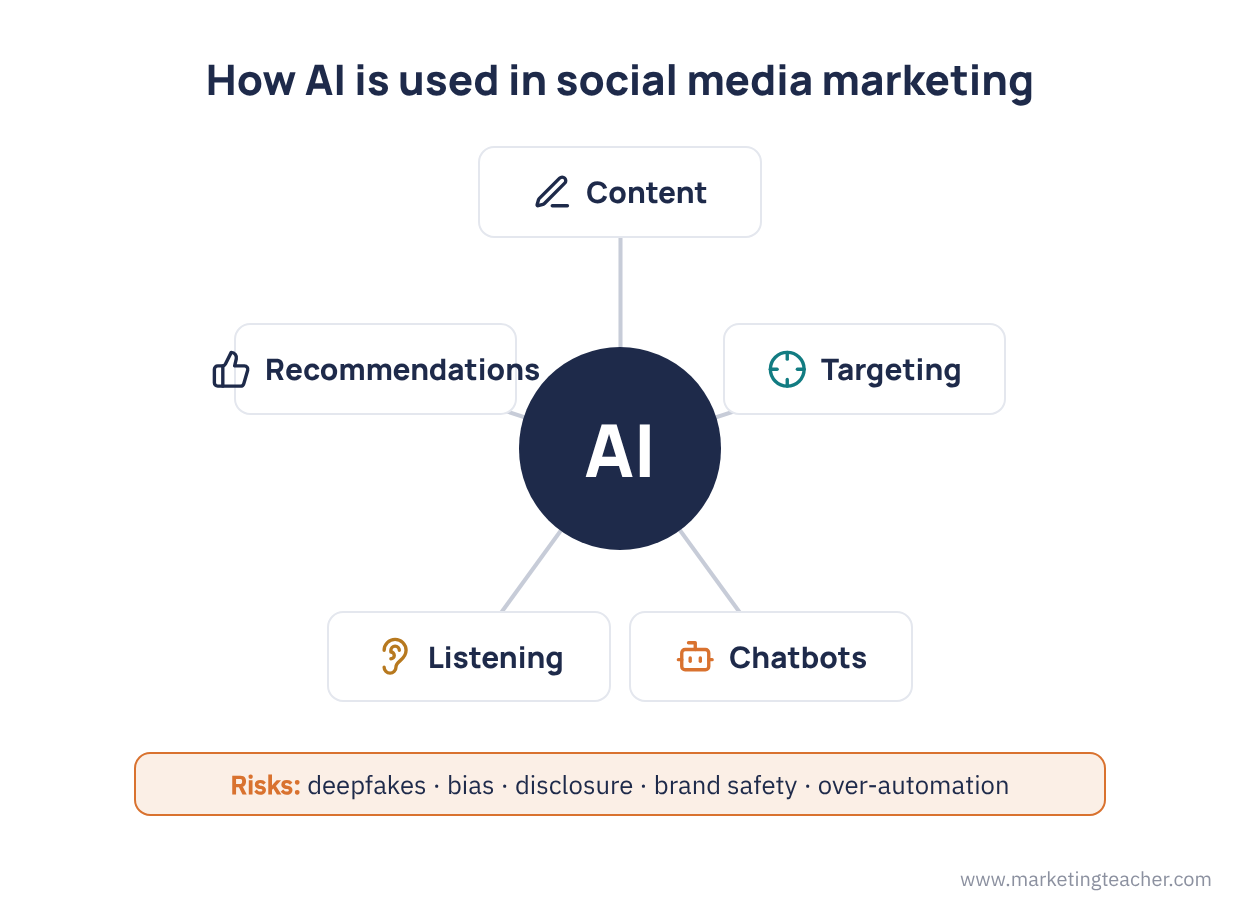
Five Ways AI Is Used in Social Media Marketing
1. Content creation. Generative AI tools can draft captions, suggest headlines, write alternative versions of an advert, and create or edit images and video. This saves time, especially for small teams. The quality still depends on a clear brief and a human edit. The Publishing Zone lesson explains why filler content rarely builds a brand, however quickly it is made.
2. Targeting and ad delivery. Platform advertising systems use machine learning to decide who sees an advert, when, and at what price. Marketers increasingly set a goal and a budget and let the system find the audience. See Social Media Advertising for how paid campaigns are structured.
3. Chatbots and customer service. AI chatbots answer common questions in messaging apps and on brand pages at any time of day. They work well for simple, repeated questions such as delivery times or returns. They work less well for complaints or emotional situations.
4. Social listening and analytics. AI can sort thousands of posts by topic and sentiment, spot sudden rises in mentions, and pick out logos in images. This turns listening from a manual task into an early warning system. The Monitoring vs Listening lesson covers the method behind this.
5. Recommendation algorithms. Every major platform uses AI to rank and recommend content. These systems decide whether a brand’s post reaches ten people or ten thousand. In practice, the algorithm is the most important “gatekeeper” a social media marketer deals with.
The Risks of AI in Social Media
Deepfakes. AI can produce realistic fake video, audio and images of real people. Ofcom (2024) found that nearly half of UK respondents aged 8 and over believed they had seen a deepfake in the previous six months. Fake celebrity endorsements are now a common feature of scam adverts. That damages trust in every brand that uses social media.
Bias. AI learns from data, and data reflects past human choices. A system trained on biased data can reproduce stereotypes in the images it makes or show adverts unevenly to different groups. The ASA (2026) treats AI bias as a compliance issue: in one ruling, adverts for an AI app that objectified women broke the advertising rules, and the advertiser was held responsible for the AI output it chose to use.
Disclosure. There is no blanket UK legal rule that every use of AI in an advert must be labelled. The UK’s advertising regulator, the ASA, states that the CAP Code has no AI-specific rules, but its existing rules apply in full. If an AI-generated image exaggerates what a product does, the advert is misleading, and a small “made with AI” label will not fix it (ASA, 2025).
Brand safety and responsibility. The ASA (2026) also warns that automated campaigns do not shift responsibility: when an advert is made with a platform’s automated tools, the advertiser is still responsible for the final result. The same applies to AI outputs that are offensive or that place a brand next to harmful content.
Over-automation. Too much automation can make a brand seem cold or careless. It can also be costly. In Moffatt v Air Canada (2024), a Canadian tribunal held the airline responsible for wrong refund information given by its own website chatbot. A brand cannot blame the bot.
Using AI Responsibly: A Simple Checklist
Before using AI in a social media campaign, ask four questions:
- Is a human in the loop? Someone should review AI content before it is published.
- Could it mislead? If the output exaggerates or invents, change it rather than just labelling it.
- Is it fair? Check images and targeting for stereotypes or excluded groups.
- Does the customer know when it matters? Be open about chatbots and AI personas, and always offer a route to a person.
These questions link directly to wider marketing ethics. See Marketing Ethics: Doing the Right Thing for Customers.
Summary
AI is a machine-based system that learns from data and produces predictions, content, recommendations or decisions (Kaplan & Haenlein, 2019; OECD, 2023). In social media marketing it is used for content creation, ad targeting, chatbots, listening and analytics, and above all in the recommendation algorithms that control organic reach. It brings real gains in speed and insight. It also brings risks: deepfakes, bias, misleading content, brand-safety failures and over-automation. UK regulators are clear that existing advertising rules apply to AI content and that the advertiser remains responsible for it. The best approach treats AI as a capable assistant, with a human checking the work.
The slides, worksheet, lesson plan and poster for this lesson are free to download and free to use in your course — no sign-up, no permission needed. See the teacher resources →
Assign this lesson to your class:
Using Canvas, Blackboard or Moodle? Copy the link and paste it into your course page or assignment. More ways to add lessons to your LMS.

