
What Is Standard Costing?
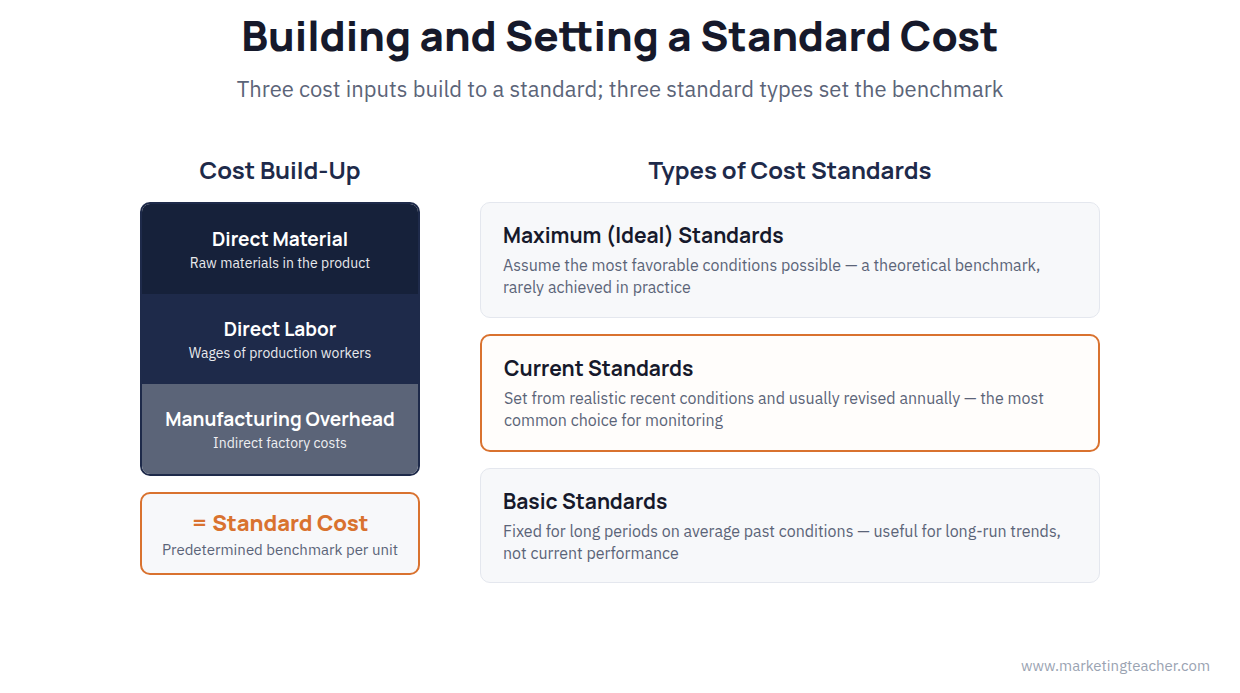
Standard costing is a cost accounting technique that sets a predetermined, expected cost for a unit of production, then compares actual costs against that standard to monitor performance. It is of particular value to manufacturing businesses, where the cost of direct material, direct labor and manufacturing overhead can be estimated with reasonable accuracy in advance and then checked against what production actually costs once it happens. Drury and Tayles (2024) describe standard costing as one of the clearest applications of performance management within cost accounting, since it gives a business a concrete benchmark rather than a vague sense of whether costs are under control.
The Three Cost Categories Standard Costing Monitors
A typical standard costing system tracks three categories of manufacturing cost. Direct material costs cover the raw materials that go directly into a finished product. Direct labor costs cover the wages of workers directly involved in production. Manufacturing overhead covers the indirect costs of running a production facility, factory utilities, equipment depreciation and supervisory salaries among them, that cannot be traced to a single unit as easily as material or labor can.
Who Sets a Standard Cost?
Setting a realistic standard cost is rarely a one-person job. A typical company forms a standard costing committee that draws on several roles: a cost accountant to model the numbers, a production manager to confirm the standards reflect achievable factory conditions, a personnel manager to account for realistic labor costs and staffing levels, and a purchasing manager to confirm realistic material prices and supplier lead times. This group also classifies costs in more detail, by function (production, selling, distribution), by behaviour (fixed or variable), and by traceability (direct or indirect), so that the resulting standards are detailed enough to be useful for monitoring performance.
Three Types of Cost Standards
Once a company decides to use standard costing, it must choose which type of standard to set, since each involves a different trade-off between ambition and realism. Maximum, or ideal, standards assume the most favourable possible conditions, no downtime, no waste, no inefficiency, and are useful as a theoretical benchmark but rarely achieved in practice. Current standards are developed from recent, realistic company and industry conditions and are usually revised annually, making them the most common choice for day-to-day performance monitoring. Basic standards are set once and left unchanged for long periods, often based on average conditions over several years; they are useful for tracking long-run cost trends but, because they are not adjusted for current conditions, are less useful for judging this year’s performance specifically (Drury and Tayles, 2024).
From Standards to Variance Analysis
The real value of a standard cost comes from comparing it against what actually happened, a process called variance analysis. When actual costs come in below standard, the resulting favourable variance suggests a business is operating more efficiently than expected, perhaps due to a lower material price or a more productive labor process. When actual costs exceed standard, the unfavourable variance flags a problem worth investigating, rising material prices, labor inefficiency, or excessive machine downtime among the common causes. Variance analysis can be broken down further into a price variance (did the input cost more or less than expected) and a quantity or efficiency variance (did the process use more or less of the input than expected), which together tell a manager not just that a cost overran but broadly why. A single unfavourable total variance can even hide a favourable price variance offset by a larger unfavourable efficiency variance, which is exactly why breaking the total down matters rather than stopping at the headline number.
Standard Costing and Related Techniques
Standard costing sits alongside other cost accounting approaches a business might use depending on its situation. Where standard costing works from a predetermined benchmark, Activity-Based Costing instead assigns overhead costs based on the specific activities that actually drive them, which can be more accurate in businesses with highly varied products. Understanding the distinction between direct and indirect costs is foundational to both approaches, since how a cost is classified determines how it gets built into a standard in the first place.
Summary
Standard costing predicts a cost for direct material, direct labor and manufacturing overhead, then compares actual results against that prediction to monitor performance (Drury and Tayles, 2024). A standard costing committee chooses between maximum, current or basic standards depending on whether the goal is an aspirational benchmark, realistic annual monitoring, or a stable long-run baseline, and the resulting favourable or unfavourable variances give managers a structured way to investigate exactly where and why costs diverged from plan.
The slides, worksheet, lesson plan and poster for this lesson are free to download and free to use in your course — no sign-up, no permission needed. See the teacher resources →
Assign this lesson to your class:
Using Canvas, Blackboard or Moodle? Copy the link and paste it into your course page or assignment. More ways to add lessons to your LMS.

