
What Is Website Optimization?
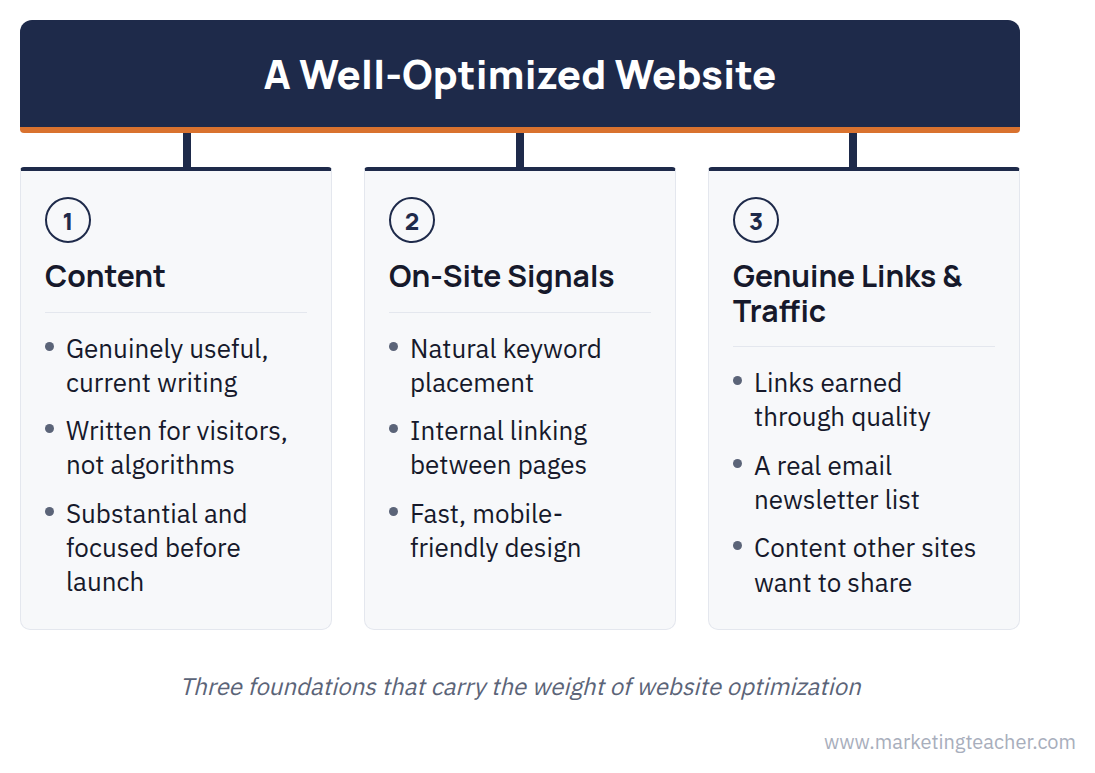
Website optimization means improving a website’s own content and structure so that it attracts more visitors and serves them better, as distinct from paid internet advertising, which buys visibility rather than earning it. It sits alongside the more technical discipline of search engine optimisation, covered in its own dedicated lesson in this Lessonstore, but is broader: it also covers the quality of the content itself and how easily a visitor can use the site once they arrive, not only how a search engine reads it. Chaffey and Ellis-Chadwick (2019) frame this distinction as one of earned versus paid and owned visibility: website optimization and search engine optimisation both build a site’s owned and earned presence, while internet advertising, covered in this batch’s own lesson on the subject, buys visibility directly.
Content Is Still King
Gates (1996) argued in a widely cited early essay on the internet that “content is king,” and this remains true of website optimization decades later: a site’s long-term traffic depends far more on genuinely useful, well-written content that visitors value and return to than on any technical trick. A website should have substantial, focused content in place before it goes live, since a thin or poorly prepared site rarely recovers the trust of a first-time visitor. Content should stay genuinely useful and current rather than reading like a static online brochure, and it should be written primarily for the visitor rather than stuffed with a chosen keyword purely to influence rankings, since search engines are now much better at recognising and penalising content written for algorithms rather than people.
On-Site Signals That Still Matter
A handful of on-page factors remain genuinely useful signals for both visitors and search engines, and the site’s own dedicated search engine optimisation lesson covers the technical detail of these in full. Including a page’s main keyword naturally in its title, meta description, and heading tags helps both a search engine and a human scanning results understand what the page is about, provided it reads naturally rather than being forced in repeatedly. A once-common rule of thumb, aiming for a fixed keyword density such as a set percentage of a page’s total word count, is now outdated and can do more harm than good: modern search engines assess relevance through many combined signals rather than counting keyword repetitions, so writing naturally for a human reader is both the safer and the more effective approach. Site structure matters too: linking between related pages on the same site, sometimes called internal or cross linking, helps visitors move naturally from a popular page to related, less-visited ones, and keeps important pages within a small number of clicks of the homepage rather than buried deep in the site. A clear, memorable domain name and a genuinely mobile-friendly, fast-loading site design are now baseline expectations rather than optional extras, since a slow or hard-to-use site loses visitors before its content ever gets a chance to work.
Building Genuine Traffic and Links
Building traffic and links takes patience rather than shortcuts. Earning links from other relevant, reputable websites, through genuinely useful content that other sites want to reference, carries far more long-term value than manually exchanging links with unrelated sites, a once-common practice that is now more likely to be treated as a manipulation signal than a ranking boost. Other realistic approaches include encouraging visitors to bookmark or return to the site, building a genuine email list for a newsletter rather than a one-off promotional blast, and letting other sites republish original content with clear credit and a link back to the source. A business without the in-house skills to manage these areas often brings in a specialist consultant, but the underlying goal, useful content that other people and sites genuinely want to link to, cannot be outsourced away entirely.
Summary
Website optimization improves a site’s own content and structure to attract and retain visitors, working alongside rather than replacing dedicated search engine optimisation and paid internet advertising. Genuinely useful, well-written content remains the most durable driver of traffic, as Gates (1996) recognised early in the internet’s history. Sensible on-page structure, internal linking, and a fast, mobile-friendly site all still matter, but links and traffic earned through genuine quality now carry far more weight than manually exchanged links or keyword-stuffed pages ever did.
The slides, worksheet, lesson plan and poster for this lesson are free to download and free to use in your course — no sign-up, no permission needed. See the teacher resources →
Assign this lesson to your class:
Using Canvas, Blackboard or Moodle? Copy the link and paste it into your course page or assignment. More ways to add lessons to your LMS.

