
Who Is the Social Media Consumer?
Before a business chooses a platform, a posting schedule or a tone of voice, it needs to understand who it is actually talking to. Market segmentation is the process of dividing a market into distinct groups that share common needs and characteristics, and marketers traditionally do this using geographic, demographic, psychographic and behavioural variables (Tuten & Solomon, 2018). Social media marketing adds a further layer on top of these familiar bases: how digital a person’s life actually is. Two people can share the same age, income and postcode and still behave completely differently online — one checks a brand’s Twitter account daily, the other has never followed a brand in their life. Understanding that difference, not just the demographic label, is what separates an effective social strategy from a wasted budget.
Building a Social Identity
Social identity is the part of a person’s self-concept that comes from their perceived membership of a group (Tajfel & Turner, 1979). When you post on Instagram, comment in a Facebook group, or simply follow a set of accounts, you are signalling which groups matter to you — and marketers read those signals closely. Tuten and Solomon (2018) describe the resulting trail as a social footprint: the cumulative mark a person leaves behind through their social media activity, from a liked post to a tagged photo. Collected at scale, this residue becomes what researchers call big social data, and it lets a brand build a far richer picture of a customer than a name and an email address ever could.
People manage this footprint deliberately. Choosing a username, deciding what to share and what to leave out, and curating a feed are all acts of building what Tuten and Solomon (2018) call a social brand — a version of yourself constructed for an online audience. For marketers, the practical implication is that the “you” visible on social media is a performance as much as a record, and it should be read as such.
Why Do People Actually Participate?
Knowing that people are active on social media is not the same as knowing why. Tuten and Solomon (2018) group the underlying motives into a small set of recurring impulses. The affinity impulse describes the desire to acknowledge a relationship or a shared interest — the reason you follow old classmates or a hobby community. The personal utility impulse is more self-interested: people participate because a platform gives them something useful, whether that is information, a discount, entertainment or convenience. The contact comfort and immediacy impulse reflects a basic human need to feel psychologically close to others and to get a fast response — it is why an unanswered brand comment on Twitter can feel like a real slight to the person who left it. The altruistic impulse drives people to use social media to do good, from crisis-relief donations to calling out unfair treatment. The curiosity impulse explains the pull of following a public figure’s every move. And the validation impulse, sometimes called the ego-defensive function, covers the very human desire to be noticed, liked and affirmed by others.
No single impulse explains all behaviour, and most people act on several at once. But recognising which impulse a piece of content is likely to trigger is a genuinely useful design question for a marketer to ask before publishing: does this post give people something to feel with others (affinity), from the brand (utility), or about themselves (validation)?
Segmenting by Social Behaviour: The Technographics Ladder
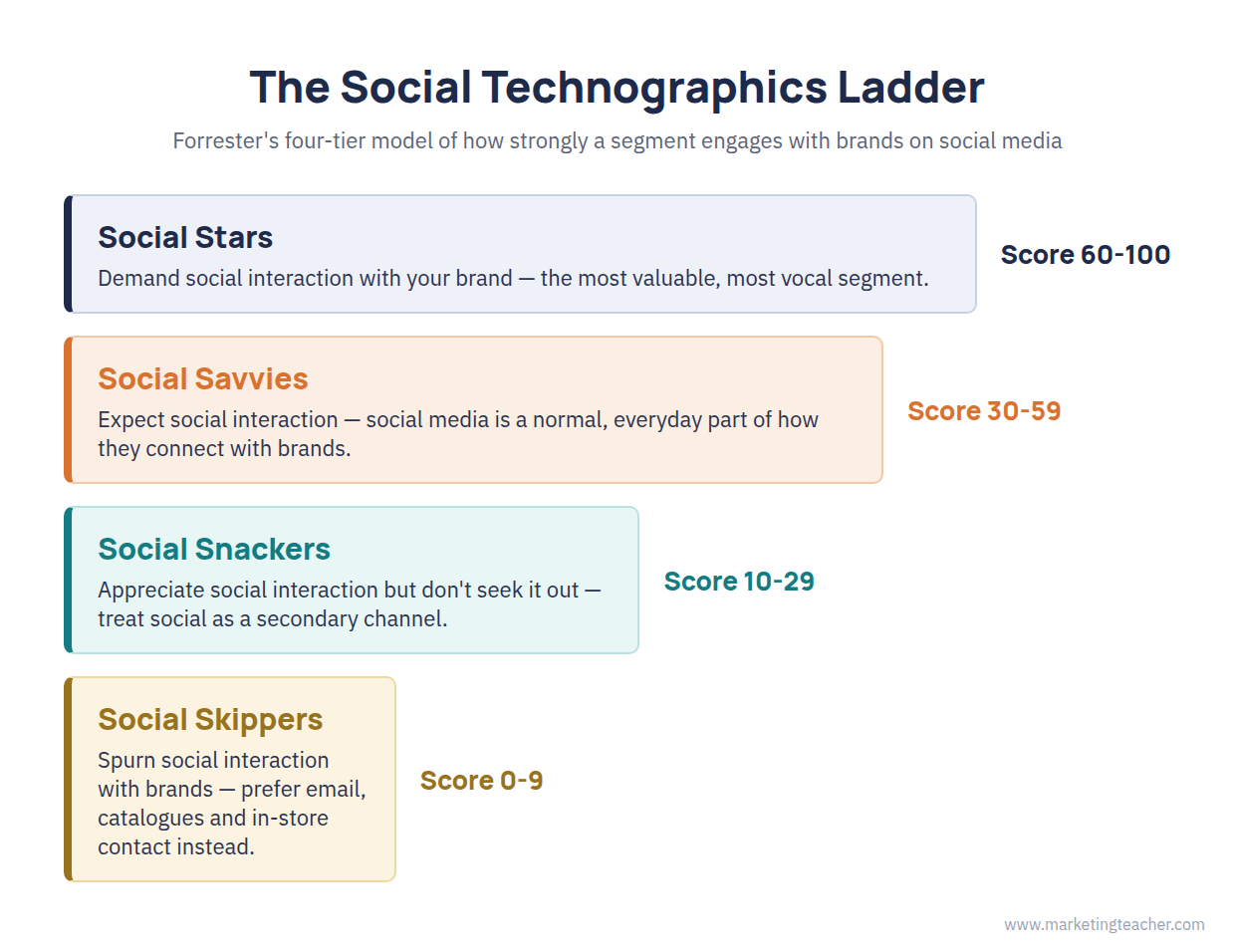
Because not everyone uses social media with the same intensity, Forrester Research developed a model called Social Technographics, later popularised in the book Groundswell (Li & Bernoff, 2008), to score how actively a person engages with social tools on a scale of 0 to 100. Tuten and Solomon (2018) summarise the model as four tiers. Social stars, scoring 60 and above, actively demand social interaction with the brands they use and are highly valuable customers to acquire. Social savvies, scoring 30–59, expect a brand to be present and responsive on social media as a normal part of doing business. Social snackers, scoring 10–29, will engage occasionally but do not go looking for it, so social tools should be treated as a secondary channel for this group. Social skippers, scoring 0–9, avoid brand interaction on social media almost entirely, preferring email, catalogues or a physical store — and, perhaps counterintuitively, they still make up a meaningful slice of the general population.
Privacy and the Limits of Knowing Your Audience
The same data that makes segmentation powerful also raises real concerns. Tuten and Solomon (2018) describe the privacy paradox: people report high levels of concern about their personal data, yet continue to share freely on social platforms. Pew Research Center’s ongoing surveys of teen social media use, cited by Tuten and Solomon (2018), found the large majority of teenage users had posted their real name and a selfie to their profiles, despite broader anxieties about online privacy. Marketers who build strategies on social data have a responsibility to use it thoughtfully — segmentation is a tool for relevance, not an excuse for intrusion.
Summary
Effective social media marketing starts with understanding the audience on its own terms: the social identity people construct online (Tajfel & Turner, 1979; Tuten & Solomon, 2018), the impulses — affinity, utility, contact comfort, altruism, curiosity and validation — that drive their participation, and the intensity of engagement captured by Forrester’s Social Technographics ladder (Li & Bernoff, 2008). Layering this behavioural understanding on top of traditional demographic segmentation is what allows a brand to design a social strategy that actually fits the people it is trying to reach.

