
What Is the Social Commerce Zone?
Tuten and Solomon (2018) define social commerce as a subset of e-commerce that uses social media applications to let shoppers interact and collaborate throughout the buying process, while helping marketers sell to them along the way. It is worth separating two related terms: social shopping is the behaviour of consumers using social media within their own purchase decisions — reading reviews, asking friends for opinions — while social commerce is the marketer’s side, the commercial use of social media to acquire and retain customers. Both sit on top of the same underlying idea covered throughout this course: shopping has always been a social activity, and social commerce simply brings that “purchase pal” dynamic online.
The Main Channels of Social Commerce
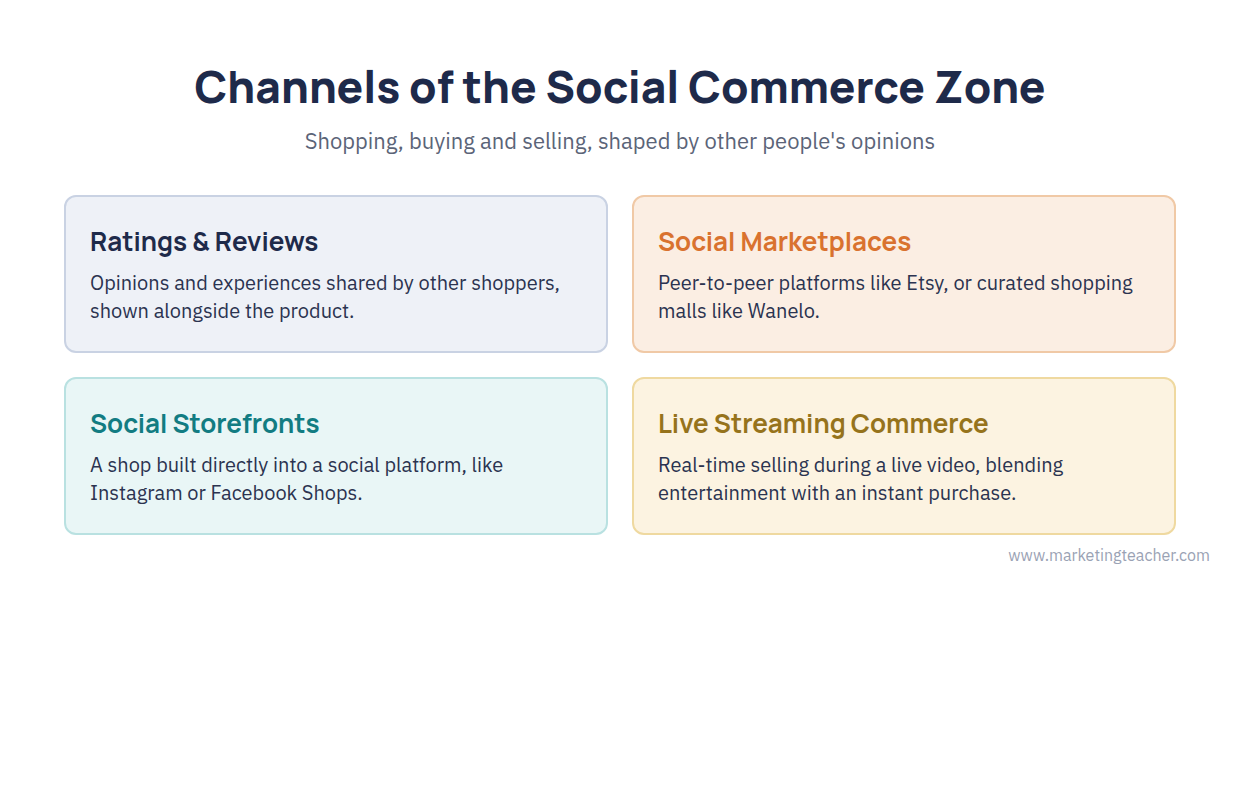
Tuten and Solomon (2018) group social commerce into several connected channels. Ratings and reviews let past customers share their opinions and experiences directly alongside a product. Social marketplaces, such as Etsy or curated shopping sites, connect peer sellers with buyers inside a social framework. Social storefronts embed an actual shop directly inside a social platform, letting someone buy without ever leaving the app they were already scrolling through. More recently, live streaming commerce has emerged as a hybrid of entertainment and retail, where a host demonstrates and sells products during a live video and viewers purchase in real time.
The Zero Moment of Truth: Why the Research Phase Matters So Much
Tuten and Solomon (2018) describe the Zero Moment of Truth (ZMOT), a concept coined by Google’s Jim Lecinski, as the research a consumer does online before ever reaching a store shelf (the First Moment of Truth) or using the product (the Second Moment of Truth). On average, shoppers consult more than ten sources of information before buying, and much of that research happens on social platforms — reviews, ratings, and recommendations from people in their own network. Academic work following Lecinski’s original concept has continued to confirm just how much this online research phase shapes the eventual purchase decision (Ertemel, 2015).
Reviews and Ratings: A Genuinely Powerful Force
Tuten and Solomon (2018) report that the vast majority of shoppers read reviews before buying, and a large share of mobile shoppers say they are more likely to purchase when reviews are visible on the page. Reviews and ratings do different jobs: a rating is a quick heuristic — a mental shortcut, useful when comparing many options fast — while a review offers the deeper detail a shopper wants when the decision matters more. Interestingly, a high volume of reviews matters more to buyers than the occasional negative one, and shoppers actively seek out some negative reviews as a sign that the rest are authentic rather than manufactured.
Social Commerce Touches Every Stage of the Decision
Tuten and Solomon (2018) map social commerce onto the five classic stages of consumer decision-making: problem recognition, information search, alternative evaluation, purchase, and post-purchase evaluation. Social media can trigger the very first stage — a friend’s post or an influencer’s content can be what makes someone realise they want something in the first place — and it continues to shape the search and evaluation stages through reviews, ratings, and direct recommendations from people the shopper actually knows and trusts. Even after the sale, social media remains active: Tuten and Solomon (2018) describe a “Third Moment of Truth,” the point at which a customer posts publicly about their experience, good or bad, and a brand’s response (or lack of one) can turn that moment into either a loyal advocate or a public complaint. Most social media users expect a response to a customer service query within a few hours, so a brand’s speed and tone in that moment carries real commercial weight.
Why This Pays Off Commercially
Tuten and Solomon (2018) cite research on independent restaurants where a one-star increase in average rating was associated with a meaningful annual revenue increase, and unsolicited, organic reviews on review platforms were linked to thousands of dollars in additional yearly revenue even for businesses that weren’t actively advertising. Reviews also tend to improve organic search visibility, since reviewers naturally use the same everyday language that other shoppers search for.
None of this works, though, without trust. Tuten and Solomon (2018) note that a meaningful share of online reviews are estimated to be fraudulent, whether posted by competitors or by people who never actually bought the product, which is why platforms increasingly restrict incentivized reviews and why brands should be transparent whenever a review was invited or rewarded rather than fully organic.
Summary
The social commerce zone spans ratings and reviews, social marketplaces, social storefronts, and live streaming commerce, all built around the same insight: people research and validate purchases socially, whether they are choosing a restaurant or a set of bed linens. Understanding the Zero Moment of Truth, and taking reviews seriously as both a trust signal and a revenue driver, is central to marketing effectively in this zone (Tuten & Solomon, 2018).

