
How Is Artificial Intelligence Changing Marketing?
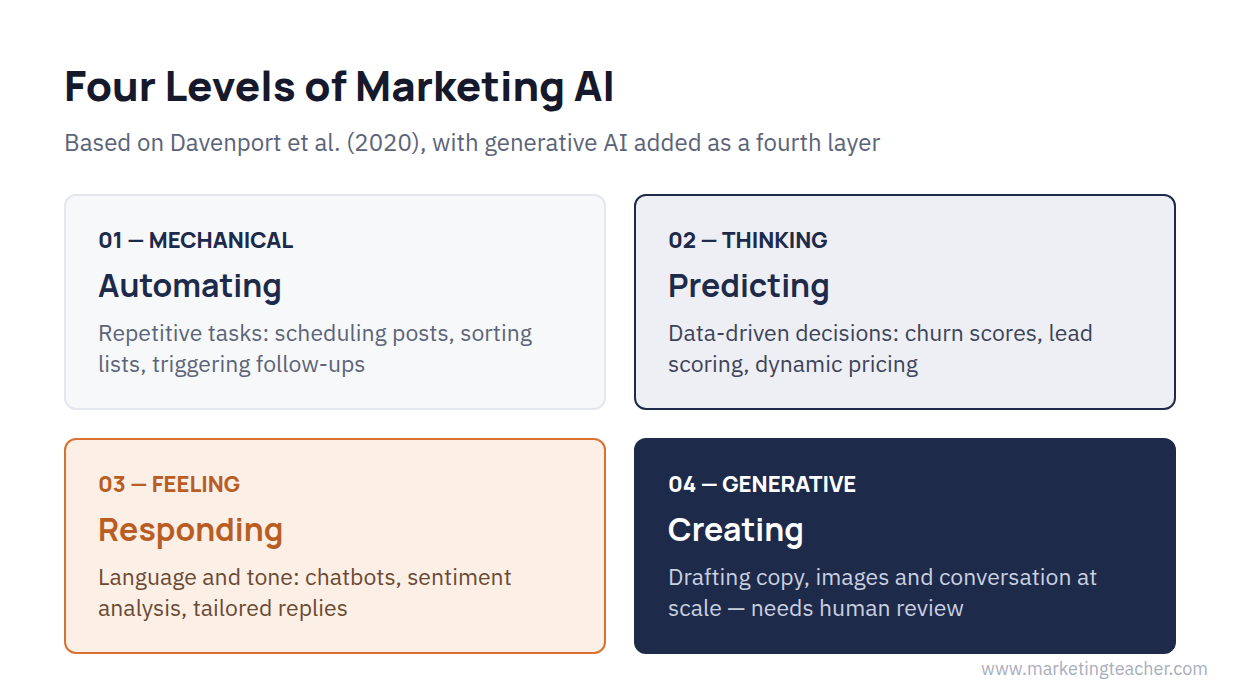
Artificial intelligence (AI) has moved from a futuristic buzzword to a working part of most marketing teams’ toolkits, from the recommendation engine that decides what a shopper sees next to the chatbot that answers a customer’s question at midnight. Rather than treating “AI in marketing” as one single thing, it helps to separate it into three levels of capability, based on the widely-cited framework from Davenport, Guha, Grewal and Bressgott (2020): mechanical AI, which automates repetitive tasks; thinking AI, which uses data to learn and predict; and feeling AI, which interprets and responds to human language and emotion. Most of the AI tools a marketer encounters day to day sit somewhere on this spectrum, and understanding which level a tool operates at is the first step to using it well.
From Automating Tasks to Augmenting Judgement
Mechanical AI is the least visible but most widespread level: it automates routine, repetitive work that used to take a person’s time, such as scheduling social media posts, sorting email lists into segments, or triggering a follow-up message when a shopper abandons a cart. Thinking AI goes a step further, using historical data to spot patterns and make predictions a human would struggle to make at the same scale, such as forecasting which customers are likely to churn, scoring which leads are worth a salesperson’s time, or adjusting an online price in real time based on demand. Feeling AI is the newest and most visible layer, covering tools that process natural language and tone, from a customer service chatbot to sentiment analysis that scans social media mentions for how customers feel about a brand. None of these levels replaces the others; a mature marketing operation typically uses all three together, with mechanical AI freeing up time, thinking AI sharpening decisions, and feeling AI handling the more conversational, emotionally-aware parts of the customer relationship.
Generative AI and the New Content Layer
The arrival of large language models added a fourth, fast-moving capability on top of Davenport’s three levels: generative AI, which can draft text, produce images, and hold a conversation rather than simply classifying or predicting. Kshetri, Dwivedi, Davenport and Panteli (2024) describe how generative AI is being applied across marketing functions, from drafting first versions of ad copy and product descriptions to powering chat-based customer engagement and personalizing content at a scale no human team could match manually. The same research also sets out the opportunities and the open challenges this creates: generative tools can dramatically cut the time to a first draft and support more personalization, but they raise real questions around factual accuracy, keeping a consistent brand voice across thousands of AI-assisted pieces, and how much a business should disclose to customers about where AI has been used. Their research agenda is explicit that these are still open problems for marketing teams to work through, not settled practice.
Risks and Limits Marketers Still Need to Manage
None of this makes AI a replacement for marketing judgement. Predictive and generative tools are only as good as the data and examples they are trained on, so a biased or unrepresentative dataset can quietly produce biased targeting or messaging; a common example is a lookalike-audience tool that, left unchecked, narrows a campaign’s reach to a less diverse group than the brand intended. Generative AI in particular still makes confident-sounding factual errors, so any AI-drafted content needs a human review step before it reaches a customer, not just a light proofread. There is also a trust dimension: customers who discover that a supposedly personal message or review was AI-generated without disclosure tend to trust the brand less afterward, which is why several regulators and platforms are moving toward disclosure requirements for AI-generated marketing content. The practical rule most teams settle on is to let AI handle the first draft, the pattern-spotting, and the routine reply, while keeping a person accountable for anything that represents the brand’s voice or a factual claim.
Summary
Artificial intelligence in marketing is best understood as three levels working together: mechanical AI automating routine tasks, thinking AI turning data into predictions, and feeling AI handling language and emotion, with generative AI now adding a fast-moving fourth layer that can draft content and hold conversations directly. Used well, as in Cinder & Sage’s move from one-size-fits-all email to data-driven segmentation, AI frees up time and sharpens decisions a human team could not make at the same scale alone. Used carelessly, the same tools can quietly encode bias, produce confident errors, or erode customer trust — which is why every level of marketing AI still needs a human accountable for what it ultimately produces.
The slides, worksheet, lesson plan and poster for this lesson are free to download and free to use in your course — no sign-up, no permission needed. See the teacher resources →
Assign this lesson to your class:
Using Canvas, Blackboard or Moodle? Copy the link and paste it into your course page or assignment. More ways to add lessons to your LMS.

