
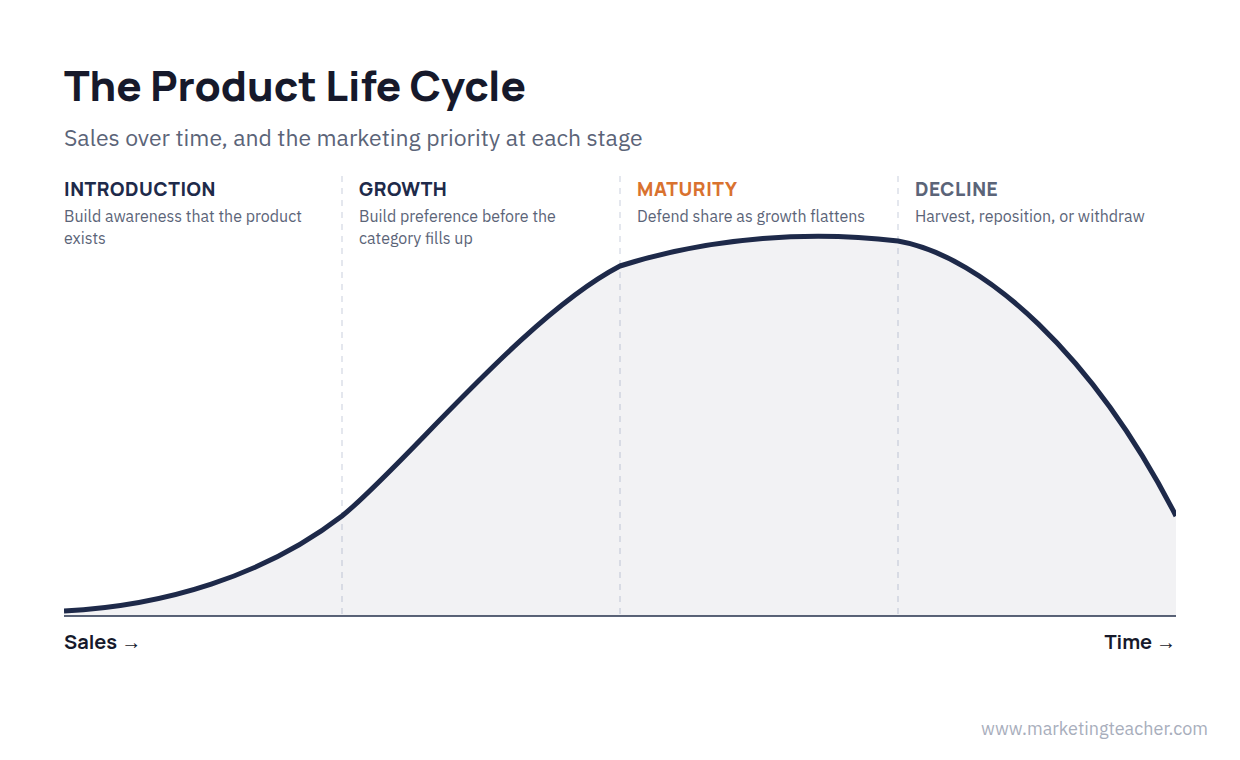
The Four Stages
The product life cycle, popularised by Levitt (1965), describes a typical sales pattern in four stages: introduction, growth, maturity and decline. Kotler and Keller (2016) note that promotional spending is usually heaviest in the introduction and growth stages, when the goal is to build awareness and market share faster than customer demand alone would have grown it – not in decline, when demand itself has already turned down.
Where Is the Colorado Ricardo Bike?
What Decline-Stage Strategy Actually Looks Like
The standard responses to decline are to harvest the product (cut costs and marketing spend, keep it available for loyal remaining customers, and let it wind down profitably), or to replace it with a new offering aimed at the same underlying need – which is exactly why Colorado Ricardo’s real strategic answer is not a bigger advertising budget for the old bike, but investment in the e-mountain-bike and gravel-bike lines discussed throughout this course.
This is the same underlying decision explored from a strategic-options angle in the Ansoff’s Matrix exercise.
The slides, worksheet, lesson plan and poster for this lesson are free to download and free to use in your course — no sign-up, no permission needed. See the teacher resources →
Assign this lesson to your class:
Using Canvas, Blackboard or Moodle? Copy the link and paste it into your course page or assignment. More ways to add lessons to your LMS.

