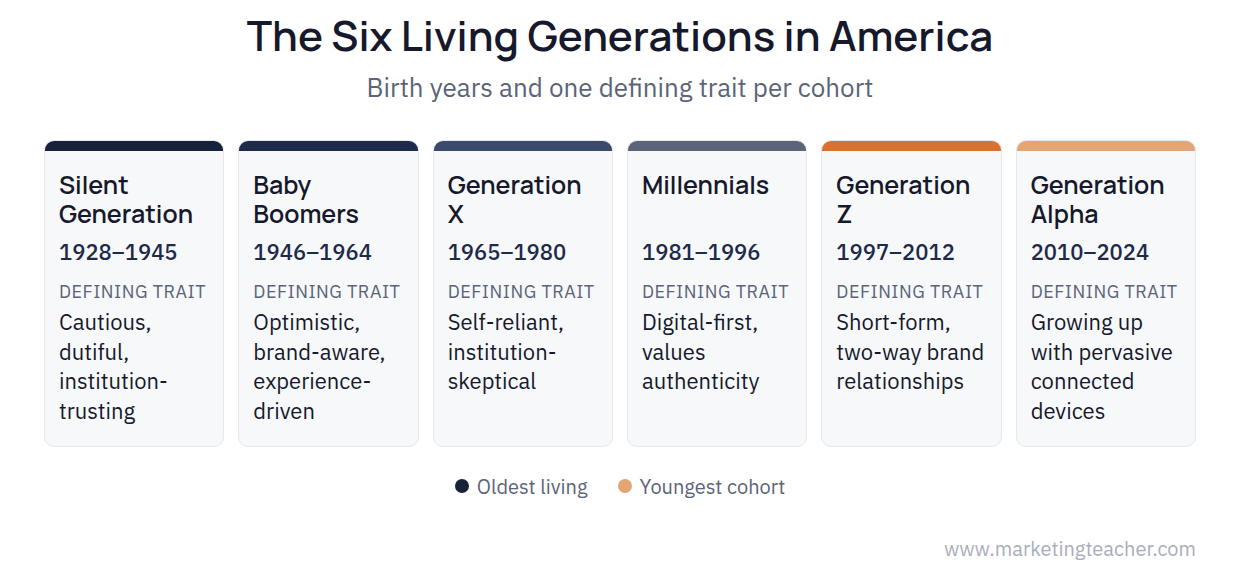
Generations Are Shaped by Shared Formative Experiences
Strauss and Howe (1991) argue that a generation is defined less by birth year alone than by the shared social, economic and technological conditions of its members’ childhood and early adulthood, which shape lasting attitudes and behaviours. The commonly used cohort labels – Baby Boomers, Generation X, Millennials, Generation Z, and Generation Alpha, with the oldest named cohort coined by researcher Mark McCrindle (2021) – are widely used in marketing to describe these differences (Dimock, 2019; McCrindle, 2021).
Applying This to Colorado Ricardo
Worked example
Colorado Ricardo’s long-standing, loyal customer base skews toward Generation X and Baby Boomer riders, who discovered the brand through word of mouth, local cycling clubs and years of repeat purchases at the Denver showroom. The newer enquiries about the e-mountain-bike are more consistent with Millennial and Generation Z riders, who research products online first, expect a strong social media presence and digital purchase path, and are more likely to be drawn to the sustainability story of an electric bike than to the brand’s decades-long heritage alone.
Key point
Dimock (2019) and McCrindle (2021) both stress that each generation’s formative years leave a lasting mark on how its members discover and evaluate brands. Marketing to a newer generation of Colorado Ricardo customers means building a genuine digital and social media presence alongside the direct, in-person showroom experience that built the brand’s original following – not replacing one with the other.
This generational shift is one input into the wider Segmentation decision covered elsewhere in this course.
Teaching this topic?
The slides, worksheet, lesson plan and poster for this lesson are free to download and free to use in your course — no sign-up, no permission needed. See the teacher resources →
Assign this lesson to your class:
Using Canvas, Blackboard or Moodle? Copy the link and paste it into your course page or assignment. More ways to add lessons to your LMS.
Online course · certificate on completion
Study a full online course — and earn a certificate
Three courses that turn the free lessons into ordered modules, written at university Levels 4 to 6, with a short quiz after each.


