
What Is Cross-Border E-commerce?
Cross-border e-commerce is the online sale of goods or services to a customer in a different country from the seller’s own, usually through a website, app or online marketplace. It is different from ordinary exporting because the transaction itself, not just the shipment, happens online: a shopper in Toronto can browse a UK retailer’s site, pay in Canadian dollars, and have a parcel clear customs days later without ever speaking to anyone at the company. Doole, Lowe and Kenyon (2022) describe this as a distinct direct-marketing channel in its own right, one that lets even small firms “market products and services globally from the first day of operation” rather than building an overseas presence first.
For many small and medium-sized exporters, a marketplace is the easiest way in. Alibaba’s business-to-business platform, for example, was built specifically to let small Chinese exporters and manufacturers sell their goods internationally without ever opening an overseas office (Doole, Lowe and Kenyon, 2022). The marketplace supplies the shopfront, the payment rails and, often, the buyer’s trust — cutting out many of the traditional intermediaries a seller would otherwise need in each country — but the seller still has to work out everything that happens after the “buy” button is clicked.
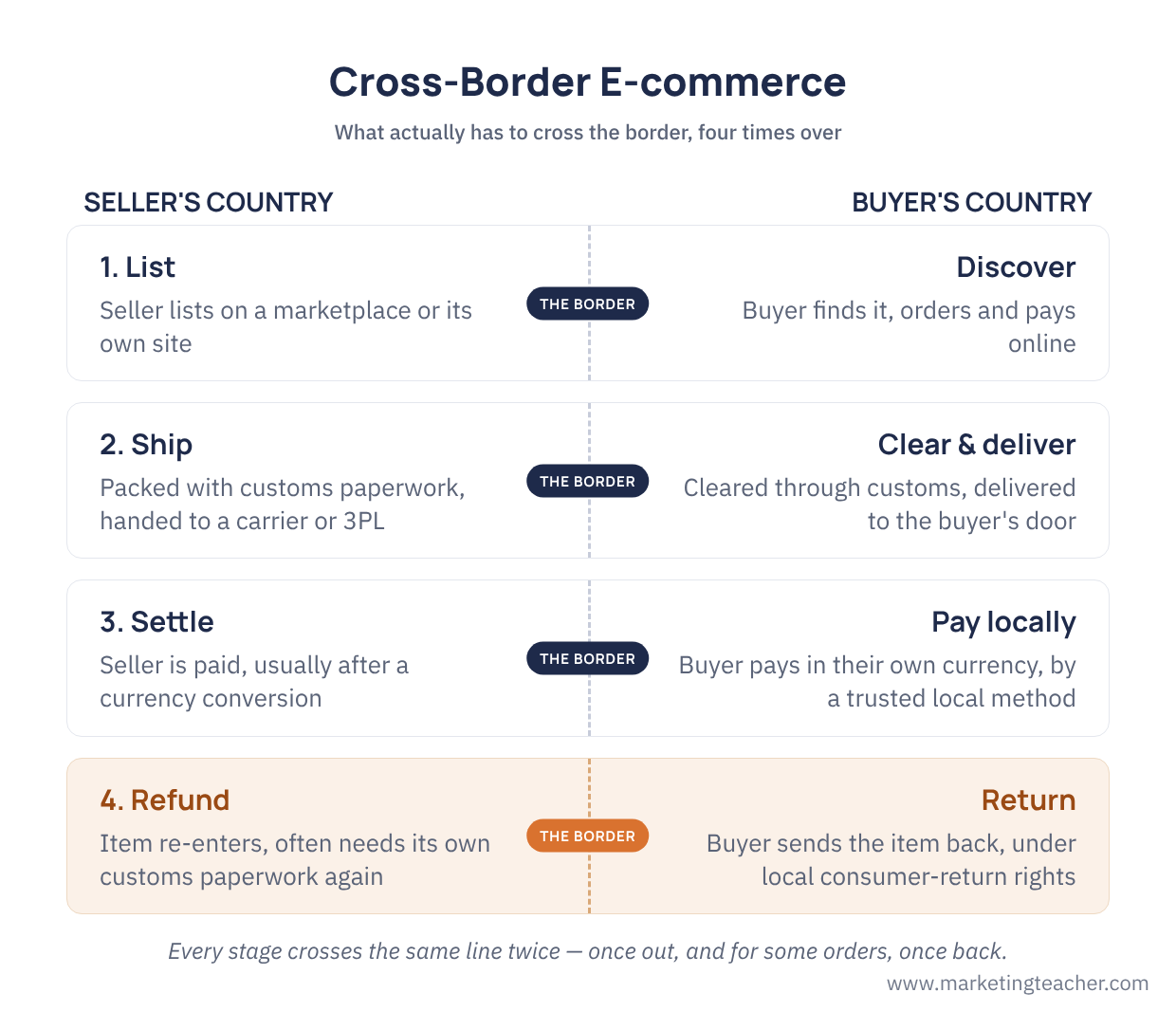
Why Cross-Border E-commerce Keeps Growing
The market is expanding quickly. Juniper Research (2023) forecasts that cross-border e-commerce transactions will rise from US$1.63 trillion in 2023 to US$3.37 trillion by 2028 — a 107 per cent increase in five years, driven by marketplaces, improved international shipping networks and consumers who are now comfortable buying directly from another country. Growth is no longer confined to physical goods: “pure play” retailers that trade online only, with no shops at all, such as Asos (UK) and Namshi (Middle East), have built entire businesses on exactly this model, usually keeping the product itself standardised across markets rather than adapting it country by country (Doole, Lowe and Kenyon, 2022).
Three Practical Barriers: Logistics, Payments and Local Trust
Listing a product on an international marketplace is the easy part. Doole, Lowe and Kenyon (2022) set out three questions every cross-border seller has to answer. Who will fulfil the order — the seller itself, or a third-party logistics (3PL) provider with warehouses closer to the buyer, since customs delays and shipping cost rise sharply with distance? Who will take the payment — and in what currency, through which locally trusted method, with what credit-control and fraud checks? And who will communicate with the buyer — because international customers expect accurate information in their own language, not just in whatever language the seller happens to trade in — all while keeping customer and payment data within whatever data protection rules apply in the buyer’s own country.
Recent research on small cross-border e-commerce exporters shows how exposed these three barriers can leave a business. Studying Chinese cross-border e-commerce SMEs through the pandemic and its aftermath, Fodouop Kouam (2025) found that customs clearance delays, rising shipping costs and sudden cash-flow pressure forced many firms to diversify suppliers and redesign how they reached buyers almost overnight — a reminder that the “e” in e-commerce does not remove the very physical, very cross-border problems of getting goods and money to move.
Who Handles the Return When It Crosses a Border?
Returns management is not an afterthought bolted onto supply-chain thinking — Croxton, García-Dastugue, Lambert and Rogers (2001) name it as one of eight core processes a business must manage deliberately, alongside customer relationship management, demand management and order fulfilment. Crossing a border makes every part of that process harder: a returned parcel can need its own customs paperwork to re-enter the seller’s country, a refund has to be converted back through whatever exchange rate applies on the day, and the seller usually pays for all of it. A clumsy, slow or expensive returns process is one of the fastest ways to lose a first-time overseas customer for good — which is exactly why Thistle & Wick, above, priced for it from the start rather than discovering the cost the hard way.
None of this is unique to tiny exporters. The same questions — who ships it, who gets paid in what currency, who pays when it comes back — sit behind every mode of entry a business chooses when it moves into a new market, whether that is a simple online listing or a full wholly owned subsidiary.
Summary
Cross-border e-commerce lets even small businesses sell directly to customers in other countries without first building an overseas presence, and the market is growing fast — Juniper Research (2023) puts it on course to more than double between 2023 and 2028. But a marketplace listing only solves the discovery problem. Logistics, payments and a workable returns process, underpinned by frameworks such as Croxton, García-Dastugue, Lambert and Rogers’ (2001) eight supply-chain processes, are what turn a browsing visitor into a repeat overseas customer — and what separates a thriving pure-play retailer from a seller who quietly gives up after the first bad review about a lost parcel or a confusing refund.
The slides, worksheet, lesson plan and poster for this lesson are free to download and free to use in your course — no sign-up, no permission needed. See the teacher resources →
Assign this lesson to your class:
Using Canvas, Blackboard or Moodle? Copy the link and paste it into your course page or assignment. More ways to add lessons to your LMS.

