
What Does CRM Technology Actually Do?
Customer relationship management is a broad business idea, but it is also, in a much narrower and more technical sense, a category of software. Kotler and Armstrong (2018) describe this narrower meaning of CRM as managing detailed information about individual customers, and carefully managing customer touch points, in order to maximise customer loyalty. In practice, that means capturing information at every possible point of contact between a company and a customer, then making sense of it well enough to act on it.
Why Customer Data Is Scattered in the First Place
Most companies are not short of customer data — they are short of a way to see it all in one place. A single customer might buy in-store, call the service line, browse the website, and respond to an email campaign, with each of those interactions typically recorded in a completely different system. Without CRM technology to pull that information together, a company can end up treating the same customer as several different, disconnected people, and no single employee ever sees the full relationship.
From Touch Point to Insight
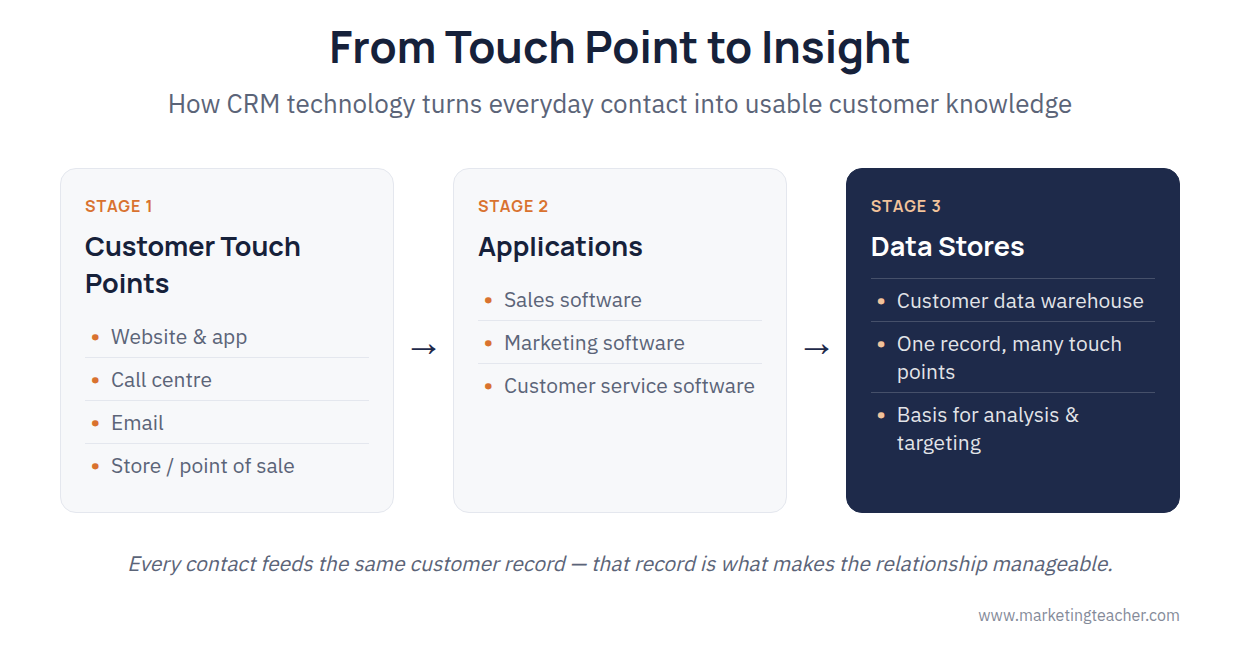
A useful way to picture a CRM system, described in period CRM technology literature such as Raisch (2001), is as three connected layers. Customer touch points — the website, the call centre, email, and the store or point of sale — are where raw information about a customer enters the business. Applications — separate software for sales, marketing and customer service — use that information to do their individual jobs. Finally, everything is drawn together into shared data stores, typically a customer data warehouse, so that one customer’s history is visible as a single record rather than several fragments. It is this last step, more than any single piece of software, that turns scattered data into a usable customer relationship.
What CRM Systems Are Built to Do With That Data
Kotler and Armstrong (2018) note that modern CRM systems consist of sophisticated software and analysis tools — from vendors such as Salesforce, Oracle, Microsoft and SAS — that integrate customer and marketplace information from every source, analyse it, and apply the results to build stronger relationships. Done well, this gives a company’s sales, service and marketing teams a single, shared view of each customer relationship, rather than each team working from its own partial picture.
Two Techniques Built on Top of CRM Data
Once customer data is captured and connected, companies use it in more specific ways. Data mining is the process of digging through large volumes of stored customer data looking for meaningful patterns — for example, discovering that customers who buy one product are statistically likely to buy another. Permission marketing, in contrast, is the practice of only sending marketing communications to customers who have explicitly agreed to receive them, using the very touch-point data described above to know who has opted in, and to what. Both depend on the same underlying CRM infrastructure: neither is possible without customer information that has already been captured, connected and made available in one place.
What CRM Technology Cannot Do on Its Own
It is tempting to assume that installing CRM software solves a company’s customer relationship problems by itself. It does not. A CRM system can only connect and analyse the data it is given — it cannot decide which customers to prioritise, what a competitive offer should look like, or how to recover a relationship that has genuinely broken down. Those are strategic questions, covered in Customer Relationship Management (CRM), that sit above the technology layer. A company with excellent CRM software and a poor customer strategy will simply have very detailed records of relationships it is still managing badly.
Summary
CRM software exists to solve a specific, practical problem: customer information that is scattered across many separate systems is very hard to use well. By capturing data at every touch point, running it through dedicated applications, and consolidating it into shared data stores, CRM technology gives a company one usable view of each customer relationship. That connected data is what techniques like data mining and permission marketing depend on, and it is what allows the broader ideas covered in Customer Relationship Management (CRM) to actually be put into practice.
The slides, worksheet, lesson plan and poster for this lesson are free to download and free to use in your course — no sign-up, no permission needed. See the teacher resources →
Assign this lesson to your class:
Using Canvas, Blackboard or Moodle? Copy the link and paste it into your course page or assignment. More ways to add lessons to your LMS.

