
What Is Social CRM?
Customer relationship management (CRM) is the use of information technology to build and maintain profitable, long-term relationships with customers. Traditionally, most of that contact ran through sales representatives, customer advisors, and call centre agents: the company controlled the conversation, and customers dealt with it indirectly.
Social media changed that. Customers now research products, share experiences, and swap recommendations directly with each other on forums, review sites, and social networks, often without the company being involved at all. Surveys consistently find that people trust the opinions of other users far more than they trust a company’s own marketing message. Social CRM is what happens when a business deliberately brings that activity into its CRM strategy: using social media technologies to plan, run, and control the same customer relationship work it already does, rather than treating a company page or profile as something separate from CRM entirely (Alt & Reinhold, 2012).
The distinction matters because most businesses that “do social media” are really just posting content and hoping for engagement. Social CRM is different: it treats the Social Web as a genuine source of customer knowledge and a genuine channel for service and sales, feeding into the same systems and processes as every other part of CRM (Alt & Reinhold, 2012).
Where Social CRM Shows Up
Social CRM activity tends to cluster around three points in a customer’s relationship with a business.
Before a purchase, it’s about listening. A clothing brand might scan design discussions and requests across social platforms to spot a trend before a competitor does, then hand promising ideas to its design team. A coffee company might run its own community specifically to collect product suggestions from customers who already care enough to show up and post.
During a purchase, it’s about reach and trust. A retailer might promote a limited-time offer directly through the social channels its followers already use, rather than waiting for them to visit the site. A travel site might gather traveller ratings and reviews and surface them at the exact moment someone is comparing options, because a stranger’s opinion often carries more weight than the retailer’s own description.
After a purchase, it’s about staying reachable and responsive. A hotel chain might monitor review sites for both glowing and scathing feedback and reply to each one individually, using the pattern of complaints to fix recurring problems internally. A transport company might let customers raise delays or ticket issues over social media instead of a phone queue, with the exchange visible to other customers who had the same question.
The Five Task Areas of Social CRM
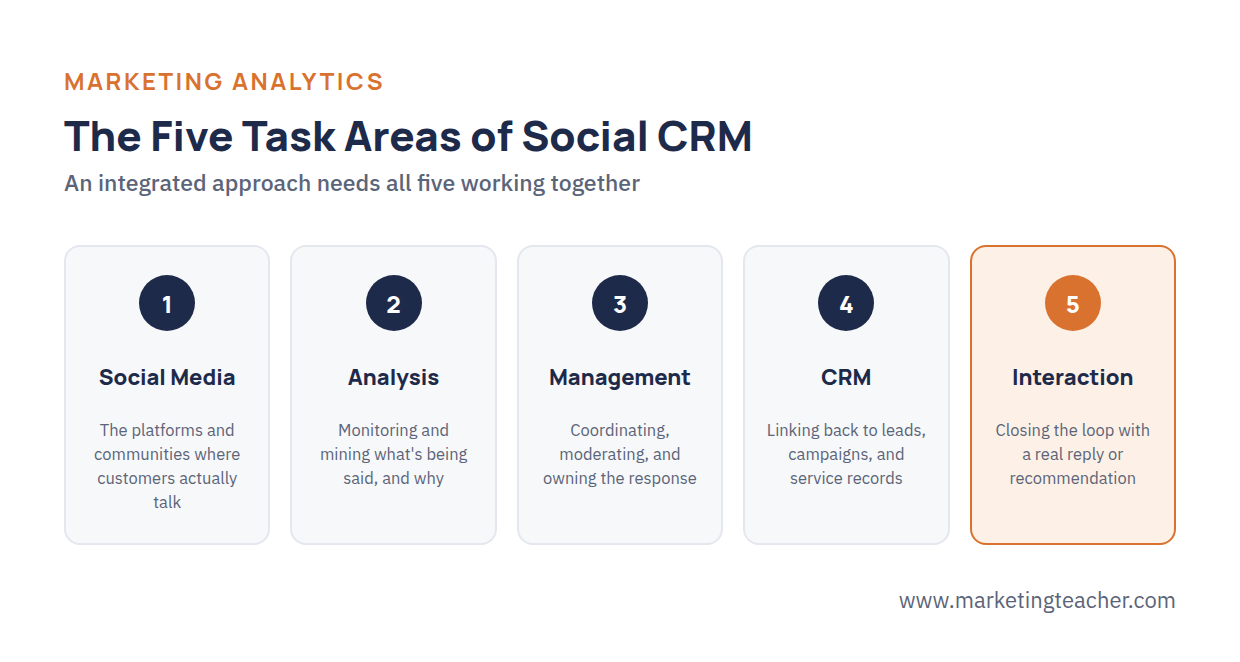
Doing this well takes more than a social media account and good intentions. An integrated Social CRM approach is generally broken into five task areas that work together (Alt & Reinhold, 2012).
The first is Social Media itself: the platforms, forums, and communities where customers actually talk, and the presence a business builds there to be part of that conversation.
The second is Analysis: monitoring and mining what’s being said. Monitoring means automatically picking out posts that mention the company, its products, or its competitors. Mining goes further, trying to work out the sentiment and context behind a post rather than just its existence, which is far harder given how much slang, sarcasm, and inconsistent wording appears in ordinary social media posts.
The third is Management: the strategic and operational work of running Social Web activity properly, including moderating conversations, managing the company’s reputation, keeping data consistent across platforms, and making sure someone is actually responsible for responding.
The fourth is CRM itself: linking everything back into existing lead, contact, campaign, and service management, so a complaint raised on social media ends up in the same system as a complaint raised by phone, rather than sitting in a separate inbox nobody else can see.
The fifth is Interaction: the actual back-and-forth with customers, whether that’s publishing content, replying to a specific request, or sending a recommendation based on what the business has learned.
Summary
Social CRM is what happens when a business treats the Social Web as part of its CRM strategy rather than a separate marketing activity. It shows up before a purchase as listening for trends and ideas, during a purchase as reach and trust-building through other customers’ opinions, and after a purchase as staying visible and responsive to feedback. Making it work depends on five task areas working together: a genuine Social Media presence, Analysis to monitor and interpret what’s being said, Management to keep the activity coordinated and accountable, a solid link back to core CRM systems, and Interaction that actually closes the loop with customers.
Quiz

The slides, worksheet, lesson plan and poster for this lesson are free to download and free to use in your course — no sign-up, no permission needed.

