
What Is e-CRM?
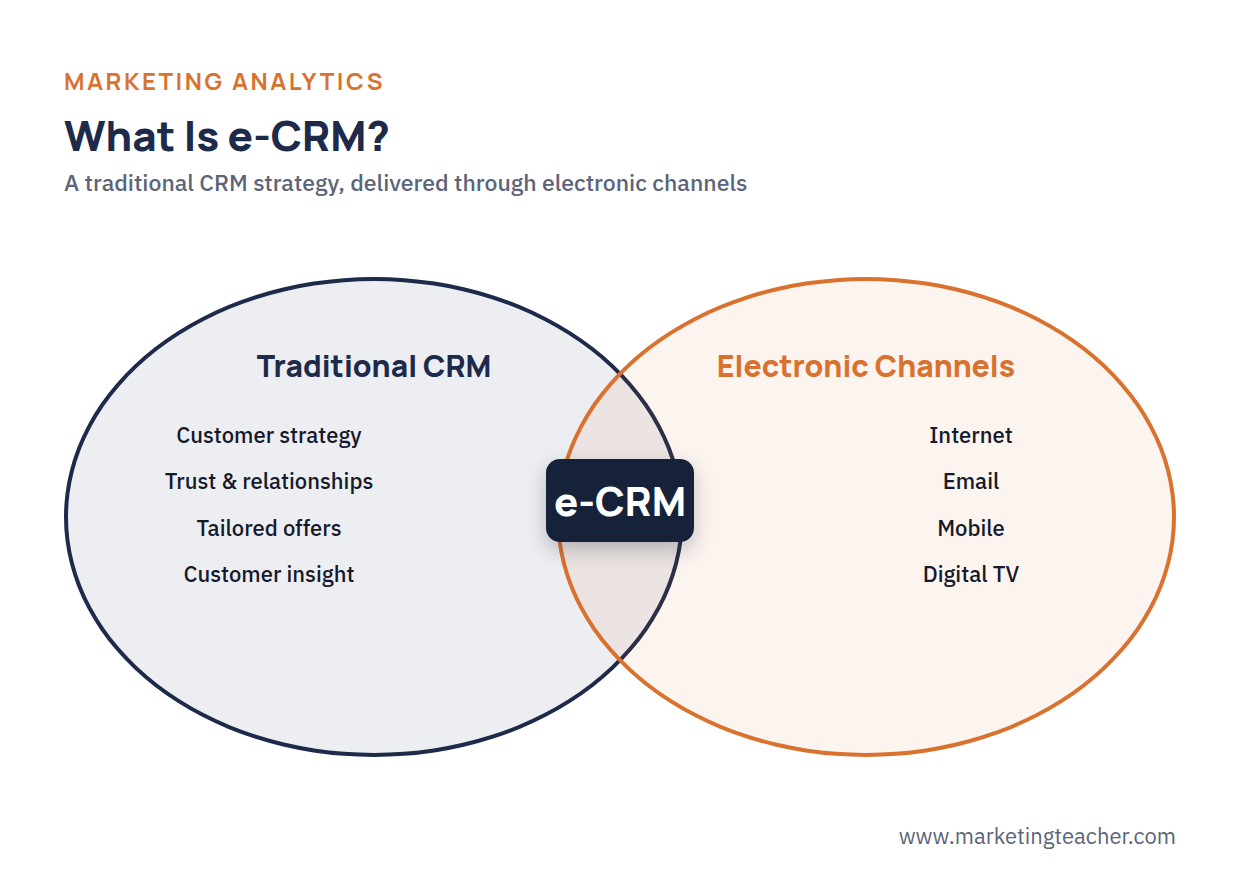
Customer relationship management (CRM) is a business strategy, not a piece of software. At its core, it means understanding who your customers are, tailoring what you offer them, and building a relationship that keeps them coming back. The classic example is the local shopkeeper who remembers a regular customer’s name, their usual order, and asks after their family: no database involved, just attention and memory.
e-CRM is what happens when that same strategy is carried out through electronic and interactive channels: the internet, email, mobile phones, and digital television (Fairhurst, 2001). The goal doesn’t change. A business practising e-CRM still wants to understand its customers and serve them better than a competitor would. What changes is the channel, and the channel changes what’s possible. Electronic interactions cost a fraction of a phone call or a face-to-face visit, which means a business can afford to tailor its service to individual customers at a scale that would be far too expensive to do by post or in a call centre.
The Challenges of Managing Customers Online
Moving a customer relationship online creates problems that don’t exist face to face (Fairhurst, 2001). The first is trust. A shopkeeper builds intimacy through small human moments, reading a customer’s mood and reacting to it. A website can’t do that in the same way, so if a business wants customers to hand over personal information, it has to earn that trust deliberately, through clear privacy policies and by consistently keeping the promises it makes.
The second is that the competition is always one click away. In a shop, switching to a rival means walking somewhere else. Online, it means typing a different address. There’s no second chance to recover from a mistake in the moment the way a good member of staff might smooth things over in person.
The third is speed. Word of mouth has always mattered, but online it travels faster and further. A single bad experience that might once have been mentioned to a handful of friends can now reach hundreds of people in the time it takes to send an email or post a review.
How Businesses Personalise Online
Because electronic channels are so much cheaper to tailor than print or phone contact, personalisation online tends to happen in two different ways (Fairhurst, 2001).
The first is active personalisation: the business analyses what it knows about a customer’s past behaviour and uses that to decide what to show them, from product recommendations to the content on a page. This gets more accurate as more data builds up, but it’s risky if it’s wrong. Recommending the completely wrong product to a customer is worse than recommending nothing at all, because it signals that the business hasn’t actually been paying attention.
The second is passive personalisation: the customer chooses how they want their own experience to work, for example by setting preferences on a homepage or selecting the categories they want to hear about. This solves a problem active personalisation can’t: a customer’s needs change depending on the situation, and letting them self-select in the moment is often more accurate than any algorithm guessing on their behalf.
Most e-CRM systems that work well use a mix of both: passive choices the customer has made, refined over time by what active analysis of their behaviour reveals.
The Building Blocks of e-CRM
e-CRM isn’t simply traditional CRM with a website bolted on. It sits at the overlap of two things a business already has to get right separately: its underlying CRM strategy (understanding customers, building trust, deciding what to offer them) and its electronic channels (the internet, email, mobile, digital TV, and the systems that run them).
For that overlap to work, the technology behind the scenes has to support it. Customer data needs to be stored and analysed to build a genuine picture of each person; content has to be created and managed so it can be published and updated across channels; and the different channels themselves need systems capable of actually delivering a tailored experience, processing a transaction, and getting the resulting task to the right person in the business. None of that works unless the organisation behind it is set up to match, with clear ownership of customer strategy, the products and content being offered, the teams delivering service day to day, and the information systems tying it all together.
Summary
e-CRM is customer relationship management carried out through electronic and interactive channels rather than face to face or by phone. The underlying goal doesn’t change: understanding customers and tailoring what a business offers them. What changes is the cost and scale that becomes possible, along with a new set of challenges around building trust, competing when rivals are a click away, and managing how fast word travels when something goes wrong. Businesses that get it right personalise using a mix of what they observe about customer behaviour and what customers choose for themselves, and they back it up with the data systems, content management, and organisational structure needed to deliver a tailored experience consistently across every channel.
Quiz

The slides, worksheet, lesson plan and poster for this lesson are free to download and free to use in your course — no sign-up, no permission needed.

